Mountain Chickadee

Mountain Chickadee

Poecile gambeli

Silhouette: Andy Wilson · PhyloPic

LCLeast ConcernNTVUENCR
Daily sighting probability ~60% · Likely
at Grand Teton National Park

In 3 days ~90% in a week >90%

2,412 Verified sightings at Grand Teton National Park From 2019 to 2026
28,989 In all 13 parks
October Best month
☀️ Diurnal When it's spotted

About the Mountain Chickadee

The mountain chickadee (Poecile gambeli) is a small songbird, a passerine bird in the tit family Paridae. The specific name honors naturalist William Gambel. The mountain chickadee was formerly placed in the genus Parus with most other tits, but mtDNA cytochrome b sequence data and morphology suggest that separating Poecile more adequately expresses these birds' relationships. Molecular phylogenetic studies have shown that the mountain chickadee is sister to the black-capped chickadee (Poecile atricapillus).

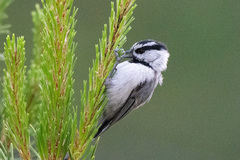
Adults of both sexes have a black cap joining a black postocular stripe behind distinctive white eyebrows. Their backs and flanks are gray and they have paler gray underparts; they have a short black bill, and a black bib. The typical adult wingspan is 7.5 in (19 cm), and the overall length is 5–6 in (13–15 cm). The Mountain Chickadee is one of 55 species of chickadees and tits. The mountain chickadee can be distinguished from other North American chickadees because mountain chickadees are marked with a white line through the side of their black cap, whereas all other North American chickadees have a solid black-cap. Another difference between the... Wikipedia →

Sounds

Call0:21

United States · 2025

© Greg Irving · XC1030189 · CC BY-NC-SA 4.0

Recording0:17

United States · 2013

© Tero Linjama · XC942745 · CC BY-NC-SA 4.0

Song0:31

Canada · 2024

© Brian Cox · XC939222 · CC BY-NC-SA 4.0

Global Distribution

Parks Where Found

# Park Country Daily sighting probability
1 Rocky Mountain National Park 🇺🇸 United States
~80%
2 Yosemite National Park 🇺🇸 United States
~70%
3 Grand Canyon National Park 🇺🇸 United States
~60%
4 Banff National Park 🇨🇦 Canada
~60%
5 Grand Teton National Park 🇺🇸 United States
~60%
6 Sequoia and Kings Canyon National Parks 🇺🇸 United States
~50%
7 Yellowstone National Park 🇺🇸 United States
~50%
8 Jasper National Park 🇨🇦 Canada
~40%
9 Glacier National Park 🇺🇸 United States
~40%
10 Guadalupe Mountains National Park 🇺🇸 United States
~20%
11 Zion National Park 🇺🇸 United States
~20%
12 Death Valley National Park 🇺🇸 United States
<5%
13 Joshua Tree National Park 🇺🇸 United States
<5%

Cities Where Found

# City Country Daily sighting probability
1 Calgary 🇨🇦 Canada
~10%
2 Salt Lake City 🇺🇸 United States
<5%
3 Los Angeles 🇺🇸 United States
<5%
4 Denver 🇺🇸 United States
<5%
5 Edmonton 🇨🇦 Canada
<5%
6 Las Vegas 🇺🇸 United States
<5%
7 Seattle 🇺🇸 United States
<5%

Before you go

What are the chances of seeing a Mountain Chickadee in Grand Teton National Park?

Likely

About 60% of wildlife watchers report a Mountain Chickadee sighting in Grand Teton National Park on a given day, based on 2,412 verified sightings from GBIF citizen-science data from 2019 to 2026. It is the 5th most-seen of the 185 birds we can rate there. Over three days the chance rises to about 90%, and over a week to over 90%, if each day is a fresh chance.

When is the best time to see a Mountain Chickadee in Grand Teton National Park?

August–October and December

In those months about 70% of wildlife watchers report a Mountain Chickadee in Grand Teton National Park on a given day, against about 40% in April, the lowest month.

What time of day is best to see a Mountain Chickadee?

Between 8 and 11 am

Across all the parks we cover, that three-hour window holds the most Mountain Chickadee sightings with a recorded time, and about 9 in 10 of them come between 6 am and 6 pm: it is a daytime animal.

Where does the Mountain Chickadee sighting chance come from?

GBIF citizen-science records

It is estimated from how often the Mountain Chickadee is recorded against all the birds logged in Grand Teton National Park (2,412 verified sightings from 2019 to 2026), calibrated against known sighting rates. Figures are rounded to the nearest 10% because citizen-science data supports honest approximations, not decimals, and months with records from fewer than five people show "—". How it works.

← Back to Grand Teton National Park