Yellow-bellied Marmot

Yellow-bellied Marmot

Marmota flaviventris

Silhouette: T. Michael Keesey · PhyloPic

LCLeast ConcernNTVUENCR
Daily sighting probability ~60% · Likely
at Grand Teton National Park

In 3 days ~90% in a week >90%

458 Verified sightings at Grand Teton National Park From 2019 to 2026
3,568 In all 6 parks
June Best month
☀️ Diurnal When it's spotted

About the Yellow-bellied Marmot

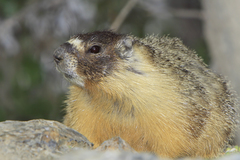
The yellow-bellied marmot (Marmota flaviventer), also known as the rock chuck, is a large, stout-bodied ground squirrel in the marmot genus. It is one of fourteen species of marmots, and is native to mountainous and semi-arid regions of southwestern Canada and western United States, including the Rocky Mountains, Sierra Nevada, and the Great Basin, often (but not exclusively) living above 2,000 metres (6,500 feet). The fur is mainly brown, with a dark bushy tail, yellow chest and white patch between the eyes, and they weigh up to approximately 5 kilograms (11 pounds). They are highly social creatures, living in burrows in colonies of up to twenty individuals. They are diurnal and feed on plant material, insects, and bird eggs. They hibernate for approximately eight months starting in September and lasting through the winter. They have an average lifespan of 15 years.

Yellow-bellied marmots usually weigh from 1.6–5.2 kg (3 lb 8 oz – 11 lb 7 oz) when fully grown, though males typically weigh more than females. The weight fluctuates quite drastically through the year, with the least measured in early spring and the most measured in early autumn. Adult males typically... Wikipedia →

Sounds

Recording0:12

Canada · 2022

Daryl Nolan · iNaturalist · CC0

Recording0:09

Canada · 2026

© bene2024 · iNaturalist · CC BY-NC 4.0

Recording0:02

United States · 2023

© onyxrat · iNaturalist · CC BY-NC 4.0

Global Distribution

Parks Where Found

# Park Country Daily sighting probability
1 Sequoia and Kings Canyon National Parks 🇺🇸 United States
~80%
2 Rocky Mountain National Park 🇺🇸 United States
~70%
3 Grand Teton National Park 🇺🇸 United States
~60%
4 Yosemite National Park 🇺🇸 United States
~50%
5 Yellowstone National Park 🇺🇸 United States
~50%
6 Glacier National Park 🇺🇸 United States
~10%

Cities Where Found

# City Country Daily sighting probability
1 Salt Lake City 🇺🇸 United States
<5%
2 Vancouver 🇨🇦 Canada
<5%
3 Calgary 🇨🇦 Canada
<5%
4 Seattle 🇺🇸 United States
<5%

Zoos & Centres Where Found

# Zoo / Centre Country
1 Zoo Idaho 🇺🇸 United States In captivity

Before you go

What are the chances of seeing a Yellow-bellied Marmot in Grand Teton National Park?

Likely

About 60% of wildlife watchers report a Yellow-bellied Marmot sighting in Grand Teton National Park on a given day, based on 458 verified sightings from GBIF citizen-science data from 2019 to 2026. It is the 4th most-seen of the 28 mammals we can rate there. Over three days the chance rises to about 90%, and over a week to over 90%, if each day is a fresh chance.

When is the best time to see a Yellow-bellied Marmot in Grand Teton National Park?

June

In that month about 80% of wildlife watchers report a Yellow-bellied Marmot in Grand Teton National Park on a given day, against under 5% in March and November, the lowest months.

What time of day is best to see a Yellow-bellied Marmot?

Between 11 am and 2 pm

Across all the parks we cover, that three-hour window holds the most Yellow-bellied Marmot sightings with a recorded time, and about 9 in 10 of them come between 6 am and 6 pm: it is a daytime animal.

Where does the Yellow-bellied Marmot sighting chance come from?

GBIF citizen-science records

It is estimated from how often the Yellow-bellied Marmot is recorded against all the mammals logged in Grand Teton National Park (458 verified sightings from 2019 to 2026), calibrated against known sighting rates. Figures are rounded to the nearest 10% because citizen-science data supports honest approximations, not decimals, and months with records from fewer than five people show "—". How it works.

← Back to Grand Teton National Park