Northern Elephant Seal

Northern Elephant Seal

Mirounga angustirostris

Silhouette: Margot Michaud · PhyloPic

LCLeast ConcernNTVUENCR
Daily sighting probability ~10% · With luck
at Great Bear Rainforest

In 3 days ~20% in a week ~40%

9 Verified sightings at Great Bear Rainforest From 2019 to 2026
106 In all 5 parks
April Best month
☀️ Diurnal When it's spotted

About the Northern Elephant Seal

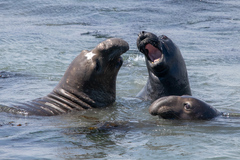
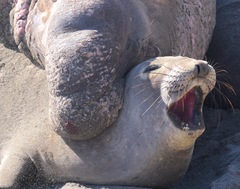
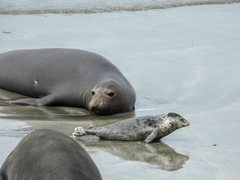
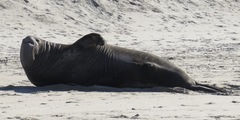
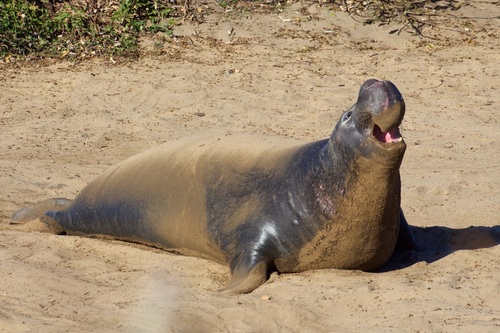
The northern elephant seal (Mirounga angustirostris) or northern sea elephant, is one of two species of elephant seal (the other is the southern elephant seal). It is a member of the family Phocidae (true seals). Elephant seals derive their name from their great size and from the male's large proboscis. Sexual dimorphism in size is great. Correspondingly, the mating system is highly polygynous; a successful male is able to impregnate up to 50 females in one season.

The huge male northern elephant seal typically weighs 1,500–2,300 kg (3,300–5,100 lb) and measures 4–5 m (13–16 ft), although some males can weigh up to 3,700 kg (8,200 lb). Females are much smaller and can range from 400 to 900 kg (880 to 1,980 lb) in weight, or roughly a third of the male's bulk, and measure from 2.5 to 3.6 m (8.2 to 11.8 ft). The bull southern elephant seals are, on average, larger than those in the northern species, but the females in both are around the same size, indicating the even higher level of sexual dimorphism in the southern species. Although a few females have been observed to reach 23 years of age and a few males to reach 14, most die much younger.

Pups are born with dark... Wikipedia →
Sounds

Recording0:15

United States · 2021

© Dawn Ellner · iNaturalist · CC BY 4.0

Recording0:06

United States · 2025

Chris (CP) and Pamela (PP) Pipes · iNaturalist · CC0

Recording0:35

United States · 2016

© User 301860901 · iNaturalist · CC BY 4.0

Global Distribution

Parks Where Found

# Park Country Daily sighting probability
1 Channel Islands National Park 🇺🇸 United States
~20%
2 Pacific Rim National Park Reserve 🇨🇦 Canada
~10%
3 Redwood National Park 🇺🇸 United States
~10%
4 Great Bear Rainforest 🇨🇦 Canada
~10%
5 Olympic National Park 🇺🇸 United States
<5%

Cities Where Found

# City Country Daily sighting probability
1 San Diego 🇺🇸 United States
<5%
2 San Francisco 🇺🇸 United States
<5%
3 Los Angeles 🇺🇸 United States
<5%

Zoos & Centres Where Found

# Zoo / Centre Country
1 SeaWorld San Diego 🇺🇸 United States In captivity
2 Pittsburgh Zoo & Aquarium 🇺🇸 United States In captivity
3 L'Oceanogràfic 🇪🇸 Spain In captivity
4 The Marine Mammal Center 🇺🇸 United States In captivity
5 Hatfield Visitors Center 🇺🇸 United States In captivity

Before you go

What are the chances of seeing a Northern Elephant Seal in Great Bear Rainforest?

With luck

About 10% of wildlife watchers report a Northern Elephant Seal sighting in Great Bear Rainforest on a given day, based on 9 verified sightings from GBIF citizen-science data from 2019 to 2026. It is the 23rd most-seen of the 35 mammals we can rate there. Over three days the chance rises to about 20%, and over a week to about 40%, if each day is a fresh chance.

When is the best time to see a Northern Elephant Seal in Great Bear Rainforest?

April, June and August–September

In those months about 10% of wildlife watchers report a Northern Elephant Seal in Great Bear Rainforest on a given day, against under 5% in May, July and October–March, the lowest months.

What time of day is best to see a Northern Elephant Seal?

Between noon and 3 pm

Across all the parks we cover, that three-hour window holds the most Northern Elephant Seal sightings with a recorded time, and about 9 in 10 of them come between 6 am and 6 pm: it is a daytime animal.

Where does the Northern Elephant Seal sighting chance come from?

GBIF citizen-science records

It is estimated from how often the Northern Elephant Seal is recorded against all the mammals logged in Great Bear Rainforest (9 verified sightings from 2019 to 2026), calibrated against known sighting rates. Figures are rounded to the nearest 10% because citizen-science data supports honest approximations, not decimals, and months with records from fewer than five people show "—". How it works.

← Back to Great Bear Rainforest