Northern Fur Seal

Northern Fur Seal

Callorhinus ursinus

Silhouette: Steven Traver · PhyloPic

LCNTVUVulnerableENCR
Daily sighting probability <5% · Rare
at Great Bear Rainforest

In 3 days ~10% in a week ~30%

9 Verified sightings at Great Bear Rainforest From 2019 to 2026
9 In 1 park
September Best month
☀️ Diurnal When it's spotted

About the Northern Fur Seal

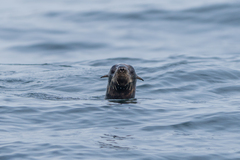
The northern fur seal (Callorhinus ursinus) is an eared seal found along the north Pacific Ocean, the Bering Sea, and the Sea of Okhotsk. It is the largest member of the fur seal subfamily (Arctocephalinae) and the only living species in the genus Callorhinus. A single fossil species, Callorhinus gilmorei, is known from the Pliocene of Japan and western North America.

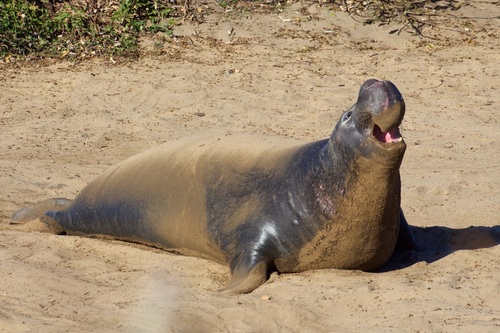
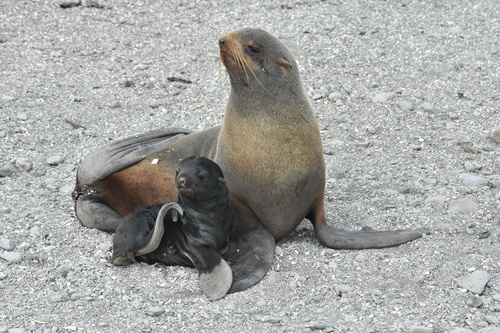
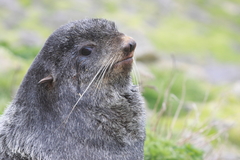
Northern fur seals have extreme sexual dimorphism, with males being 30–40% longer and more than 4.5 times heavier than adult females. The head is foreshortened in both sexes because of the very short, down-curved muzzle, and small nose, which extends slightly beyond the mouth in females and moderately in males. The pelage is thick and luxuriant, with a dense underfur in a creamy color. The underfur is obscured by the longer guard hairs, although it is partially visible when the animals are wet. Features of both fore and hind flippers are unique and diagnostic of the species. Fur is absent on the top of the fore flippers and an abrupt "clean line" is seen across the wrist where the fur ends. The hind flippers are proportionately the longest in any otariid because of extremely long, cartilaginous extensions... Wikipedia →

Global Distribution

Parks Where Found

# Park Country Daily sighting probability
1 Great Bear Rainforest 🇨🇦 Canada
<5%

More parks will be added in future updates.

Zoos & Centres Where Found

# Zoo / Centre Country
1 Woodland Park Zoo 🇺🇸 United States In captivity
2 Edmonton Valley Zoo 🇨🇦 Canada In captivity
3 Pittsburgh Zoo & Aquarium 🇺🇸 United States In captivity
4 Le Cornelle 🇮🇹 Italy In captivity
5 Mystic Aquarium & Institute for Exploration 🇺🇸 United States In captivity
6 Vancouver Aquarium 🇨🇦 Canada In captivity
7 Blue Hills Trailside Museum Habitats 🇺🇸 United States In captivity
8 Moscow Oceanarium 🇷🇺 Russia In captivity
9 Seattle Marine Aquarium 🇺🇸 United States In captivity
10 Tamano Marine Museum 🇯🇵 Japan In captivity

Before you go

What are the chances of seeing a Northern Fur Seal in Great Bear Rainforest?

Rare

Under 5% of wildlife watchers report a Northern Fur Seal sighting in Great Bear Rainforest on a given day, based on 9 verified sightings from GBIF citizen-science data from 2019 to 2026. It is the 35th most-seen of the 35 mammals we can rate there. Over three days the chance rises to about 10%, and over a week to about 30%, if each day is a fresh chance.

When is the best time to see a Northern Fur Seal in Great Bear Rainforest?

March–April and September

In those months about 10% of wildlife watchers report a Northern Fur Seal in Great Bear Rainforest on a given day, against under 5% in May–August and October–February, the lowest months.

What time of day is best to see a Northern Fur Seal?

Between 11 am and 2 pm

Across all the parks we cover, that three-hour window holds the most Northern Fur Seal sightings with a recorded time, and about 9 in 10 of them come between 6 am and 6 pm: it is a daytime animal.

Where else can you see a Northern Fur Seal?

Only Great Bear Rainforest, in our data

Great Bear Rainforest is the only park on Wallace's Line with enough records to rate Northern Fur Seal sightings: under 5% of wildlife watchers there report one on a given day.

Which relatives of the Northern Fur Seal live in Great Bear Rainforest?

Same family: Otariidae

The closest relatives of the Northern Fur Seal that you can see in Great Bear Rainforest (family Otariidae, Eared Seals) are Northern Sea Lion (about 40%) and California Sea Lion (about 10%), with each one's daily chance of a sighting.

Where does the Northern Fur Seal sighting chance come from?

GBIF citizen-science records

It is estimated from how often the Northern Fur Seal is recorded against all the mammals logged in Great Bear Rainforest (9 verified sightings from 2019 to 2026), calibrated against known sighting rates. Figures are rounded to the nearest 10% because citizen-science data supports honest approximations, not decimals, and months with records from fewer than five people show "—". How it works.
← Back to Great Bear Rainforest