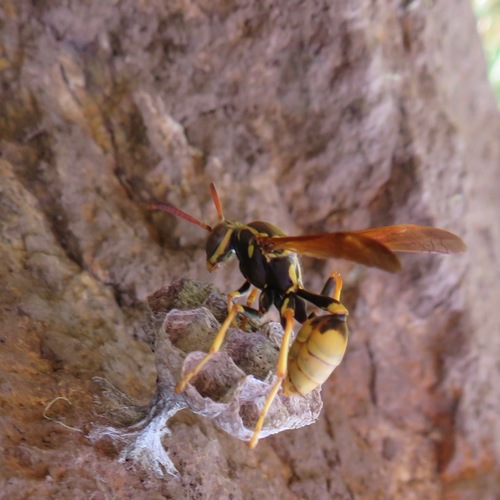
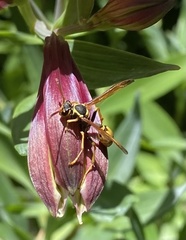
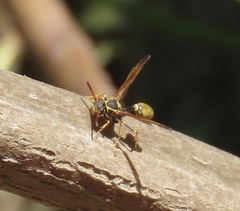
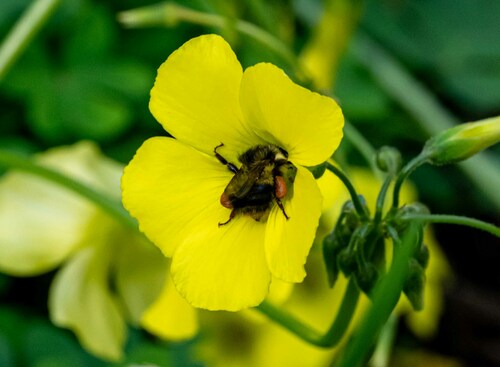
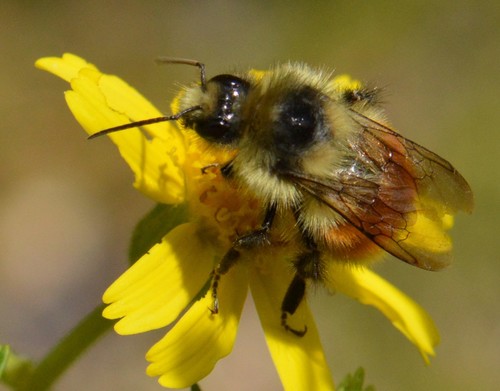
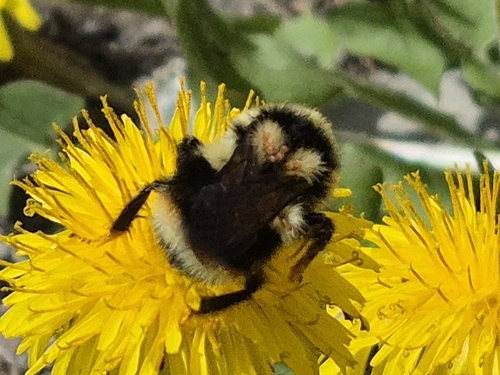
Western Paper Wasp

Western Paper Wasp

Mischocyttarus flavitarsis

Daily sighting probability <5% · Rare
at Great Bear Rainforest

In 3 days ~10% in a week ~30%

5 Verified sightings at Great Bear Rainforest From 2019 to 2026
21 In all 3 parks
September Best month
☀️ Diurnal When it's spotted

About the Western Paper Wasp

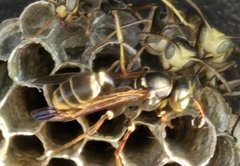
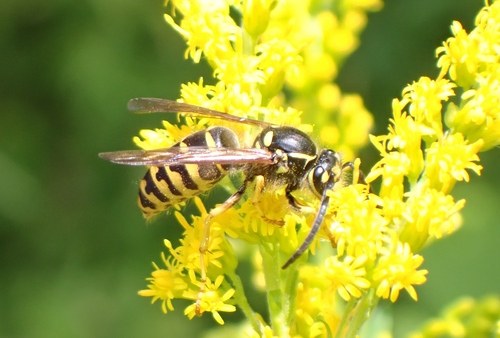
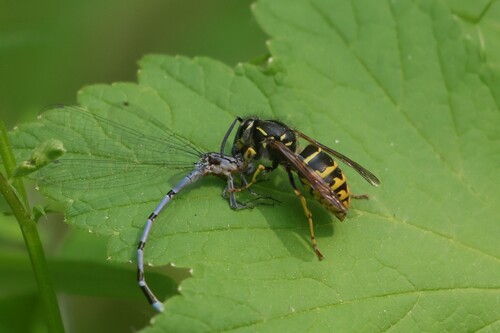
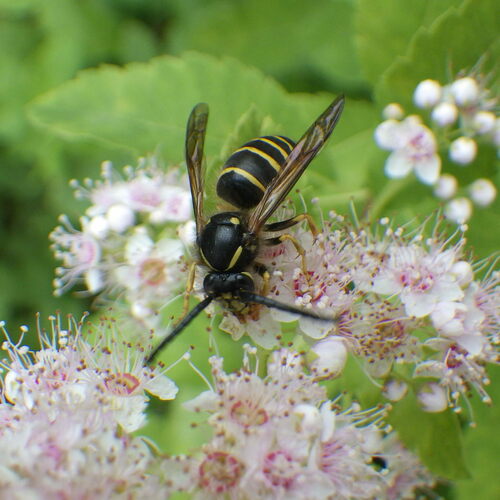
Mischocyttarus flavitarsis is a social paper wasp found in western North America. Their nests can be found both in forests close to rivers or in close proximity to human life under the eaves of roofs. Despite the fact that M. flavitarsis nests are frequently in close contact with humans, M. flavitarsis typically will not sting, but rather ram into the threatening individual. Their colony cycle typically begins before May and will last until October. The queen will then seek a hibernation site for the winter. Perched near female hibernation sites are males with whom the female will mate. The males have claimed their territory by rubbing sternal brushes along the border of the site, leaving a chemical that deters other individuals from approaching. M. flavitarsis feed on arthropods, nectar, and animal carcasses and are often prey to birds, ants, and praying mantis.

Henri Louis Frédéric de Saussure, a Swiss mineralogist and entomologist, classified M. flavitarsis in 1854. The genus Mischocyttarus is the only genus in the tribe Mischocyttarini and is the second largest genus of social wasps. Mischocyttarus species are recognizable by the internal and external... Wikipedia →

Global Distribution

Parks Where Found

# Park Country Daily sighting probability
1 Zion National Park 🇺🇸 United States
~10%
2 Yosemite National Park 🇺🇸 United States
~10%
3 Great Bear Rainforest 🇨🇦 Canada
<5%

Cities Where Found

# City Country Daily sighting probability
1 Denver 🇺🇸 United States
~10%
2 Salt Lake City 🇺🇸 United States
<5%
3 San Francisco 🇺🇸 United States
<5%
4 Portland 🇺🇸 United States
<5%
5 Sacramento 🇺🇸 United States
<5%
6 Vancouver 🇨🇦 Canada
<5%
7 Los Angeles 🇺🇸 United States
<5%

Before you go

What are the chances of seeing a Western Paper Wasp in Great Bear Rainforest?

Rare

Under 5% of wildlife watchers report a Western Paper Wasp sighting in Great Bear Rainforest on a given day, based on 5 verified sightings from GBIF citizen-science data from 2019 to 2026. It is the 200th most-seen of the 235 insects we can rate there. Over three days the chance rises to about 10%, and over a week to about 30%, if each day is a fresh chance.

When is the best time to see a Western Paper Wasp in Great Bear Rainforest?

April, July and September

In those months about 10% of wildlife watchers report a Western Paper Wasp in Great Bear Rainforest on a given day, against under 5% in May–June, August and October–March, the lowest months.

What time of day is best to see a Western Paper Wasp?

Between 1 and 4 pm

Across all the parks we cover, that three-hour window holds the most Western Paper Wasp sightings with a recorded time, and about 9 in 10 of them come between 6 am and 6 pm: it is a daytime animal.

Is Great Bear Rainforest the best place to see a Western Paper Wasp?

3rd of 3

Of the 3 parks where we can rate Western Paper Wasp sightings, Great Bear Rainforest ranks 3rd at under 5%. The best odds are in Zion National Park (United States, about 10%) and Yosemite National Park (United States, about 10%).

Which relatives of the Western Paper Wasp live in Great Bear Rainforest?

Same family: Vespidae

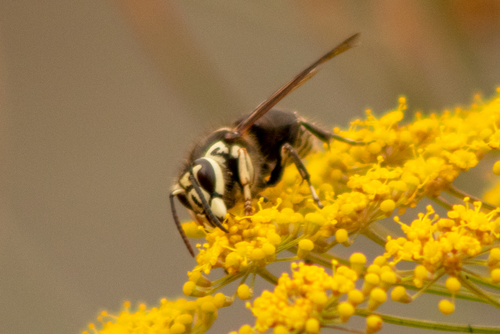
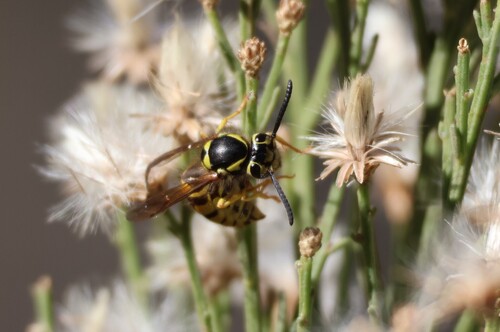
The closest relatives of the Western Paper Wasp that you can see in Great Bear Rainforest (family Vespidae, Hornets, Paper Wasps, Potter Wasps, and Allies) are Common Aerial Yellowjacket (about 10%), Bald-Faced Hornet (about 10%) and Western Yellowjacket (about 10%), with each one's daily chance of a sighting.

Where does the Western Paper Wasp sighting chance come from?

GBIF citizen-science records

It is estimated from how often the Western Paper Wasp is recorded against all the insects logged in Great Bear Rainforest (5 verified sightings from 2019 to 2026), calibrated against known sighting rates. Figures are rounded to the nearest 10% because citizen-science data supports honest approximations, not decimals, and months with records from fewer than five people show "—". How it works.

← Back to Great Bear Rainforest