Brewer's Mole

Brewer's Mole

Parascalops breweri

Silhouette: T. Michael Keesey · PhyloPic

LCLeast ConcernNTVUENCR
Daily sighting probability ~10% · With luck
at Great Smoky Mountains National Park

In 3 days ~20% in a week ~40%

10 Verified sightings at Great Smoky Mountains National Park From 2019 to 2026
10 In 1 park
March Best month
☀️ Diurnal When it's spotted

About the Brewer's Mole

The hairy-tailed mole (Parascalops breweri), also known as Brewer's mole, is a medium-sized North American mole. It is the only member of the genus Parascalops. The species epithet breweri refers to Thomas Mayo Brewer, an American naturalist.

Despite inhabiting North America, studies indicate that it is not closely related to the two other North American scalopine moles (Scalopus and Scapanus), but rather to the two Chinese scalopine moles (Scapanulus and Alpiscaptulus). This indicates that the two Chinese moles likely descend from a migration from North America back into Eurasia, where the scalopine moles originated. Some studies have suggested placing Parascalops, Scapanulus, and Alpiscaptulus into a single subtribe Parascalopina.

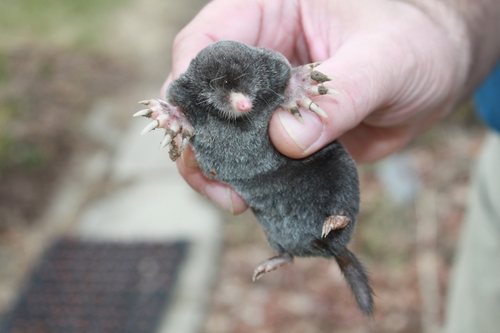
This animal has dark grey fur with lighter underparts, a pointed nose and a short, hairy tail. It is about 15 centimeters (5.9 in) in length, including a 3-centimeter-long (1.2 in) tail, and weighs about 55 grams (1.9 oz). Its front paws are broad and spade-shaped, specialized for digging. It has 44 teeth. Its eyes are covered by fur and its ears are not external. Its feet and snout are pinkish, but become white in older... Wikipedia →

Sounds

Recording0:11

United States · 2015

© William J. Deml · iNaturalist · CC BY 4.0

Global Distribution

Parks Where Found

# Park Country Daily sighting probability
1 Great Smoky Mountains National Park 🇺🇸 United States
~10%

More parks will be added in future updates.

Cities Where Found

# City Country Daily sighting probability
1 Toronto 🇨🇦 Canada
<5%

Before you go

What are the chances of seeing a Brewer's Mole in Great Smoky Mountains National Park?

With luck

About 10% of wildlife watchers report a Brewer's Mole sighting in Great Smoky Mountains National Park on a given day, based on 10 verified sightings from GBIF citizen-science data from 2019 to 2026. It is the 16th most-seen of the 27 mammals we can rate there. Over three days the chance rises to about 20%, and over a week to about 40%, if each day is a fresh chance.

When is the best time to see a Brewer's Mole in Great Smoky Mountains National Park?

March–April, June–July and September

In those months about 10% of wildlife watchers report a Brewer's Mole in Great Smoky Mountains National Park on a given day, against under 5% in May, August and October–February, the lowest months.

What time of day is best to see a Brewer's Mole?

Between 11 am and 2 pm

Across all the parks we cover, that three-hour window holds the most Brewer's Mole sightings with a recorded time, and about 9 in 10 of them come between 6 am and 6 pm: it is a daytime animal.

Where else can you see a Brewer's Mole?

Only Great Smoky Mountains National Park, in our data

Great Smoky Mountains National Park is the only park on Wallace's Line with enough records to rate Brewer's Mole sightings: about 10% of wildlife watchers there report one on a given day.

Where does the Brewer's Mole sighting chance come from?

GBIF citizen-science records

It is estimated from how often the Brewer's Mole is recorded against all the mammals logged in Great Smoky Mountains National Park (10 verified sightings from 2019 to 2026), calibrated against known sighting rates. Figures are rounded to the nearest 10% because citizen-science data supports honest approximations, not decimals, and months with records from fewer than five people show "—". How it works.

← Back to Great Smoky Mountains National Park