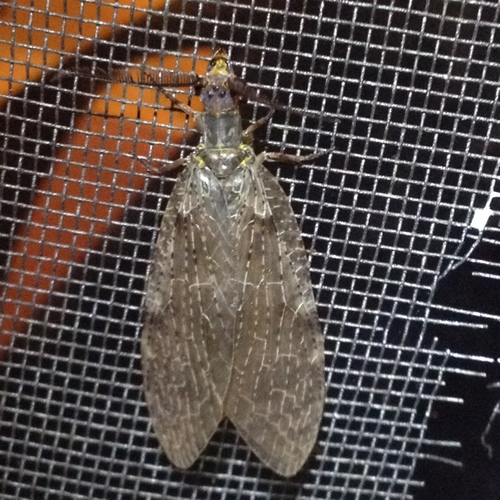
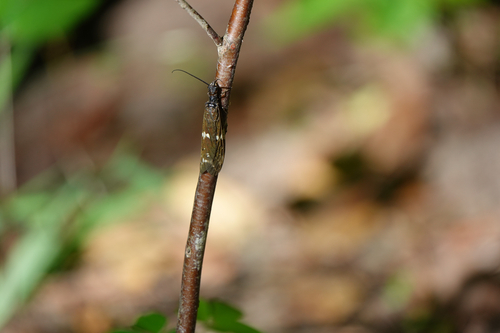
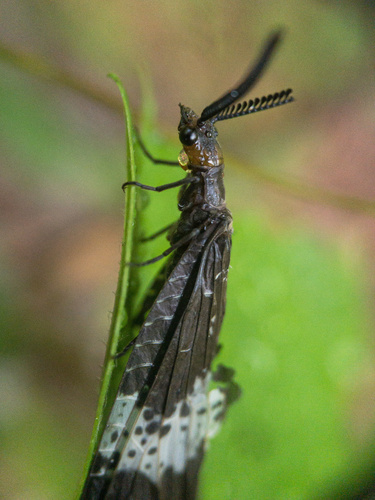
Saw-Combed Fishfly

Saw-Combed Fishfly

Nigronia serricornis

Daily sighting probability ~10% · With luck
at Great Smoky Mountains National Park

In 3 days ~20% in a week ~50%

35 Verified sightings at Great Smoky Mountains National Park From 2019 to 2026
70 In all 3 parks
May Best month
☀️ Diurnal When it's spotted

About the Saw-Combed Fishfly

Nigronia serricornis has many common names including hellgrammites or fishflies or saw-combed fishflies. The genus Nigronia has one other North American member N. fasciatus and South American which lives in much of the same territory and is quite similar in all regards. They are holometabolous insects with an aquatic larval stage. N. serricornis is a common inhabitant of woodland streams in North America and they are often the largest insect predator found in 2nd and 3rd order streams. The larvae are a sit-and -wait ambush predators that feed on a large variety of invertebrates. Studies have shown that N. serricornis has a varying diet throughout the seasons.

Despite this small organism's limited ability to disperse it has managed to spread throughout the Eastern United States. The range of N. serricornis expands northward from Florida into Ontario, and west to the US Rocky Mountains. By using genetic analyses, Heilveil and Berlocher (2006) have identified that there are six major clades of N. serricornis. The ancestral clade in the north end of their range, represent the initial colonization of N. serricornis on the Eastern US. This clade was separated from the derived... Wikipedia →

Global Distribution

Parks Where Found

# Park Country Daily sighting probability
1 Great Smoky Mountains National Park 🇺🇸 United States
~10%
2 Shenandoah National Park 🇺🇸 United States
~10%
3 Acadia National Park 🇺🇸 United States
~10%

Cities Where Found

# City Country Daily sighting probability
1 Toronto 🇨🇦 Canada
<5%

Before you go

What are the chances of seeing a Saw-Combed Fishfly in Great Smoky Mountains National Park?

With luck

About 10% of wildlife watchers report a Saw-Combed Fishfly sighting in Great Smoky Mountains National Park on a given day, based on 35 verified sightings from GBIF citizen-science data from 2019 to 2026. It is the 146th most-seen of the 822 insects we can rate there. Over three days the chance rises to about 20%, and over a week to about 50%, if each day is a fresh chance.

When is the best time to see a Saw-Combed Fishfly in Great Smoky Mountains National Park?

May

In that month about 20% of wildlife watchers report a Saw-Combed Fishfly in Great Smoky Mountains National Park on a given day, against under 5% in April, July–August and October–February, the lowest months.

What time of day is best to see a Saw-Combed Fishfly?

Between 11 am and 2 pm

Across all the parks we cover, that three-hour window holds the most Saw-Combed Fishfly sightings with a recorded time, and about 9 in 10 of them come between 6 am and 6 pm: it is a daytime animal.

Is Great Smoky Mountains National Park the best place to see a Saw-Combed Fishfly?

Yes

Of the 3 parks where we can rate Saw-Combed Fishfly sightings, Great Smoky Mountains National Park has the highest daily chance: about 10%. Next come Shenandoah National Park (United States, about 10%) and Acadia National Park (United States, about 10%).

Where does the Saw-Combed Fishfly sighting chance come from?

GBIF citizen-science records

It is estimated from how often the Saw-Combed Fishfly is recorded against all the insects logged in Great Smoky Mountains National Park (35 verified sightings from 2019 to 2026), calibrated against known sighting rates. Figures are rounded to the nearest 10% because citizen-science data supports honest approximations, not decimals, and months with records from fewer than five people show "—". How it works.
← Back to Great Smoky Mountains National Park