Canada Lynx

Canada Lynx

Lynx canadensis

Silhouette: Margot Michaud · PhyloPic

LCLeast ConcernNTVUENCR
Daily sighting probability ~10% · With luck
at Gros Morne National Park

In 3 days ~40% in a week ~70%

8 Verified sightings at Gros Morne National Park From 2019 to 2026
72 In all 7 parks
December Best month
☀️ Diurnal When it's spotted

About the Canada Lynx

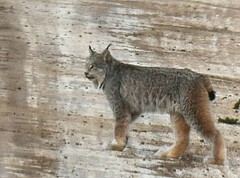
The Canada lynx (Lynx canadensis) or Canadian lynx is one of the four living species in the genus Lynx. It is a medium-sized wild cat characterized by long, dense fur, triangular ears with black tufts at the tips, and broad, snowshoe-like paws. Its hindlimbs are longer than the forelimbs, so its back slopes downward to the front. The Canada lynx stands 48–56 cm (19–22 in) tall at the shoulder and weighs between 5 and 17 kg (11 and 37 lb). It is a good swimmer and an agile climber.

The Canada lynx was first described by Robert Kerr in 1792. Three subspecies have been proposed, but their validity is doubted; it is mostly considered a monotypic species. It ranges across Alaska, Canada and northern areas of the contiguous United States, where it predominantly inhabits dense boreal forests.

It is a specialist predator and depends heavily on the snowshoe hare (Lepus americanus) for food. This leads to a prey-predator cycle, as the Canada lynx population responds to the cyclic rises and falls in snowshoe hare populations over the years in Alaska and central Canada. The Canada lynx population increases with an increasing hare population; if the hare population decreases in a given area, it moves to areas with more hares and has fewer offspring. The Canada lynx hunts mainly around twilight, or at night, when the snowshoe hare tends to be active. The Canada lynx waits for the hare on specific trails or in "ambush beds", then pounces on it and kills it by a bite on its head, throat or the nape of its neck. Individuals, particularly of the same sex, tend to avoid each other, forming "intrasexual" territories. The mating season is roughly a month long from March to early April. After a gestation of two to three months, females give birth to a litter of one to eight kittens, which are weaned at the age of 12 weeks.

Given its abundance throughout the range and lack of severe threats, the Canada lynx has been listed as Least Concern on the IUCN Red List. It is regularly trapped for the international fur trade in most of Alaska and Canada but is protected in the southern half of its range due to threats such as habitat loss. Wikipedia →

Sounds

Call0:07

United States · 2008

© Paul Driver · XC961784 · CC BY-NC-SA 4.0

Recording0:30

Canada · 2023

© nacht_flug · iNaturalist · CC BY-NC 4.0

Recording0:54

Canada · 2024

© Rich Russell · iNaturalist · CC BY-NC 4.0

Global Distribution

Parks Where Found

# Park Country Daily sighting probability
1 Katmai National Park 🇺🇸 United States
~30%
2 Denali National Park 🇺🇸 United States
~20%
3 Gros Morne National Park 🇨🇦 Canada
~10%
4 Riding Mountain National Park 🇨🇦 Canada
~10%
5 Banff National Park 🇨🇦 Canada
~10%
6 Jasper National Park 🇨🇦 Canada
~10%
7 Glacier National Park 🇺🇸 United States
~10%

Zoos & Centres Where Found

# Zoo / Centre Country
1 San Diego Zoo 🇺🇸 United States In captivity
2 National Zoological Park 🇺🇸 United States In captivity
3 Zoo Pilsen 🇨🇿 Czechia In captivity
4 Ecomuseum Zoo 🇨🇦 Canada In captivity
5 Yukon Wildlife Preserve 🇨🇦 Canada In captivity
6 Northwest Trek Wildlife Park 🇺🇸 United States In captivity
7 Zoo Sauvage de St-Félicien 🇨🇦 Canada In captivity
8 Minnesota Zoo 🇺🇸 United States In captivity
9 Columbus Zoo and Aquarium 🇺🇸 United States In captivity
10 Cheyenne Mountain Zoo 🇺🇸 United States In captivity
11 Alaska Wildlife Conservation Center 🇺🇸 United States In captivity
12 Louisville Zoo 🇺🇸 United States In captivity
13 Bear Country USA 🇺🇸 United States In captivity
14 Woodland Park Zoo 🇺🇸 United States In captivity
15 Calgary Zoo 🇨🇦 Canada In captivity
16 ZooMontana 🇺🇸 United States In captivity
17 Fort Wayne Children's Zoo 🇺🇸 United States In captivity
18 Riverview Park & Zoo 🇨🇦 Canada In captivity
19 Edmonton Valley Zoo 🇨🇦 Canada In captivity
20 Philadelphia Zoo 🇺🇸 United States In captivity
21 Connecticut's Beardsley Zoo 🇺🇸 United States In captivity
22 Pittsburgh Zoo & Aquarium 🇺🇸 United States In captivity
23 Point Defiance Zoo & Aquarium 🇺🇸 United States In captivity
24 Lincoln Park Zoo 🇺🇸 United States In captivity
25 John Ball Zoo 🇺🇸 United States In captivity
26 Thompson Park Zoo 🇺🇸 United States In captivity
27 Alaska Zoo 🇺🇸 United States In captivity
28 Lehigh Valley Zoo 🇺🇸 United States In captivity
29 Northeastern Wisconsin Zoo 🇺🇸 United States In captivity
30 Queens Zoo 🇺🇸 United States In captivity
31 Racine Zoo 🇺🇸 United States In captivity
32 Seneca Park Zoo 🇺🇸 United States In captivity
33 Stone Zoo 🇺🇸 United States In captivity
34 Salisbury Zoo 🇺🇸 United States In captivity
35 Buttonwood Park Zoo 🇺🇸 United States In captivity
36 Heritage Park Zoological Sanctuary 🇺🇸 United States In captivity
37 Utica Zoo 🇺🇸 United States In captivity
38 Trevor Zoo 🇺🇸 United States In captivity
39 Zoo Koki (Parque zoológico y botánico) 🇪🇸 Spain In captivity
40 Cosley Zoo 🇺🇸 United States In captivity
41 Cedar Cove Feline Conservatory & Sanctuary 🇺🇸 United States In captivity
42 Montreal Biodome 🇨🇦 Canada In captivity
43 West Coast Game Park Safari 🇺🇸 United States In captivity

Before you go

What are the chances of seeing a Canada Lynx in Gros Morne National Park?

With luck

About 10% of wildlife watchers report a Canada Lynx sighting in Gros Morne National Park on a given day, based on 8 verified sightings from GBIF citizen-science data from 2019 to 2026. It is the 12th most-seen of the 16 mammals we can rate there. Over three days the chance rises to about 40%, and over a week to about 70%, if each day is a fresh chance.

When is the best time to see a Canada Lynx in Gros Morne National Park?

March and November–December

In those months about 40% of wildlife watchers report a Canada Lynx in Gros Morne National Park on a given day, against under 5% in January–February, April–May, August and October, the lowest months.

What time of day is best to see a Canada Lynx?

Between 11 am and 2 pm

Across all the parks we cover, that three-hour window holds the most Canada Lynx sightings with a recorded time, and about 8 in 10 of them come between 6 am and 6 pm: it is a daytime animal.

Is Gros Morne National Park the best place to see a Canada Lynx?

3rd of 7

Of the 7 parks where we can rate Canada Lynx sightings, Gros Morne National Park ranks 3rd at about 10%. The best odds are in Katmai National Park (United States, about 30%) and Denali National Park (United States, about 20%).

Which relatives of the Canada Lynx live in Gros Morne National Park?

Same order: Carnivora

The closest relatives of the Canada Lynx that you can see in Gros Morne National Park (order Carnivora, Carnivorans) are Red Fox (about 30%), Harbor Seal (about 20%) and American Black Bear (about 20%), with each one's daily chance of a sighting.

Where does the Canada Lynx sighting chance come from?

GBIF citizen-science records

It is estimated from how often the Canada Lynx is recorded against all the mammals logged in Gros Morne National Park (8 verified sightings from 2019 to 2026), calibrated against known sighting rates. Figures are rounded to the nearest 10% because citizen-science data supports honest approximations, not decimals, and months with records from fewer than five people show "—". How it works.

← Back to Gros Morne National Park