Montezuma Quail

Montezuma Quail

Cyrtonyx montezumae

Silhouette: Edwin Price · PhyloPic

LCLeast ConcernNTVUENCR
Daily sighting probability <5% · Rare
at Guadalupe Mountains National Park

In 3 days <5% in a week ~10%

10 Verified sightings at Guadalupe Mountains National Park From 2019 to 2026
26 In all 3 parks
August Best month
☀️ Diurnal When it's spotted

About the Montezuma Quail

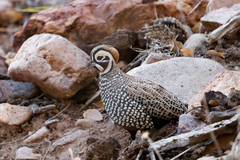
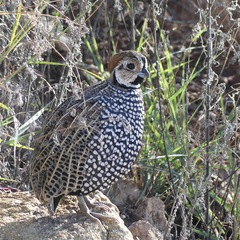
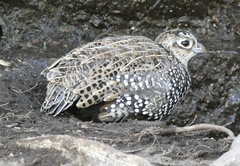
The Montezuma quail (Cyrtonyx montezumae) is a stubby, secretive New World quail of Mexico and some nearby parts of the United States. It is also known as Mearns's quail, the harlequin quail (for the male's striking pattern), and the fool quail (for its behavior).

The Montezuma quail was formally described in 1830 by Irish zoologist Nicholas Aylward Vigors under the binomial name Ortyx montezumae based on a specimen collected in Mexico. This species is now placed in the genus Cyrtonyx that was introduced in 1844 by English ornithologist John Gould, with Montezuma quail as the type species. The specific epithet montezumae is from the name of the Aztec Emperor Moctezuma Xocoyotzin.

The southern populations are sometimes considered a separate species, Cyrtonyx sallei. The Montezuma quail, though, is sometimes considered conspecific with the very similar ocellated quail, Cyrtonyx ocellatus, which replaces it from the Isthmus of Tehuantepec to northern Nicaragua. Wikipedia →
Sounds

Song0:17

United States · 2025

© David Tattersley · XC1000188 · CC BY-NC-SA 4.0

Call1:07

United States · 2020

© Richard E. Webster · XC637530 · CC BY-NC-SA 4.0

Call0:32

United States · 2019

© Diana Doyle · XC505242 · CC BY-SA 4.0

Global Distribution

Parks Where Found

# Park Country Daily sighting probability
1 Guadalupe Mountains National Park 🇺🇸 United States
<5%
2 Cumbres de Monterrey National Park 🇲🇽 Mexico
<5%
3 Saguaro National Park 🇺🇸 United States
<5%

Zoos & Centres Where Found

# Zoo / Centre Country
1 Ecological Center of Sonora 🇲🇽 Mexico In captivity
2 Burgers' Ocean 🇳🇱 Netherlands In captivity
3 Royal Burgers' Zoo 🇳🇱 Netherlands In captivity
4 Buttonwood Park Zoo 🇺🇸 United States In captivity
5 Elmwood Park Zoo 🇺🇸 United States In captivity
6 Tropical Birdland, Leicestershire 🇬🇧 United Kingdom In captivity

Before you go

What are the chances of seeing a Montezuma Quail in Guadalupe Mountains National Park?

Rare

Under 5% of wildlife watchers report a Montezuma Quail sighting in Guadalupe Mountains National Park on a given day, based on 10 verified sightings from GBIF citizen-science data from 2019 to 2026. It is the 123rd most-seen of the 141 birds we can rate there. Over three days the chance rises to under 5%, and over a week to about 10%, if each day is a fresh chance.

When is the best time to see a Montezuma Quail in Guadalupe Mountains National Park?

Any time of year

In every month with enough records, under 5% of wildlife watchers report a Montezuma Quail in Guadalupe Mountains National Park on a given day, so our monthly data shows no clear season.

What time of day is best to see a Montezuma Quail?

Between 8 and 11 am

Across all the parks we cover, that three-hour window holds the most Montezuma Quail sightings with a recorded time, and about 8 in 10 of them come between 6 am and 6 pm: it is a daytime animal.

Is Guadalupe Mountains National Park the best place to see a Montezuma Quail?

Yes

Of the 3 parks where we can rate Montezuma Quail sightings, Guadalupe Mountains National Park has the highest daily chance: under 5%. Next come Cumbres de Monterrey National Park (Mexico, under 5%) and Saguaro National Park (United States, under 5%).

Where does the Montezuma Quail sighting chance come from?

GBIF citizen-science records

It is estimated from how often the Montezuma Quail is recorded against all the birds logged in Guadalupe Mountains National Park (10 verified sightings from 2019 to 2026), calibrated against known sighting rates. Figures are rounded to the nearest 10% because citizen-science data supports honest approximations, not decimals, and months with records from fewer than five people show "—". How it works.

← Back to Guadalupe Mountains National Park