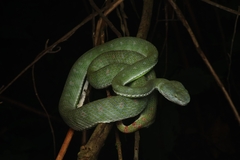
Hagen’s Pitviper

Hagen’s Pitviper

Trimeresurus hageni

Silhouette: Steven Traver · PhyloPic

LCLeast ConcernNTVUENCR
Daily sighting probability ~20% · Possible
at Gunung Leuser National Park

In 3 days ~50% in a week ~80%

12 Verified sightings at Gunung Leuser National Park From 2019 to 2026
12 In 1 park
September Best month
🌙 Nocturnal When it's spotted

About the Hagen’s Pitviper

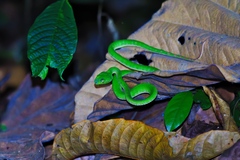
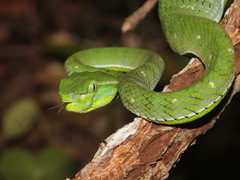
Trimeresurus hageni, commonly known as Hagen's pit viper and Hagen's green pit viper, is a species of venomous snake in the subfamily Crotalinae of the family Viperidae. The species is native to Southeast Asia. There are no subspecies that are recognized as being valid.

The specific name, hageni, is in honor of German naturalist Dr. Bernhard Hagen, who collected mammals, birds, reptiles, and insects in the eastern part of Sumatra. Scalation of T. hageni includes 21 rows of dorsal scales at midbody, 176–198 ventral scales, 63–89 subcaudal scales, and 9–12 supralabial scales. The lectotype has a total length (including tail) of 97 cm (38 in).

T. hageni is found in Peninsular Thailand, Peninsular Malaysia, East Malaysia (Borneo), and Indonesia (Sumatra and the nearby islands of Bangka, Simalur, Nias, Batu, and the Mentawai Islands). The type locality given is "Sumatra... [and] island of Banka". Brongersma (1933) emended this to "Deli, Sumatra".

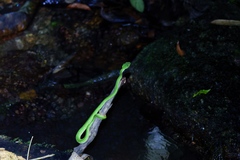
The preferred natural habitat of T. hageni is forest, at altitudes of 100–300 m (330–980 ft). T. hageni is arboreal and nocturnal. T. hageni preys... Wikipedia →

Global Distribution

Parks Where Found

# Park Country Daily sighting probability
1 Gunung Leuser National Park 🇮🇩 Indonesia
~20%

More parks will be added in future updates.

Before you go

What are the chances of seeing a Hagen’s Pitviper in Gunung Leuser National Park?

Possible

About 20% of wildlife watchers report a Hagen’s Pitviper sighting in Gunung Leuser National Park on a given day, based on 12 verified sightings from GBIF citizen-science data from 2019 to 2026. It is the 22nd most-seen of the 47 reptiles we can rate there. Over three days the chance rises to about 50%, and over a week to about 80%, if each day is a fresh chance.

When is the best time to see a Hagen’s Pitviper in Gunung Leuser National Park?

March and September

In those months about 40% of wildlife watchers report a Hagen’s Pitviper in Gunung Leuser National Park on a given day, against under 5% in April–August and October–December, the lowest months.

What time of day is best to see a Hagen’s Pitviper?

Between 9 pm and midnight

Across all the parks we cover, that three-hour window holds the most Hagen’s Pitviper sightings with a recorded time, and about 8 in 10 of them come between 6 pm and 6 am: it is mostly seen at night.

Where else can you see a Hagen’s Pitviper?

Only Gunung Leuser National Park, in our data

Gunung Leuser National Park is the only park on Wallace's Line with enough records to rate Hagen’s Pitviper sightings: about 20% of wildlife watchers there report one on a given day.

Which relatives of the Hagen’s Pitviper live in Gunung Leuser National Park?

Same genus: Trimeresurus

The closest relatives of the Hagen’s Pitviper that you can see in Gunung Leuser National Park (genus Trimeresurus, Asian Lanceheads) are Gunalen's Pitviper (about 20%) and Sabah Bamboo Pitviper (about 20%), with each one's daily chance of a sighting.

Where does the Hagen’s Pitviper sighting chance come from?

GBIF citizen-science records

It is estimated from how often the Hagen’s Pitviper is recorded against all the reptiles logged in Gunung Leuser National Park (12 verified sightings from 2019 to 2026), calibrated against known sighting rates. Figures are rounded to the nearest 10% because citizen-science data supports honest approximations, not decimals, and months with records from fewer than five people show "—". How it works.

← Back to Gunung Leuser National Park