
Sabah Bamboo Pitviper

Sabah Bamboo Pitviper

Trimeresurus sabahi

Silhouette: Steven Traver · PhyloPic

LCLeast ConcernNTVUENCR
Daily sighting probability ~20% · Possible
at Gunung Leuser National Park

In 3 days ~40% in a week ~70%

9 Verified sightings at Gunung Leuser National Park From 2019 to 2026
144 In all 4 parks
February Best month
☀️ Diurnal When it's spotted

About the Sabah Bamboo Pitviper

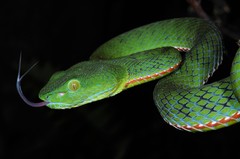
Trimeresurus sabahi, commonly known as the Sabah pit viper or Sabah bamboo pitviper, is a venomous pitviper species. If defined narrowly, it is endemic to the island of Borneo. If defined more broadly, it consists of five subspecies found in Southeast Asia.

There are five subspecies: Trimeresurus sabahi barati Regenass & Kramer, 1981 – Sumatra, Mentawai Archipelago (Indonesia) IUCN treats these as full species, respectively T. barati, T. buniana, T. fucatus, and T. toba, restricting T. sabahi to the nominotypical subspecies.

Adults may attain a snout-vent length (SVL) of 62 cm (24 in). Dorsally, it is uniform green, without crossbars. Ventrally it is pale green. There is narrow bicolor stripe on the first one and a half dorsal scale rows. In males this stripe is rust-colored or red below, and it is white above. In females it is yellow or white. The iris... Wikipedia →

Global Distribution

Parks Where Found

# Park Country Daily sighting probability
1 Kinabalu Park 🇲🇾 Malaysia
~40%
2 Khao Luang National Park 🇹🇭 Thailand
~40%
3 Khao Sok National Park 🇹🇭 Thailand
~20%
4 Gunung Leuser National Park 🇮🇩 Indonesia
~20%

Before you go

What are the chances of seeing a Sabah Bamboo Pitviper in Gunung Leuser National Park?

Possible

About 20% of wildlife watchers report a Sabah Bamboo Pitviper sighting in Gunung Leuser National Park on a given day, based on 9 verified sightings from GBIF citizen-science data from 2019 to 2026. It is the 29th most-seen of the 47 reptiles we can rate there. Over three days the chance rises to about 40%, and over a week to about 70%, if each day is a fresh chance.

When is the best time to see a Sabah Bamboo Pitviper in Gunung Leuser National Park?

February

In that month about 40% of wildlife watchers report a Sabah Bamboo Pitviper in Gunung Leuser National Park on a given day, against under 5% in January, March–June, August and October, the lowest months. That is one of Gunung Leuser National Park's driest months, with about 150 mm of rain against 700 mm in September.

What time of day is best to see a Sabah Bamboo Pitviper?

Between 2 and 5 pm

Across all the parks we cover, that three-hour window holds the most Sabah Bamboo Pitviper sightings with a recorded time, and about 8 in 10 of them come between 6 am and 6 pm: it is a daytime animal.

Is Gunung Leuser National Park the best place to see a Sabah Bamboo Pitviper?

4th of 4

Of the 4 parks where we can rate Sabah Bamboo Pitviper sightings, Gunung Leuser National Park ranks 4th at about 20%. The best odds are in Kinabalu Park (Malaysia, about 40%), Khao Luang National Park (Thailand, about 40%) and Khao Sok National Park (Thailand, about 20%). All parks ranked.

Which relatives of the Sabah Bamboo Pitviper live in Gunung Leuser National Park?

Same genus: Trimeresurus

The closest relatives of the Sabah Bamboo Pitviper that you can see in Gunung Leuser National Park (genus Trimeresurus, Asian Lanceheads) are Gunalen's Pitviper (about 20%) and Hagen’s Pitviper (about 20%), with each one's daily chance of a sighting.

Where does the Sabah Bamboo Pitviper sighting chance come from?

GBIF citizen-science records

It is estimated from how often the Sabah Bamboo Pitviper is recorded against all the reptiles logged in Gunung Leuser National Park (9 verified sightings from 2019 to 2026), calibrated against known sighting rates. Figures are rounded to the nearest 10% because citizen-science data supports honest approximations, not decimals, and months with records from fewer than five people show "—". How it works.

← Back to Gunung Leuser National Park