Spiny Terrapin

Spiny Terrapin

Heosemys spinosa

Silhouette: SeismicShrimp · PhyloPic

LCNTVUENEndangeredCR
Daily sighting probability ~30% · Possible
at Gunung Leuser National Park

In 3 days ~60% in a week ~90%

23 Verified sightings at Gunung Leuser National Park From 2019 to 2026
43 In all 2 parks
December Best month
☀️🌙 Day & Night When it's spotted

About the Spiny Terrapin

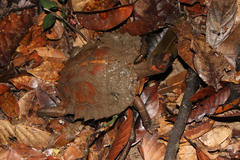
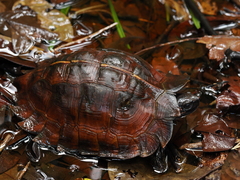
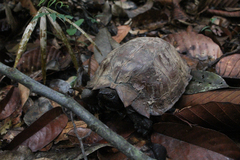
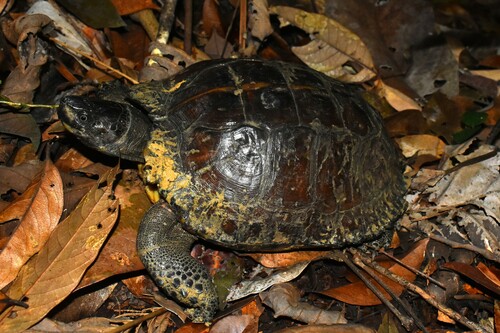
The spiny turtle (Heosemys spinosa) is a South-East Asian turtle species. It inhabits lowland and hill rainforest, usually dwelling in the vicinity of small streams in hill areas up to 1,000 m above sea level. It is found in Brunei, Indonesia, Malaysia, Myanmar, India, the Philippines, Singapore, and Thailand.

The spiny turtle is a medium-sized tortoise with a brown shell and red-spotted head. Also known as the "cog-wheel turtle," it derives its name from its spiky-edged carapace, marginal scutes, and spiny keel. As juvenile spiny turtles become adults, the black striped and yellow underside of their shell fades in color. In addition, the juveniles' serrations, or jagged edges, at the carapace margin decrease in size and become restricted to the carapace's rear margin. These changes of the spine and carapace serve as evolutionary adaptations attempting to prevent predators from preying on juvenile turtles.

The spiny turtle belongs to the kingdom of Animalia, the order of Testudines, and the genus of Heosemys. The classification of Heosemys incorporates four species: Heosemys annandalii, Heosemys depressa, Heosemys grandis, and Heosemys spinosa; however... Wikipedia →
Global Distribution

Parks Where Found

# Park Country Daily sighting probability
1 Gunung Leuser National Park 🇮🇩 Indonesia
~30%
2 Sepilok 🇲🇾 Malaysia
~20%

Zoos & Centres Where Found

# Zoo / Centre Country
1 Lisbon Oceanarium 🇵🇹 Portugal In captivity
2 Zoo Pilsen 🇨🇿 Czechia In captivity
3 Columbus Zoo and Aquarium 🇺🇸 United States In captivity
4 Detroit Zoo 🇺🇸 United States In captivity
5 Zoo Knoxville 🇺🇸 United States In captivity
6 Gembira Loka Zoo 🇮🇩 Indonesia In captivity
7 Bandung Zoo 🇮🇩 Indonesia In captivity
8 Entopia 🇲🇾 Malaysia In captivity
9 Snake Farm of Queen Saovabha Memorial Institute 🇹🇭 Thailand In captivity
10 Sea World Indonesia 🇮🇩 Indonesia In captivity
11 Centro de Recuperação de Animais Silvestres 🇵🇹 Portugal In captivity

Closest Relatives at Gunung Leuser National Park

No species of the same family or order lives in Gunung Leuser National Park, so these are its closest relatives here: other reptiles.

Before you go

What are the chances of seeing a Spiny Terrapin in Gunung Leuser National Park?

Possible

About 30% of wildlife watchers report a Spiny Terrapin sighting in Gunung Leuser National Park on a given day, based on 23 verified sightings from GBIF citizen-science data from 2019 to 2026. It is the 10th most-seen of the 47 reptiles we can rate there. Over three days the chance rises to about 60%, and over a week to about 90%, if each day is a fresh chance.

When is the best time to see a Spiny Terrapin in Gunung Leuser National Park?

December

In that month about 50% of wildlife watchers report a Spiny Terrapin in Gunung Leuser National Park on a given day, against under 5% in January–February, August and October–November, the lowest months.

What time of day is best to see a Spiny Terrapin?

Between 10 am and 1 pm

Across all the parks we cover, that three-hour window holds the most Spiny Terrapin sightings with a recorded time, and about 7 in 10 of them come between 6 am and 6 pm: it is seen both by day and at night.

Is Gunung Leuser National Park the best place to see a Spiny Terrapin?

Yes

Of the 2 parks where we can rate Spiny Terrapin sightings, Gunung Leuser National Park has the highest daily chance: about 30%. Next come Sepilok (Malaysia, about 20%).

Where does the Spiny Terrapin sighting chance come from?

GBIF citizen-science records

It is estimated from how often the Spiny Terrapin is recorded against all the reptiles logged in Gunung Leuser National Park (23 verified sightings from 2019 to 2026), calibrated against known sighting rates. Figures are rounded to the nearest 10% because citizen-science data supports honest approximations, not decimals, and months with records from fewer than five people show "—". How it works.

← Back to Gunung Leuser National Park