
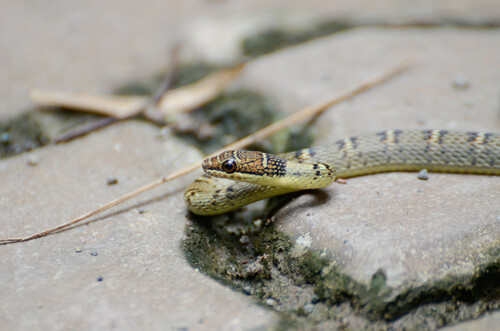
Western Mangrove Cat Snake

Western Mangrove Cat Snake

Boiga melanota

Silhouette: Alex Slavenko · PhyloPic

Daily sighting probability ~20% · Possible
at Gunung Leuser National Park

In 3 days ~60% in a week ~90%

14 Verified sightings at Gunung Leuser National Park From 2019 to 2026
91 In all 2 parks
February Best month
☀️ Diurnal When it's spotted

About the Western Mangrove Cat Snake

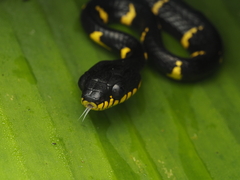
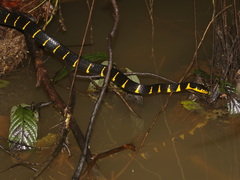
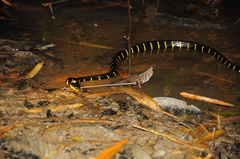
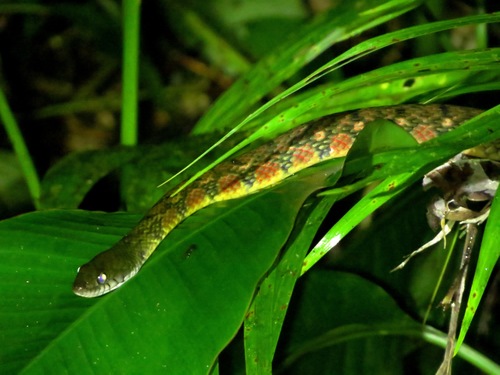
Boiga melanota, the western mangrove cat snake, is one of the biggest cat snake species in Asia. It is found in Thailand, West Malaysia, Singapore, and Indonesia (Sumatra). It is shiny bluish black in colour, marked with 40-50 yellow stripes. The mouth and throat area are yellow, whereas the ventral part of the body is yellowish black. The eyes are greyish in colour. It is categorised as a mildly venomous snake.

An adult mangrove snake can reach a length of 2.5 metres (8 ft 2 in). It is active at night (nocturnal) and hunts for birds, rats and birds eggs as its main diet. Its large head and mouth enables it to swallows its prey easily.

Recently reclassed from within the Dendrophila family, they share some physical traits such as similar colouring and being rear-fanged. Species Boiga melanota at The Reptile Database Wikipedia →

Global Distribution

Parks Where Found

# Park Country Daily sighting probability
1 Khao Sok National Park 🇹🇭 Thailand
~50%
2 Gunung Leuser National Park 🇮🇩 Indonesia
~20%

Cities Where Found

# City Country Daily sighting probability
1 Singapore 🇸🇬 Singapore
~10%

Zoos & Centres Where Found

# Zoo / Centre Country
1 National Zoological Park 🇺🇸 United States In captivity
2 Tierpark Berlin 🇩🇪 Germany In captivity
3 Chester Zoo 🇬🇧 United Kingdom In captivity
4 National Zoological Garden of South Africa 🇿🇦 South Africa In captivity
5 Night Safari 🇸🇬 Singapore In captivity
6 National Zoo of Malaysia 🇲🇾 Malaysia In captivity
7 Singapore Zoo 🇸🇬 Singapore In captivity
8 John Ball Zoo 🇺🇸 United States In captivity
9 River Wonders 🇸🇬 Singapore In captivity
10 Farm in the City 🇲🇾 Malaysia In captivity
11 Siam Serpentarium 🇹🇭 Thailand In captivity
12 Entopia 🇲🇾 Malaysia In captivity
13 Snake Farm of Queen Saovabha Memorial Institute 🇹🇭 Thailand In captivity
14 Blue Planet Aquarium 🇬🇧 United Kingdom In captivity
15 Terrariet 🇩🇰 Denmark In captivity
16 Dolphins Bay Phuket 🇹🇭 Thailand In captivity

Before you go

What are the chances of seeing a Western Mangrove Cat Snake in Gunung Leuser National Park?

Possible

About 20% of wildlife watchers report a Western Mangrove Cat Snake sighting in Gunung Leuser National Park on a given day, based on 14 verified sightings from GBIF citizen-science data from 2019 to 2026. It is the 15th most-seen of the 47 reptiles we can rate there. Over three days the chance rises to about 60%, and over a week to about 90%, if each day is a fresh chance.

When is the best time to see a Western Mangrove Cat Snake in Gunung Leuser National Park?

February–March and August

In those months about 40% of wildlife watchers report a Western Mangrove Cat Snake in Gunung Leuser National Park on a given day, against under 5% in June–July and September–November, the lowest months.

What time of day is best to see a Western Mangrove Cat Snake?

Between 2 and 5 pm

Across all the parks we cover, that three-hour window holds the most Western Mangrove Cat Snake sightings with a recorded time, and about 8 in 10 of them come between 6 am and 6 pm: it is a daytime animal.

Is Gunung Leuser National Park the best place to see a Western Mangrove Cat Snake?

2nd of 2

Of the 2 parks where we can rate Western Mangrove Cat Snake sightings, Gunung Leuser National Park ranks 2nd at about 20%. The best odds are in Khao Sok National Park (Thailand, about 50%).

Where does the Western Mangrove Cat Snake sighting chance come from?

GBIF citizen-science records

It is estimated from how often the Western Mangrove Cat Snake is recorded against all the reptiles logged in Gunung Leuser National Park (14 verified sightings from 2019 to 2026), calibrated against known sighting rates. Figures are rounded to the nearest 10% because citizen-science data supports honest approximations, not decimals, and months with records from fewer than five people show "—". How it works.

← Back to Gunung Leuser National Park