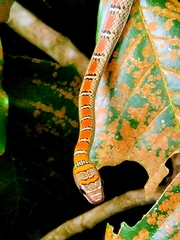
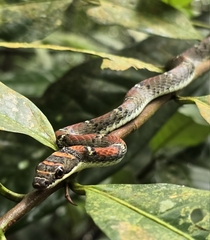
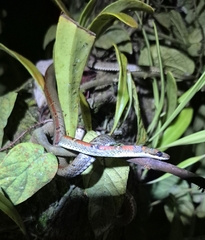
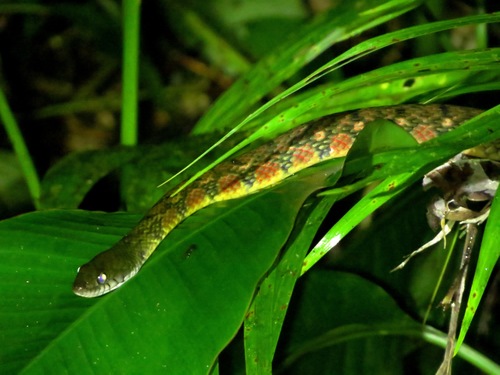
Banded Flying Snake

Banded Flying Snake

Chrysopelea pelias

Silhouette: Alex Slavenko · PhyloPic

LCLeast ConcernNTVUENCR
Daily sighting probability ~10% · With luck
at Gunung Leuser National Park

In 3 days ~40% in a week ~70%

6 Verified sightings at Gunung Leuser National Park From 2019 to 2026
26 In all 4 parks
November Best month
🌅 Crepuscular When it's spotted

About the Banded Flying Snake

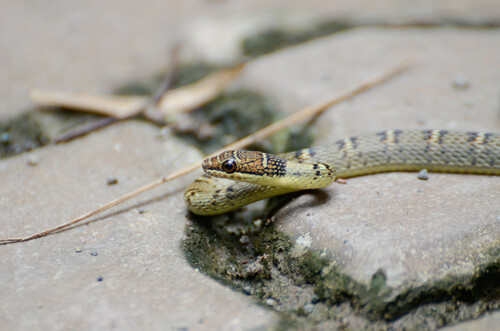
The twin-barred tree snake (Chrysopelea pelias) is a species of colubrid snake found in Southeast Asia. It is also called the banded flying snake. It can glide, as with all species of its genus Chrysopelea, by stretching the body into a flattened strip using its ribs. It is fully arboreal, mostly found in moist forests, and can cover a horizontal distance of about 100 metres in a glide from the top of a tree. It is an oviparous snake.

Chrysopelea pelias belongs to the genus Chrysopelea, which contains four other described species. Chrysopelea is one of five genera belonging to the vine snake subfamily Ahaetuliinae, of which Chrysopelea is most closely related to Dendrelaphis, as shown in the cladogram below:

It is found in Indonesia, Malaysia, Brunei, Singapore, Thailand, and Myanmar. It was erroneously reported in India. Chrysopelea pelias has an overlapping range with the paradise tree snake (Chrysopelea paradisi) in Malaysia, Singapore, Borneo and Indonesia. However, Chrysopelea pelias is not nearly as common as the paradise tree snake.

Chrysopelea pelias begins gliding by jumping in an upward position that seems to be different from... Wikipedia →
Global Distribution

Parks Where Found

# Park Country Daily sighting probability
1 Bako National Park 🇲🇾 Malaysia
~20%
2 Danum Valley Conservation Area 🇲🇾 Malaysia
~20%
3 Gunung Leuser National Park 🇮🇩 Indonesia
~10%
4 Kinabalu Park 🇲🇾 Malaysia
~10%

Cities Where Found

# City Country Daily sighting probability
1 Singapore 🇸🇬 Singapore
~10%

Before you go

What are the chances of seeing a Banded Flying Snake in Gunung Leuser National Park?

With luck

About 10% of wildlife watchers report a Banded Flying Snake sighting in Gunung Leuser National Park on a given day, based on 6 verified sightings from GBIF citizen-science data from 2019 to 2026. It is the 33rd most-seen of the 47 reptiles we can rate there. Over three days the chance rises to about 40%, and over a week to about 70%, if each day is a fresh chance.

When is the best time to see a Banded Flying Snake in Gunung Leuser National Park?

March, July and November

In those months about 30% of wildlife watchers report a Banded Flying Snake in Gunung Leuser National Park on a given day, against under 5% in April–June, August, October and December–February, the lowest months.

What time of day is best to see a Banded Flying Snake?

Between 4 and 7 am

Across all the parks we cover, that three-hour window holds the most Banded Flying Snake sightings with a recorded time, and about half of them come between 6 am and 6 pm: it is most active around dawn and dusk.

Is Gunung Leuser National Park the best place to see a Banded Flying Snake?

3rd of 4

Of the 4 parks where we can rate Banded Flying Snake sightings, Gunung Leuser National Park ranks 3rd at about 10%. The best odds are in Bako National Park (Malaysia, about 20%) and Danum Valley Conservation Area (Malaysia, about 20%).

Where does the Banded Flying Snake sighting chance come from?

GBIF citizen-science records

It is estimated from how often the Banded Flying Snake is recorded against all the reptiles logged in Gunung Leuser National Park (6 verified sightings from 2019 to 2026), calibrated against known sighting rates. Figures are rounded to the nearest 10% because citizen-science data supports honest approximations, not decimals, and months with records from fewer than five people show "—". How it works.

← Back to Gunung Leuser National Park