
Black-backed Antshrike

Black-backed Antshrike

Thamnophilus melanonotus

Silhouette: Sheatherius · PhyloPic

LCLeast ConcernNTVUENCR
Daily sighting probability <5% · Rare
at Henri Pittier National Park

In 3 days ~10% in a week ~20%

18 Verified sightings at Henri Pittier National Park From 2019 to 2026
102 In all 2 parks
April Best month
☀️ Diurnal When it's spotted

About the Black-backed Antshrike

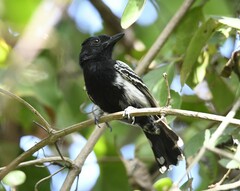
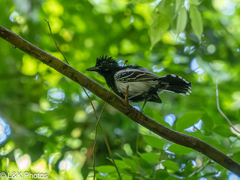
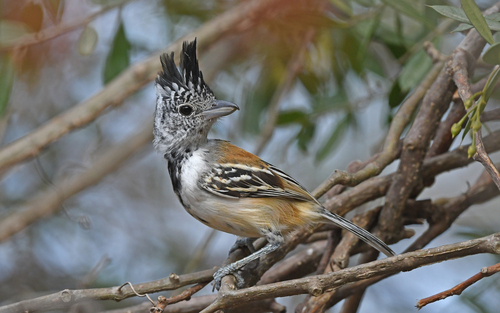
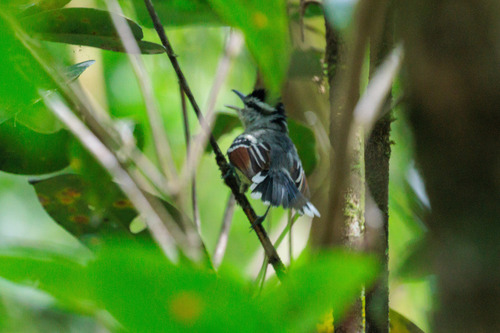
The black-backed antshrike (Thamnophilus melanonotus) is a species of bird in subfamily Thamnophilinae of family Thamnophilidae, the "typical antbirds". It is found in Colombia and Venezuela. The black-backed antshrike was described by the English zoologist Philip Sclater in 1855 and given the binomial name Thamnophilus melanonotus. It was subsequently placed in the genus Sakesphorus. A molecular phylogenetic study published in 2007 found that Sakesphorus was polyphyletic and that three species including the black-backed antshrike were embedded within a clade containing members of Thamnophilus. The black-backed antshrike was therefore moved back to its original genus.

The black-backed antshrike is monotypic. The black-backed antshrike is 15 to 16 cm (5.9 to 6.3 in) long. Members of genus Thamnophilus are largish members of the antbird family; all have stout bills with a hook like those of true shrikes. Adult males have a black to blackish brown head and back with white edges on the scapulars and a hidden white patch between them. Their lower back and rump are light gray. Their wings are black with wide white tips on the coverts and white... Wikipedia →

Sounds

Song0:41

Venezuela · 1997

© Peter Boesman · XC229177 · CC BY-NC-ND 4.0

Call0:13

Colombia · 2001

© Bernabe Lopez-Lanus · XC45415 · CC BY-NC-SA 3.0

Call?0:38

Venezuela · 2009

© Hans Matheve · XC163405 · CC BY-NC-ND 3.0

Global Distribution

Parks Where Found

# Park Country Daily sighting probability
1 Tayrona National Natural Park 🇨🇴 Colombia
<5%
2 Henri Pittier National Park 🇻🇪 Venezuela
<5%

Before you go

What are the chances of seeing a Black-backed Antshrike in Henri Pittier National Park?

Rare

Under 5% of wildlife watchers report a Black-backed Antshrike sighting in Henri Pittier National Park on a given day, based on 18 verified sightings from GBIF citizen-science data from 2019 to 2026. It is the 267th most-seen of the 358 birds we can rate there. Over three days the chance rises to about 10%, and over a week to about 20%, if each day is a fresh chance.

When is the best time to see a Black-backed Antshrike in Henri Pittier National Park?

April

In that month about 20% of wildlife watchers report a Black-backed Antshrike in Henri Pittier National Park on a given day, against under 5% in June to March, the lowest months.

What time of day is best to see a Black-backed Antshrike?

Between 6 and 9 am

Across all the parks we cover, that three-hour window holds the most Black-backed Antshrike sightings with a recorded time, and about 9 in 10 of them come between 6 am and 6 pm: it is a daytime animal.

Is Henri Pittier National Park the best place to see a Black-backed Antshrike?

Among the best

Of the 2 parks where we can rate Black-backed Antshrike sightings, Henri Pittier National Park ranks 2nd at under 5%, level with the leaders once rounded. The best odds are in Tayrona National Natural Park (Colombia, under 5%).

Where does the Black-backed Antshrike sighting chance come from?

GBIF citizen-science records

It is estimated from how often the Black-backed Antshrike is recorded against all the birds logged in Henri Pittier National Park (18 verified sightings from 2019 to 2026), calibrated against known sighting rates. Figures are rounded to the nearest 10% because citizen-science data supports honest approximations, not decimals, and months with records from fewer than five people show "—". How it works.

← Back to Henri Pittier National Park