Helmeted Curassow

Helmeted Curassow

Pauxi pauxi

Silhouette: Sheatherius · PhyloPic

LCNTVUVulnerableENCR
Daily sighting probability ~10% · With luck
at Henri Pittier National Park

In 3 days ~30% in a week ~60%

60 Verified sightings at Henri Pittier National Park From 2019 to 2026
60 In 1 park
April Best month
☀️ Diurnal When it's spotted

About the Helmeted Curassow

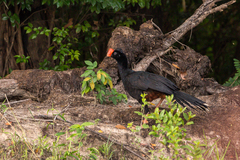
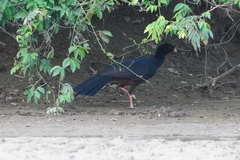
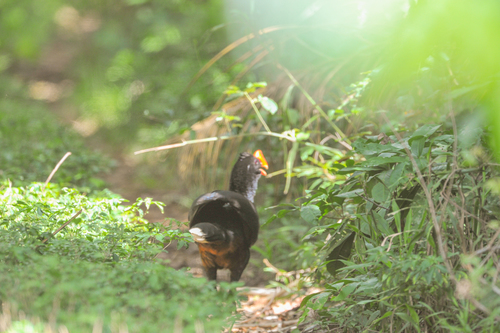
The helmeted curassow (Pauxi pauxi) or northern helmeted curassow, is a large terrestrial bird in the family Cracidae found in the subtropical cloud-forest in steep, mountainous regions of western Venezuela and northern Colombia. There are two subspecies found in different mountain ranges. It is a mostly black bird with a white tip to its tail, a red bill and a distinctive grey casque on its forehead. The population of this bird is in decline and the International Union for Conservation of Nature has rated its conservation status as "endangered".

It is a large terrestrial black curassow with a small head, large bluish grey casque on forehead, red bill, white-tipped tail feathers, greenish glossed mantle and breast feathers, and white below. Both sexes are similar. Length in adult birds can vary from 80 to 100 cm (31 to 39 in). The male, at 3.6 kg (8 lbs), is larger than the female, at 2.6 kg (5.8 lbs). Among standard measurements, the wing chord is 36.3 to 42.7 cm (14.3 to 16.8 in), the tail is 30.4 to 36.2 cm (12.0 to 14.3 in) and the tarsus is 8.9 to 11.2 cm (3.5 to 4.4 in). Some rare rufous morph female has a black barred and reddish brown plumage. For some time... Wikipedia →
Sounds

Call0:28

Venezuela · 2004

© Rosendo Manuel Fraga · XC466733 · CC BY-NC-SA 4.0

Call0:23

Venezuela · 1995

© Peter Boesman · XC227372 · CC BY-NC-ND 4.0

Call0:41

Venezuela · 2009

© Hans Matheve · XC202360 · CC BY-NC-ND 4.0

Global Distribution

Parks Where Found

# Park Country Daily sighting probability
1 Henri Pittier National Park 🇻🇪 Venezuela
~10%

More parks will be added in future updates.

Zoos & Centres Where Found

# Zoo / Centre Country
1 Shedd Aquarium 🇺🇸 United States In captivity
2 ZooParc de Beauval 🇫🇷 France In captivity
3 Denver Zoo 🇺🇸 United States In captivity
4 Lisbon Oceanarium 🇵🇹 Portugal In captivity
5 Zoo Miami 🇺🇸 United States In captivity
6 Bronx Zoo 🇺🇸 United States In captivity
7 Brookfield Zoo 🇺🇸 United States In captivity
8 Dallas Zoo 🇺🇸 United States In captivity
9 Selwo Aventura 🇪🇸 Spain In captivity
10 Caldwell Zoo 🇺🇸 United States In captivity
11 Fresno Chaffee Zoo 🇺🇸 United States In captivity
12 Attica Zoological Park 🇬🇷 Greece In captivity
13 Łódź Zoo 🇵🇱 Poland In captivity
14 Reserva Animal La Pequeña África 🇪🇸 Spain In captivity
15 Lincoln Park Zoo 🇺🇸 United States In captivity
16 Aviario Nacional de Colombia 🇨🇴 Colombia In captivity
17 Henry Vilas Zoo 🇺🇸 United States In captivity
18 Parque del pueblo 🇲🇽 Mexico In captivity
19 Hong Kong Zoological and Botanical Gardens 🇨🇳 China In captivity
20 Greenville Zoo 🇺🇸 United States In captivity
21 Tracy Aviary 🇺🇸 United States In captivity
22 Zoo Koki (Parque zoológico y botánico) 🇪🇸 Spain In captivity
23 Zoo Lagos 🇵🇹 Portugal In captivity
24 Johor Zoo 🇲🇾 Malaysia In captivity
25 Castellar Zoo 🇪🇸 Spain In captivity
26 Zoo de Lourosa 🇵🇹 Portugal In captivity
27 Aviary 🇭🇰 Hong Kong SAR China In captivity
28 Cali Zoo 🇨🇴 Colombia In captivity
29 Centro de Recuperação de Animais Silvestres 🇵🇹 Portugal In captivity
30 Ocean Park Hong Kong 🇨🇳 China In captivity
31 Ogród zoologiczny w Lubinie 🇵🇱 Poland In captivity
32 Parco Gallorose 🇮🇹 Italy In captivity
33 Zooparque Itatiba 🇧🇷 Brazil In captivity

Before you go

What are the chances of seeing a Helmeted Curassow in Henri Pittier National Park?

With luck

About 10% of wildlife watchers report a Helmeted Curassow sighting in Henri Pittier National Park on a given day, based on 60 verified sightings from GBIF citizen-science data from 2019 to 2026. It is the 117th most-seen of the 358 birds we can rate there. Over three days the chance rises to about 30%, and over a week to about 60%, if each day is a fresh chance.

When is the best time to see a Helmeted Curassow in Henri Pittier National Park?

April

In that month about 40% of wildlife watchers report a Helmeted Curassow in Henri Pittier National Park on a given day, against under 5% in January, May and July–October, the lowest months.

What time of day is best to see a Helmeted Curassow?

Between 1 and 4 pm

Across all the parks we cover, that three-hour window holds the most Helmeted Curassow sightings with a recorded time, and about 8 in 10 of them come between 6 am and 6 pm: it is a daytime animal.

Where else can you see a Helmeted Curassow?

Only Henri Pittier National Park, in our data

Henri Pittier National Park is the only park on Wallace's Line with enough records to rate Helmeted Curassow sightings: about 10% of wildlife watchers there report one on a given day.

Which relatives of the Helmeted Curassow live in Henri Pittier National Park?

Same family: Cracidae

The closest relatives of the Helmeted Curassow that you can see in Henri Pittier National Park (family Cracidae, Guans, Chachalacas, and Curassows) are Rufous-vented Chachalaca (about 20%) and Band-tailed Guan (about 10%), with each one's daily chance of a sighting.

Where does the Helmeted Curassow sighting chance come from?

GBIF citizen-science records

It is estimated from how often the Helmeted Curassow is recorded against all the birds logged in Henri Pittier National Park (60 verified sightings from 2019 to 2026), calibrated against known sighting rates. Figures are rounded to the nearest 10% because citizen-science data supports honest approximations, not decimals, and months with records from fewer than five people show "—". How it works.

← Back to Henri Pittier National Park