Rufous-vented Chachalaca

Rufous-vented Chachalaca

Ortalis ruficauda

Silhouette: PhyloPic

LCLeast ConcernNTVUENCR
Daily sighting probability ~20% · Possible
at Henri Pittier National Park

In 3 days ~50% in a week ~80%

152 Verified sightings at Henri Pittier National Park From 2019 to 2026
1,054 In all 2 parks
January Best month
☀️ Diurnal When it's spotted

About the Rufous-vented Chachalaca

The rufous-vented chachalaca (Ortalis ruficauda) is a member of an ancient group of birds of the family Cracidae, which are related to the Australasian mound builders. It inhabits northeast Colombia and northern Venezuela where it is called guacharaca, and the island of Tobago in Trinidad and Tobago where it is known as the cocrico and is one of the country's two national birds (being featured on the country's coat of arms). It is also found on Bequia and Union Island in the Grenadines where it may have been introduced.

The rufous-vented chachalaca is a largely arboreal species found in forest and woodland, but it is also found in more open dry scrubby areas. This combined with relatively low hunting pressure, make it far less vulnerable than larger members of the family, notably curassows.

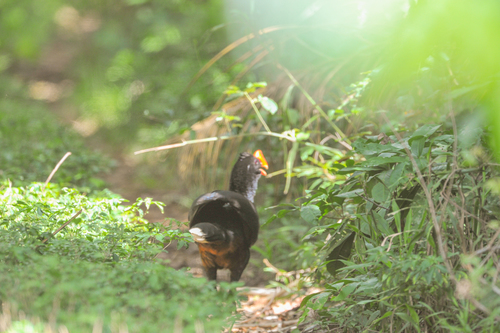
These are medium-sized birds, similar in general appearance to turkeys, with small heads, long strong legs and a long broad tail. They are typically 53–58 cm long; the female weighs 540g and the larger male 640g. They have fairly dull plumage, dark brown above and paler below. The head is grey, and the brown tail is tipped rufous or white depending on race. Wikipedia →

Sounds

Song1:14

Venezuela · 2022

© Francisco contreras · XC837794 · CC BY-NC-SA 4.0

Call1:16

Trinidad & Tobago · 2013

© Simon Elliott · XC590691 · CC BY-NC-ND 4.0

Dawn chorus0:07

Venezuela · 1996

© Peter Boesman · XC226995 · CC BY-NC-ND 4.0

Global Distribution

Parks Where Found

# Park Country Daily sighting probability
1 Main Ridge Forest Reserve 🇹🇹 Trinidad and Tobago
~80%
2 Henri Pittier National Park 🇻🇪 Venezuela
~20%

Cities Where Found

# City Country Daily sighting probability
1 Caracas 🇻🇪 Venezuela
~30%
2 Valencia 🇻🇪 Venezuela
~20%

Zoos & Centres Where Found

# Zoo / Centre Country
1 Aviario Nacional de Colombia 🇨🇴 Colombia In captivity
2 Buenaventura Zoo 🇵🇦 Panama In captivity
3 Bird Kingdom 🇨🇦 Canada In captivity

Before you go

What are the chances of seeing a Rufous-vented Chachalaca in Henri Pittier National Park?

Possible

About 20% of wildlife watchers report a Rufous-vented Chachalaca sighting in Henri Pittier National Park on a given day, based on 152 verified sightings from GBIF citizen-science data from 2019 to 2026. It is the 59th most-seen of the 358 birds we can rate there. Over three days the chance rises to about 50%, and over a week to about 80%, if each day is a fresh chance.

When is the best time to see a Rufous-vented Chachalaca in Henri Pittier National Park?

January

In that month about 50% of wildlife watchers report a Rufous-vented Chachalaca in Henri Pittier National Park on a given day, against under 5% in August, the lowest month.

What time of day is best to see a Rufous-vented Chachalaca?

Between 7 and 10 am

Across all the parks we cover, that three-hour window holds the most Rufous-vented Chachalaca sightings with a recorded time, and about 9 in 10 of them come between 6 am and 6 pm: it is a daytime animal.

Is Henri Pittier National Park the best place to see a Rufous-vented Chachalaca?

2nd of 2

Of the 2 parks where we can rate Rufous-vented Chachalaca sightings, Henri Pittier National Park ranks 2nd at about 20%. The best odds are in Main Ridge Forest Reserve (Trinidad and Tobago, about 80%).

Which relatives of the Rufous-vented Chachalaca live in Henri Pittier National Park?

Same family: Cracidae

The closest relatives of the Rufous-vented Chachalaca that you can see in Henri Pittier National Park (family Cracidae, Guans, Chachalacas, and Curassows) are Band-tailed Guan (about 10%) and Helmeted Curassow (about 10%), with each one's daily chance of a sighting.

Where does the Rufous-vented Chachalaca sighting chance come from?

GBIF citizen-science records

It is estimated from how often the Rufous-vented Chachalaca is recorded against all the birds logged in Henri Pittier National Park (152 verified sightings from 2019 to 2026), calibrated against known sighting rates. Figures are rounded to the nearest 10% because citizen-science data supports honest approximations, not decimals, and months with records from fewer than five people show "—". How it works.

← Back to Henri Pittier National Park