
Violet-chested Hummingbird

Violet-chested Hummingbird

Sternoclyta cyanopectus

Silhouette: Ferran Sayol · PhyloPic

LCLeast ConcernNTVUENCR Endemic
Daily sighting probability ~20% · Possible
at Henri Pittier National Park

In 3 days ~50% in a week ~80%

120 Verified sightings at Henri Pittier National Park From 2019 to 2026
120 In 1 park
October Best month
☀️ Diurnal When it's spotted

About the Violet-chested Hummingbird

The violet-chested hummingbird (Sternoclyta cyanopectus) is a species of hummingbird in the "mountain gems", tribe Lampornithini in subfamily Trochilinae. It is found in Colombia and Venezuela. The violet-chested hummingbird is the only member of its genus and has no subspecies. A proposal in the early 21st century to move it into genus Eugenes was not adopted by major worldwide taxonomic systems.

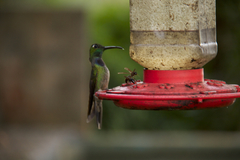
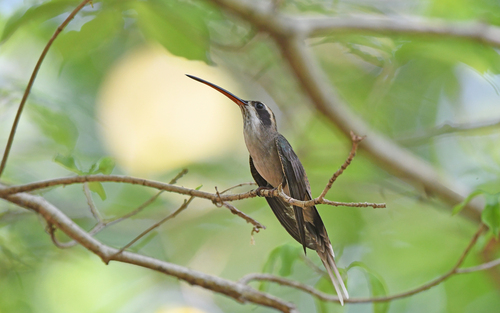
The violet-chested hummingbird is 11.4 to 13 cm (4.5 to 5.1 in) long. Males weigh 7 to 9.4 g (0.25 to 0.33 oz) and females 4.0 to 10.3 g (0.14 to 0.36 oz). Both sexes have a decurved black bill, with the male's being longer, and a small white spot behind the eye. Adult males have shining grass green upperparts. Their gorget is glittering emerald green with a patch of glittering violet blue below it on the breast. The rest of the underparts are grayish buff with golden-green spots on the flanks. The tail is bronze with small white tips on the outer feathers. Adult females are also shining grass green above. Their underparts are mostly grayish with green spots on the chest; the center of the belly is rufescent. Young juveniles resemble the adult... Wikipedia →

Sounds

Call0:15

Venezuela · 1996

© Peter Boesman · XC230040 · CC BY-NC-ND 4.0

Global Distribution

Parks Where Found

# Park Country Daily sighting probability
1 Henri Pittier National Park 🇻🇪 Venezuela
~20%

More parks will be added in future updates.

Before you go

What are the chances of seeing a Violet-chested Hummingbird in Henri Pittier National Park?

Possible

About 20% of wildlife watchers report a Violet-chested Hummingbird sighting in Henri Pittier National Park on a given day, based on 120 verified sightings from GBIF citizen-science data from 2019 to 2026. It is the 56th most-seen of the 358 birds we can rate there. Over three days the chance rises to about 50%, and over a week to about 80%, if each day is a fresh chance.

When is the best time to see a Violet-chested Hummingbird in Henri Pittier National Park?

October

In that month about 60% of wildlife watchers report a Violet-chested Hummingbird in Henri Pittier National Park on a given day, against under 5% in June, the lowest month.

What time of day is best to see a Violet-chested Hummingbird?

Between 11 am and 2 pm

Across all the parks we cover, that three-hour window holds the most Violet-chested Hummingbird sightings with a recorded time, and nearly all of them come between 6 am and 6 pm: it is a daytime animal.

Where else can you see a Violet-chested Hummingbird?

Only Henri Pittier National Park, in our data

Henri Pittier National Park is the only park on Wallace's Line with enough records to rate Violet-chested Hummingbird sightings: about 20% of wildlife watchers there report one on a given day.

Which relatives of the Violet-chested Hummingbird live in Henri Pittier National Park?

Same family: Trochilidae

The closest relatives of the Violet-chested Hummingbird that you can see in Henri Pittier National Park (family Trochilidae, Hummingbirds) are Long-tailed Sylph (about 30%), White-vented Plumeleteer (about 30%) and Copper-rumped Hummingbird (about 20%), with each one's daily chance of a sighting.

Where does the Violet-chested Hummingbird sighting chance come from?

GBIF citizen-science records

It is estimated from how often the Violet-chested Hummingbird is recorded against all the birds logged in Henri Pittier National Park (120 verified sightings from 2019 to 2026), calibrated against known sighting rates. Figures are rounded to the nearest 10% because citizen-science data supports honest approximations, not decimals, and months with records from fewer than five people show "—". How it works.

← Back to Henri Pittier National Park