Stripe-throated Hermit

Stripe-throated Hermit

Phaethornis striigularis

Silhouette: Andy Wilson · PhyloPic

LCLeast ConcernNTVUENCR
Daily sighting probability ~10% · With luck
at Henri Pittier National Park

In 3 days ~30% in a week ~50%

49 Verified sightings at Henri Pittier National Park From 2019 to 2026
18,233 In all 41 parks
April Best month
☀️ Diurnal When it's spotted

About the Stripe-throated Hermit

The stripe-throated hermit (Phaethornis striigularis) is a species of hummingbird from Central America and north-western South America. It is generally fairly common and considered Least Concern by BirdLife International.

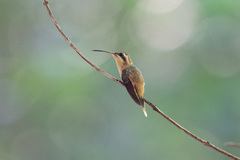
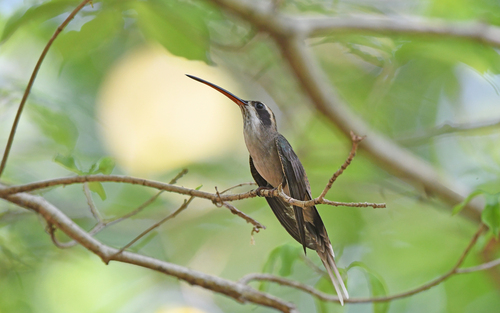
With a total length of 9–10 cm (3.5–3.9 in) and a weight of 2–3 g (0.071–0.106 oz), it is among the smaller species of hermits. The wing-coverts, mantle, nape and crown are dull iridescent green, the rump is pale rufous, the belly and flanks are buff, and the central underparts and throat are pale greyish brown, the latter with small dark streaks that often are faint and difficult to see. The face has a blackish "bandit-mask" border above by a whitish-buff supercilium and below by whitish-buff malar. The flight-feathers and tail are blackish; the latter tipped whitish to ochraceous depending on the subspecies involved. As in most other hermits, it has a long, decurved bill. The basal half of the lower mandible is yellow, but otherwise the entire bill is black.

The sexes are virtually identical. Juveniles apparently have the entire back pale rufous. The male has a song which is high-pitched, squeaky, monotonous and easily overheard... Wikipedia →

Sounds

Song1:28

Mexico · 2021

© Alán Palacios · XC694422 · CC BY-NC-SA 4.0

Flight call0:06

Mexico · 2016

© Marilyn Castillo · XC402746 · CC BY-NC-ND 4.0

Call0:08

Ecuador · 1997

© Olaf Jahn · XC261703 · CC BY-NC-SA 4.0

Global Distribution

Parks Where Found

# Park Country Daily sighting probability
1 Cockscomb Basin Wildlife Sanctuary 🇧🇿 Belize
~40%
2 Pico Bonito National Park 🇭🇳 Honduras
~40%
3 Bastimentos Island National Marine Park 🇵🇦 Panama
~30%
4 Cusuco National Park 🇭🇳 Honduras
~30%
5 Piedras Blancas National Park 🇨🇷 Costa Rica
~30%
6 Gandoca-Manzanillo Wildlife Refuge 🇨🇷 Costa Rica
~30%
7 Tenorio Volcano National Park 🇨🇷 Costa Rica
~30%
8 Arenal Volcano National Park 🇨🇷 Costa Rica
~20%
9 Soberanía National Park 🇵🇦 Panama
~20%
10 Cahuita National Park 🇨🇷 Costa Rica
~20%
11 Corcovado National Park 🇨🇷 Costa Rica
~20%
12 Cerro Azul Meámbar National Park 🇭🇳 Honduras
~20%
13 Chagres National Park 🇵🇦 Panama
~20%
14 Braulio Carrillo National Park 🇨🇷 Costa Rica
~20%
15 La Amistad International Park (Panama) 🇵🇦 Panama
~20%
16 San Lorenzo Protected Forest 🇵🇦 Panama
~20%
17 Carara National Park 🇨🇷 Costa Rica
~20%
18 Tikal National Park 🇬🇹 Guatemala
~20%
19 Montes Azules Biosphere Reserve 🇲🇽 Mexico
~10%
20 Tortuguero National Park 🇨🇷 Costa Rica
~10%
21 Rincón de la Vieja National Park 🇨🇷 Costa Rica
~10%
22 Darién National Park 🇵🇦 Panama
~10%
23 Henri Pittier National Park 🇻🇪 Venezuela
~10%
24 Lago de Yojoa 🇭🇳 Honduras
~10%
25 Tapantí-Macizo de la Muerte National Park 🇨🇷 Costa Rica
~10%
26 Manuel Antonio National Park 🇨🇷 Costa Rica
~10%
27 Santa Rosa National Park 🇨🇷 Costa Rica
~10%
28 Chirripó National Park 🇨🇷 Costa Rica
~10%
29 Cabo Blanco Absolute Nature Reserve 🇨🇷 Costa Rica
~10%
30 Calakmul Biosphere Reserve 🇲🇽 Mexico
<5%
31 Cañón del Sumidero National Park 🇲🇽 Mexico
<5%
32 Marino Ballena National Park 🇨🇷 Costa Rica
<5%
33 Ostional Wildlife Refuge 🇨🇷 Costa Rica
<5%
34 Monteverde Cloud Forest Reserve 🇨🇷 Costa Rica
<5%
35 Machalilla National Park 🇪🇨 Ecuador
<5%
36 Palo Verde National Park 🇨🇷 Costa Rica
<5%
37 Tayrona National Natural Park 🇨🇴 Colombia
<5%
38 Volcán Barú National Park 🇵🇦 Panama
<5%
39 Farallones de Cali National Natural Park 🇨🇴 Colombia
<5%
40 Poás Volcano National Park 🇨🇷 Costa Rica
<5%
41 Parque Natural Metropolitano 🇵🇦 Panama
<5%

Cities Where Found

# City Country Daily sighting probability
1 San Pedro Sula 🇭🇳 Honduras
<5%
2 Panama City 🇵🇦 Panama
<5%
3 San José 🇨🇷 Costa Rica
<5%
4 Caracas 🇻🇪 Venezuela
<5%

Before you go

What are the chances of seeing a Stripe-throated Hermit in Henri Pittier National Park?

With luck

About 10% of wildlife watchers report a Stripe-throated Hermit sighting in Henri Pittier National Park on a given day, based on 49 verified sightings from GBIF citizen-science data from 2019 to 2026. It is the 132nd most-seen of the 358 birds we can rate there. Over three days the chance rises to about 30%, and over a week to about 50%, if each day is a fresh chance.

When is the best time to see a Stripe-throated Hermit in Henri Pittier National Park?

April

In that month about 30% of wildlife watchers report a Stripe-throated Hermit in Henri Pittier National Park on a given day, against under 5% in February–March, June and November, the lowest months.

What time of day is best to see a Stripe-throated Hermit?

Between 10 am and 1 pm

Across all the parks we cover, that three-hour window holds the most Stripe-throated Hermit sightings with a recorded time, and about 9 in 10 of them come between 6 am and 6 pm: it is a daytime animal.

Which relatives of the Stripe-throated Hermit live in Henri Pittier National Park?

Same genus: Phaethornis

The closest relatives of the Stripe-throated Hermit that you can see in Henri Pittier National Park (genus Phaethornis, Typical Hermits) are Pale-bellied Hermit (about 10%) and Sooty-capped Hermit (about 10%), with each one's daily chance of a sighting.

Where does the Stripe-throated Hermit sighting chance come from?

GBIF citizen-science records

It is estimated from how often the Stripe-throated Hermit is recorded against all the birds logged in Henri Pittier National Park (49 verified sightings from 2019 to 2026), calibrated against known sighting rates. Figures are rounded to the nearest 10% because citizen-science data supports honest approximations, not decimals, and months with records from fewer than five people show "—". How it works.

← Back to Henri Pittier National Park