Dewy Ringlet

Dewy Ringlet

Erebia pandrose

Daily sighting probability ~10% · With luck
at Hohe Tauern National Park

In 3 days ~30% in a week ~60%

6 Verified sightings at Hohe Tauern National Park From 2019 to 2026
48 In all 4 parks
July Best month
☀️ Diurnal When it's spotted

About the Dewy Ringlet

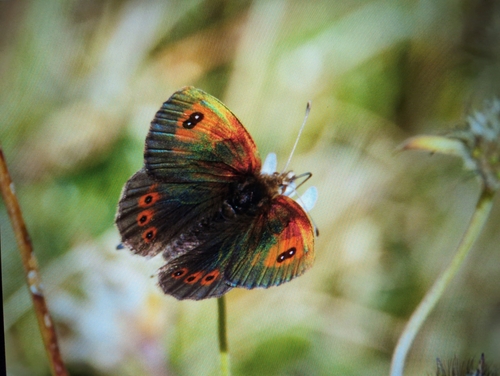
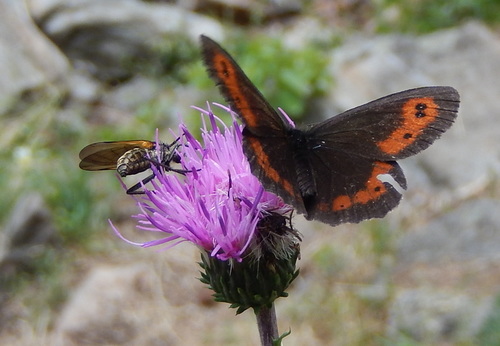
Erebia pandrose, the dewy ringlet, is a member of the subfamily Satyrinae of the family Nymphalidae. It is found from the Arctic areas of northern Europe, the Pyrenees, Alps, the Apennine Mountains, the Carpathian Mountains, Kola Peninsula and Kanin Peninsula, part of the Ural and the Altai and Sayan Mountains up to Mongolia.

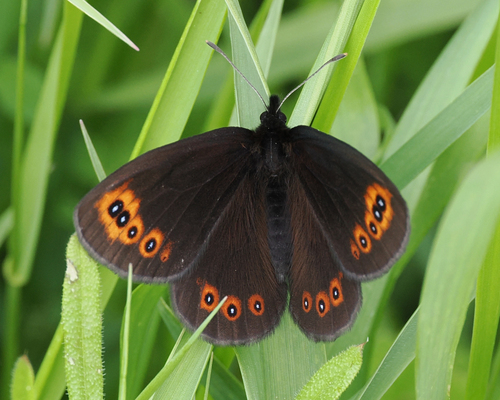
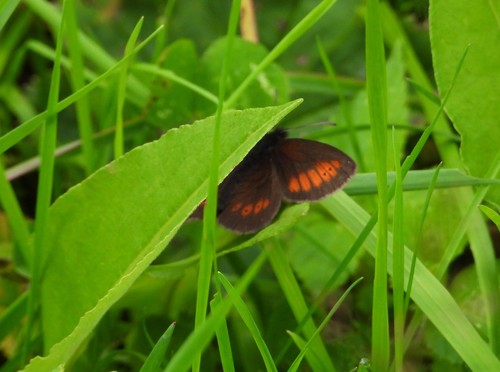
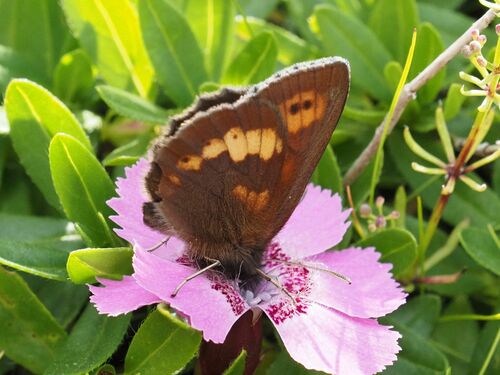
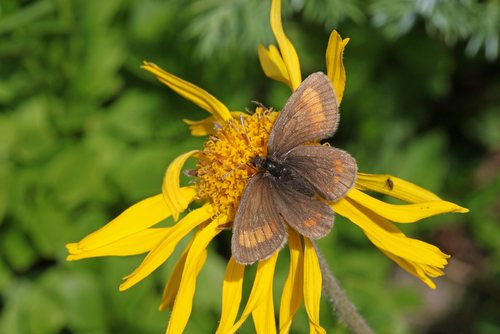
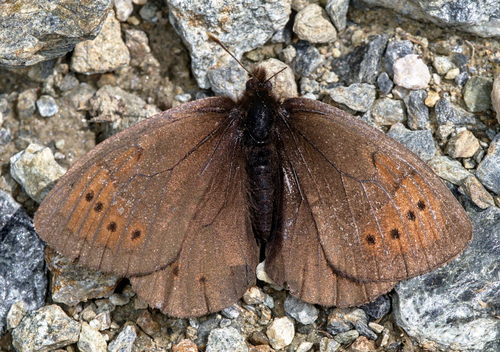
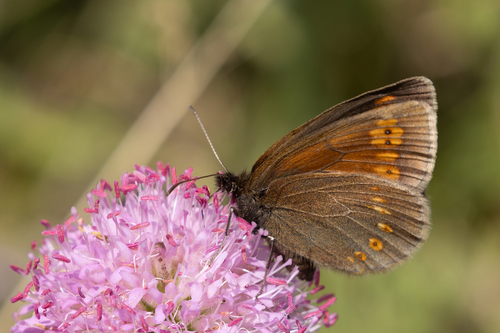
The wingspan is 30–38 mm. The forewing upperside ground colour is brown adorned with an orange postmedian band interspersed by the veins and marked with a line of blind black ocelli. The hind wing upperside has line of discrete orange spots each centered with a blind black ocella.

The underside of the forewings is copper orange with a line of blind black ocelli, the hindwing undersides are mottled beige grey and brown with a lighter broad band. E. lappona Esp. (= manto Frr., zilia Bkh.) (37 i). Upperside of both wings black-brown, somewhat glossy, the ground-colour of the female lighter, more grey-brown. The forewing with a rather broad russet brown band which does not reach the hindmargin and bears 4 black ocelli without pupils, the 2 upper ones standing close together and being somewhat shifted proximad. The band is not always equally... Wikipedia →
Global Distribution

Parks Where Found

# Park Country Daily sighting probability
1 Vanoise National Park 🇫🇷 France
~20%
2 Hohe Tauern National Park 🇦🇹 Austria
~10%
3 Mercantour National Park 🇫🇷 France
~10%
4 Triglav National Park 🇸🇮 Slovenia
~10%

Before you go

What are the chances of seeing a Dewy Ringlet in Hohe Tauern National Park?

With luck

About 10% of wildlife watchers report a Dewy Ringlet sighting in Hohe Tauern National Park on a given day, based on 6 verified sightings from GBIF citizen-science data from 2019 to 2026. It is the 115th most-seen of the 165 insects we can rate there. Over three days the chance rises to about 30%, and over a week to about 60%, if each day is a fresh chance.

When is the best time to see a Dewy Ringlet in Hohe Tauern National Park?

June and July

In those months about 20% of wildlife watchers report a Dewy Ringlet in Hohe Tauern National Park on a given day, against under 5% in February–May and August–October, the lowest months. December has too few records to rate.

What time of day is best to see a Dewy Ringlet?

Between 9 am and noon

Across all the parks we cover, that three-hour window holds the most Dewy Ringlet sightings with a recorded time, and about 9 in 10 of them come between 6 am and 6 pm: it is a daytime animal.

Is Hohe Tauern National Park the best place to see a Dewy Ringlet?

2nd of 4

Of the 4 parks where we can rate Dewy Ringlet sightings, Hohe Tauern National Park ranks 2nd at about 10%. The best odds are in Vanoise National Park (France, about 20%).

Which relatives of the Dewy Ringlet live in Hohe Tauern National Park?

Same genus: Erebia

The closest relatives of the Dewy Ringlet that you can see in Hohe Tauern National Park (genus Erebia, Alpines) are Almond Ringlet (about 20%), Common Brassy Ringlet (about 20%) and Large Ringlet (about 10%), with each one's daily chance of a sighting.

Where does the Dewy Ringlet sighting chance come from?

GBIF citizen-science records

It is estimated from how often the Dewy Ringlet is recorded against all the insects logged in Hohe Tauern National Park (6 verified sightings from 2019 to 2026), calibrated against known sighting rates. Figures are rounded to the nearest 10% because citizen-science data supports honest approximations, not decimals, and months with records from fewer than five people show "—". How it works.

← Back to Hohe Tauern National Park