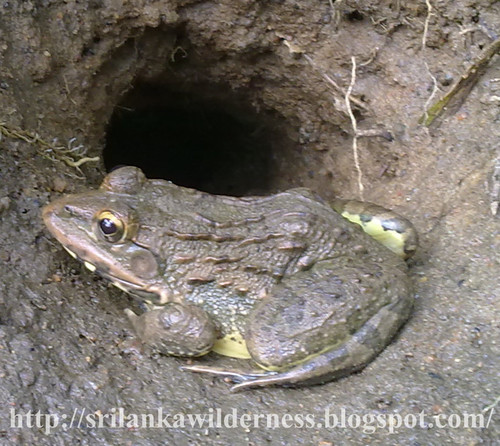
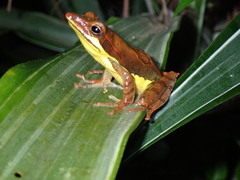
Saddled Tree frog

Saddled Tree frog

Taruga eques

Silhouette: Jose Carlos Arenas-Monroy · PhyloPic

LCNTVUENEndangeredCR Endemic
Daily sighting probability ~30% · Possible
at Horton Plains National Park

In 3 days ~70% in a week ~90%

41 Verified sightings at Horton Plains National Park From 2019 to 2026
41 In 1 park
November Best month
☀️🌙 Day & Night When it's spotted

About the Saddled Tree frog

Taruga eques (common names: Günther's whipping frog, Spurred Tree-frog, Montane Hour-glass Tree-frog) is a species of tree frog in the family Rhacophoridae. It is endemic to the central hills of Sri Lanka. Taruga eques is a species of tree frog in the Rhacophoridae family, commonly known as shrub or flying frogs. The species was first described in 1858 by Albert Günther, who named the species Polypedates eques. In 1882, George Albert Boulenger described the species as Rhacophorus eques. Ernst Ahl upheld this classification in 1931 when he described the species as Rhacophorus (Rhacophorus) eques. In 1957, Kirtisinghe reclassified the species as Rhacophorus cruciger eques, and in 1992, the species was renamed again to Polypedates eques by Kelum Manamendra-Arachchi and Sushil Kumar Dutta. In 2010, the Taruga genus was established by a team led by Madhava Meegaskumbura, resulting in the species being renamed to Taruga eques. This reclassification was upheld in 2024 with the name Polypedates (Taruga) eques. The species is known colloquially as the Spurred Tree-frog, Gunther's Whipping Frog, and the Montane Hour-glass Tree-frog.

The genus Taruga is considered... Wikipedia →

Sounds

Recording0:13

Sri Lanka · 2009

© probreviceps · iNaturalist · CC BY-NC 4.0

Global Distribution

Parks Where Found

# Park Country Daily sighting probability
1 Horton Plains National Park 🇱🇰 Sri Lanka
~30%

More parks will be added in future updates.

Before you go

What are the chances of seeing a Saddled Tree frog in Horton Plains National Park?

Possible

About 30% of wildlife watchers report a Saddled Tree frog sighting in Horton Plains National Park on a given day, based on 41 verified sightings from GBIF citizen-science data from 2019 to 2026. Over three days the chance rises to about 70%, and over a week to about 90%, if each day is a fresh chance.

When is the best time to see a Saddled Tree frog in Horton Plains National Park?

November

In that month about 50% of wildlife watchers report a Saddled Tree frog in Horton Plains National Park on a given day, against about 20% in June, the lowest month. That is one of Horton Plains National Park's wettest months, with about 350 mm of rain against 80 mm in March.

What time of day is best to see a Saddled Tree frog?

Between 7 and 10 pm

Across all the parks we cover, that three-hour window holds the most Saddled Tree frog sightings with a recorded time, and about 6 in 10 of them come between 6 am and 6 pm: it is seen both by day and at night.

Where else can you see a Saddled Tree frog?

Only Horton Plains National Park, in our data

Horton Plains National Park is the only park on Wallace's Line with enough records to rate Saddled Tree frog sightings: about 30% of wildlife watchers there report one on a given day.

Where does the Saddled Tree frog sighting chance come from?

GBIF citizen-science records

It is estimated from how often the Saddled Tree frog is recorded against all the amphibians logged in Horton Plains National Park (41 verified sightings from 2019 to 2026), calibrated against known sighting rates. Figures are rounded to the nearest 10% because citizen-science data supports honest approximations, not decimals, and months with records from fewer than five people show "—". How it works.

← Back to Horton Plains National Park