Common Giant Plated Lizard

Common Giant Plated Lizard

Matobosaurus validus

Silhouette: Beth Reinke · PhyloPic

LCLeast ConcernNTVUENCR
Daily sighting probability ~30% · Possible
at Hwange National Park

In 3 days ~70% in a week ~90%

11 Verified sightings at Hwange National Park From 2019 to 2026
254 In all 3 parks
March Best month
☀️ Diurnal When it's spotted

About the Common Giant Plated Lizard

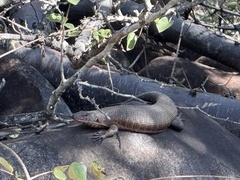
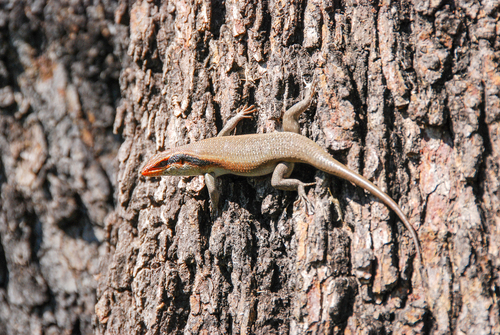
The giant plated lizard (Matobosaurus validus) is a lizard in the family Gerrhosauridae, which is found in dry to mesic habitats of southern Africa. They are wary and stay close to their rocky retreats. A large lizard with a flattened head and body with a total length of up to 69 cm (27 in) or even 75 cm (29.5 in) and a snout-vent length (SVL) of 28 cm (11 in). The soles of the feet have black rubber-like balls, an adaptation to living on rock outcrops. It is called the plated lizard because of the platelike scales on the back. This lizard is very shy and hard to approach. When threatened, it will jam itself into rock crevices (aided by its flattened body) and inflate with air, making it impossible to extricate it.

It is omnivorous, consuming a fair amount of plant matter in addition to insects and even baby tortoises. It also tends to form loose colonies. Wikipedia →

Global Distribution

Parks Where Found

# Park Country Daily sighting probability
1 Gonarezhou National Park 🇿🇼 Zimbabwe
~30%
2 Hwange National Park 🇿🇼 Zimbabwe
~30%
3 Kruger National Park 🇿🇦 South Africa
~30%

Zoos & Centres Where Found

# Zoo / Centre Country
1 Pairi Daiza 🇧🇪 Belgium In captivity
2 National Zoological Park 🇺🇸 United States In captivity
3 Zürich Zoo 🇨🇭 Switzerland In captivity
4 California Academy of Sciences 🇺🇸 United States In captivity
5 North Carolina Zoo 🇺🇸 United States In captivity
6 Oakland Zoo 🇺🇸 United States In captivity
7 National Zoological Garden of South Africa 🇿🇦 South Africa In captivity
8 Detroit Zoo 🇺🇸 United States In captivity
9 Oklahoma City Zoo and Botanical Garden 🇺🇸 United States In captivity
10 Berlin Zoological Garden 🇩🇪 Germany In captivity
11 Oregon Zoo 🇺🇸 United States In captivity
12 Reptile Gardens 🇺🇸 United States In captivity
13 Montecasino Bird Gardens 🇿🇦 South Africa In captivity
14 Hartbeespoort Dam Snake and Animal Park 🇿🇦 South Africa In captivity
15 Aquarium Berlin 🇩🇪 Germany In captivity
16 Exotic Animal World 🇿🇦 South Africa In captivity

Before you go

What are the chances of seeing a Common Giant Plated Lizard in Hwange National Park?

Possible

About 30% of wildlife watchers report a Common Giant Plated Lizard sighting in Hwange National Park on a given day, based on 11 verified sightings from GBIF citizen-science data from 2019 to 2026. It is the 5th most-seen of the 8 reptiles we can rate there. Over three days the chance rises to about 70%, and over a week to about 90%, if each day is a fresh chance.

When is the best time to see a Common Giant Plated Lizard in Hwange National Park?

March and May

In those months about 50% of wildlife watchers report a Common Giant Plated Lizard in Hwange National Park on a given day, against under 5% in February, June–August and December, the lowest months.

What time of day is best to see a Common Giant Plated Lizard?

Between 8 and 11 am

Across all the parks we cover, that three-hour window holds the most Common Giant Plated Lizard sightings with a recorded time, and about 9 in 10 of them come between 6 am and 6 pm: it is a daytime animal.

Is Hwange National Park the best place to see a Common Giant Plated Lizard?

Among the best

Of the 3 parks where we can rate Common Giant Plated Lizard sightings, Hwange National Park ranks 2nd at about 30%, level with the leaders once rounded. The best odds are in Gonarezhou National Park (Zimbabwe, about 30%).

Where does the Common Giant Plated Lizard sighting chance come from?

GBIF citizen-science records

It is estimated from how often the Common Giant Plated Lizard is recorded against all the reptiles logged in Hwange National Park (11 verified sightings from 2019 to 2026), calibrated against known sighting rates. Figures are rounded to the nearest 10% because citizen-science data supports honest approximations, not decimals, and months with records from fewer than five people show "—". How it works.

← Back to Hwange National Park