Edible bullfrog

Edible bullfrog

Pyxicephalus edulis

Silhouette: Jose Carlos Arenas-Monroy · PhyloPic

LCLeast ConcernNTVUENCR
Daily sighting probability ~20% · Possible
at Hwange National Park

In 3 days ~50% in a week ~80%

6 Verified sightings at Hwange National Park From 2019 to 2026
102 In all 4 parks
January Best month
🌅 Crepuscular When it's spotted

About the Edible bullfrog

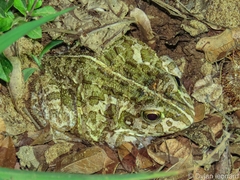
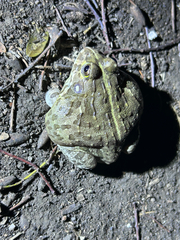
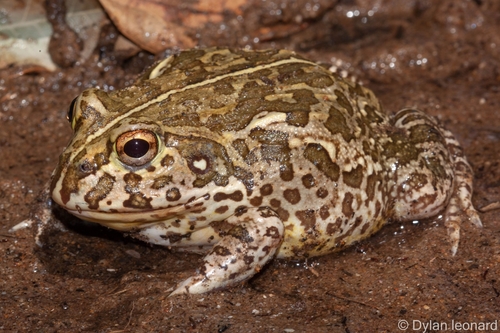
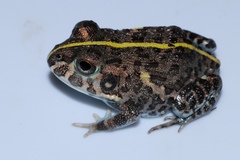
The edible bullfrog (Pyxicephalus edulis), also known as the pixie frog, lesser bullfrog or Peter's bullfrog, is a large-bodied African species of frog in the family Pyxicephalidae. The edible bullfrog is a large bodied frog in which the males typically reach 8.3–12 cm (3.3–4.7 in) in snout–to–vent length and the females 8.5–11 cm (3.3–4.3 in). Exceptionally large males may even reach 13.8 cm (5.4 in), although the species does not approach the sizes attained by the related African bullfrog (P. adspersus). The females of the edible bullfrog are much less bulky than the males and typically reach just half of the weight of the males. There are two tooth like structures in the lower jaw of the broad mouth bears which point upwards. The skin of the edible bullfrog has slight, rather rounded warts. It has short lateral ridges which never stretch all the way from the head to the end of the body, their form changes considerably as the frog grows. The young frogs are quite sturdy and look almost plump but the adults show dorsoventral flattening. As the frogs grow their eyes become more centrally placed, and the eyes of adults are very protruding. They show a distinct tympanum... Wikipedia →

Sounds

Recording0:11

Zimbabwe · 2024

© Nick Helme · iNaturalist · CC BY-NC 4.0

Global Distribution

Parks Where Found

# Park Country Daily sighting probability
1 Hwange National Park 🇿🇼 Zimbabwe
~20%
2 uMkhuze Game Reserve 🇿🇦 South Africa
~20%
3 Kruger National Park 🇿🇦 South Africa
~10%
4 iSimangaliso Wetland Park 🇿🇦 South Africa
~10%

Cities Where Found

# City Country Daily sighting probability
1 Maputo 🇲🇿 Mozambique
~30%

Zoos & Centres Where Found

# Zoo / Centre Country
1 Budapest Zoo & Botanical Garden 🇭🇺 Hungary In captivity

Before you go

What are the chances of seeing an Edible bullfrog in Hwange National Park?

Possible

About 20% of wildlife watchers report an Edible bullfrog sighting in Hwange National Park on a given day, based on 6 verified sightings from GBIF citizen-science data from 2019 to 2026. Over three days the chance rises to about 50%, and over a week to about 80%, if each day is a fresh chance.

When is the best time to see an Edible bullfrog in Hwange National Park?

January

In that month about 60% of wildlife watchers report an Edible bullfrog in Hwange National Park on a given day, against under 5% in February–March and May–November, the lowest months. That is one of Hwange National Park's wettest months, with about 150 mm of rain against almost none in July.

What time of day is best to see an Edible bullfrog?

Between 7 and 10 pm

Across all the parks we cover, that three-hour window holds the most Edible bullfrog sightings with a recorded time, and about half of them come between 6 pm and 6 am: it is most active around dawn and dusk.

Is Hwange National Park the best place to see an Edible bullfrog?

Yes

Of the 4 parks where we can rate Edible bullfrog sightings, Hwange National Park has the highest daily chance: about 20%. Next come uMkhuze Game Reserve (South Africa, about 20%) and Kruger National Park (South Africa, about 10%).

Where does the Edible bullfrog sighting chance come from?

GBIF citizen-science records

It is estimated from how often the Edible bullfrog is recorded against all the amphibians logged in Hwange National Park (6 verified sightings from 2019 to 2026), calibrated against known sighting rates. Figures are rounded to the nearest 10% because citizen-science data supports honest approximations, not decimals, and months with records from fewer than five people show "—". How it works.
← Back to Hwange National Park