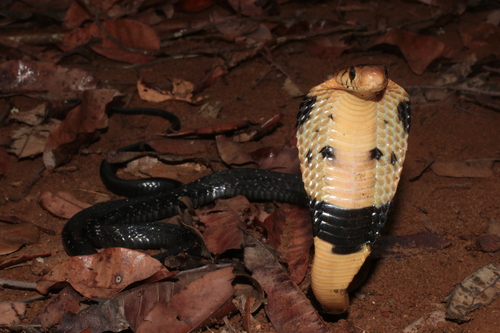
Gaboon Adder

Gaboon Adder

Bitis gabonica

Silhouette: Steven Traver · PhyloPic

LCNTVUVulnerableENCR
Daily sighting probability ~10% · With luck
at iSimangaliso Wetland Park

In 3 days ~20% in a week ~40%

7 Verified sightings at iSimangaliso Wetland Park From 2019 to 2026
7 In 1 park
May Best month
☀️ Diurnal When it's spotted

About the Gaboon Adder

The Gaboon viper (Bitis gabonica), also called the Gaboon adder, is a large and highly venomous species of viper found in the rainforests and savannas of sub-Saharan Africa. It is the largest member of the genus Bitis. Like all other vipers, it is venomous, and it has the longest fangs of any venomous snake – up to 2 inches (5.1 cm) in length – and the highest venom yield of any snake. No subspecies are recognized.

The Gaboon viper was described in 1854 as Echidna gabonica. According to their research, these two subspecies are as genetically different from each other as they are from B. nasicornis. Consequently, they regard the western form as a separate species, B. rhinoceros.

The snake's common names include Gaboon viper, butterfly adder, forest puff adder, whisper, swampjack, and Gaboon adder. Originally a name given by the Portuguese, Gabon (Gabão) refers to the estuary on which the town of Libreville was built, in Gabon, and to a narrow strip of territory on either bank of this arm of the sea. As of 1909, Gaboon referred... Wikipedia →

Global Distribution

Parks Where Found

# Park Country Daily sighting probability
1 iSimangaliso Wetland Park 🇿🇦 South Africa
~10%

More parks will be added in future updates.

Zoos & Centres Where Found

# Zoo / Centre Country
1 San Diego Zoo 🇺🇸 United States In captivity
2 Prague Zoo 🇨🇿 Czechia In captivity
3 National Zoological Park 🇺🇸 United States In captivity
4 Leipzig Zoological Garden 🇩🇪 Germany In captivity
5 Cabarceno Natural Park 🇪🇸 Spain In captivity
6 Réserve africaine de Sigean 🇫🇷 France In captivity
7 Toronto Zoo 🇨🇦 Canada In captivity
8 Bronx Zoo 🇺🇸 United States In captivity
9 Sedgwick County Zoo 🇺🇸 United States In captivity
10 Los Angeles Zoo 🇺🇸 United States In captivity
11 Toledo Zoo 🇺🇸 United States In captivity
12 Jacksonville Zoo and Gardens 🇺🇸 United States In captivity
13 Central Florida Zoo and Botanical Gardens 🇺🇸 United States In captivity
14 Louisville Zoo 🇺🇸 United States In captivity
15 Saint Louis Zoo 🇺🇸 United States In captivity
16 Zoologischer Garten Leipzig 🇩🇪 Germany In captivity
17 Fort Worth Zoo 🇺🇸 United States In captivity
18 Indianapolis Zoo 🇺🇸 United States In captivity
19 Houston Zoo 🇺🇸 United States In captivity
20 Cameron Park Zoo 🇺🇸 United States In captivity
21 Philadelphia Zoo 🇺🇸 United States In captivity
22 Zoo Atlanta 🇺🇸 United States In captivity
23 Budapest Zoo & Botanical Garden 🇭🇺 Hungary In captivity
24 Faunia 🇪🇸 Spain In captivity
25 Crocworld Conservation Centre 🇿🇦 South Africa In captivity
26 Zagreb Zoo 🇭🇷 Croatia In captivity
27 Ménagerie du Jardin des Plantes 🇫🇷 France In captivity
28 Chattanooga Zoo at Warner Park 🇺🇸 United States In captivity
29 Universeum 🇸🇪 Sweden In captivity
30 Aquarium of Gijón 🇪🇸 Spain In captivity
31 Terrariet 🇩🇰 Denmark In captivity
32 Rákosův pavilon 🇨🇿 Czechia In captivity
33 Velemlokárium 🇨🇿 Czechia In captivity
34 Città della Domenica 🇮🇹 Italy In captivity
35 Wolfgang-Köhler-Primaten-Forschungszentrum 🇩🇪 Germany In captivity

Before you go

What are the chances of seeing a Gaboon Adder in iSimangaliso Wetland Park?

With luck

About 10% of wildlife watchers report a Gaboon Adder sighting in iSimangaliso Wetland Park on a given day, based on 7 verified sightings from GBIF citizen-science data from 2019 to 2026. It is the 36th most-seen of the 43 reptiles we can rate there. Over three days the chance rises to about 20%, and over a week to about 40%, if each day is a fresh chance.

When is the best time to see a Gaboon Adder in iSimangaliso Wetland Park?

May

In that month about 20% of wildlife watchers report a Gaboon Adder in iSimangaliso Wetland Park on a given day, against under 5% in February, June and August–December, the lowest months.

What time of day is best to see a Gaboon Adder?

Between 8 and 11 am

Across all the parks we cover, that three-hour window holds the most Gaboon Adder sightings with a recorded time, and about 8 in 10 of them come between 6 am and 6 pm: it is a daytime animal.

Where else can you see a Gaboon Adder?

Only iSimangaliso Wetland Park, in our data

iSimangaliso Wetland Park is the only park on Wallace's Line with enough records to rate Gaboon Adder sightings: about 10% of wildlife watchers there report one on a given day.

Where does the Gaboon Adder sighting chance come from?

GBIF citizen-science records

It is estimated from how often the Gaboon Adder is recorded against all the reptiles logged in iSimangaliso Wetland Park (7 verified sightings from 2019 to 2026), calibrated against known sighting rates. Figures are rounded to the nearest 10% because citizen-science data supports honest approximations, not decimals, and months with records from fewer than five people show "—". How it works.

← Back to iSimangaliso Wetland Park