Southern Tree Agama

Southern Tree Agama

Acanthocercus atricollis

Silhouette: Michael Scroggie · PhyloPic

LCLeast ConcernNTVUENCR
Daily sighting probability ~20% · Possible
at iSimangaliso Wetland Park

In 3 days ~50% in a week ~80%

58 Verified sightings at iSimangaliso Wetland Park From 2019 to 2026
634 In all 5 parks
May Best month
☀️ Diurnal When it's spotted

About the Southern Tree Agama

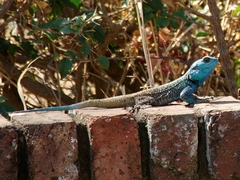
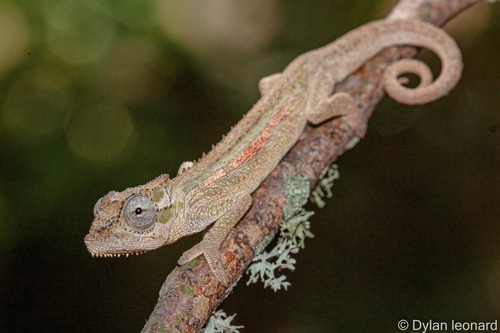
Acanthocercus atricollis, the black-necked agama or southern tree agama, is a species of tree agama that is native to East, Central and southern Africa. Its largest continuous range is in southeastern Africa, and it occurs at high densities in the Kruger National Park.

The sexes have a comparable snout-to-vent length (SVL) and have similar tail lengths. Mature males have somewhat larger heads than females, which is deemed to be an adaptation for intraspecific competition for territory. Females reach sexual maturity when about 96 mm (3.8 in) long (SVL) and males from about 82 mm (3.2 in) (SVL).

They form structured colonies with a dominant male, several females and juveniles. The males defend territories and engage in combat. Although mostly diurnal, they sometimes exhibit nocturnal activity. It adapts readily to the vicinity of human habitation. They are classic ambush foragers which spend only some 4% of their time moving. This involves an average of less than one movement in two minutes. When stationary, the adults position themselves on lateral branches (42% of the time), on tree trunks (35%), or occasionally on the ground (23%).

Acanthocercus a... Wikipedia →

Global Distribution

Parks Where Found

# Park Country Daily sighting probability
1 uMkhuze Game Reserve 🇿🇦 South Africa
~40%
2 Kruger National Park 🇿🇦 South Africa
~40%
3 Hluhluwe-Imfolozi Park 🇿🇦 South Africa
~30%
4 iSimangaliso Wetland Park 🇿🇦 South Africa
~20%
5 Pilanesberg National Park 🇿🇦 South Africa
~10%

Cities Where Found

# City Country Daily sighting probability
1 Maputo 🇲🇿 Mozambique
~60%
2 Durban 🇿🇦 South Africa
~30%
3 Harare 🇿🇼 Zimbabwe
~30%

Zoos & Centres Where Found

# Zoo / Centre Country
1 Chimp Eden 🇿🇦 South Africa In captivity
2 Touroparc Zoo 🇫🇷 France In captivity

Closest Relatives at iSimangaliso Wetland Park

No species of the same family or order lives in iSimangaliso Wetland Park, so these are its closest relatives here: other reptiles.

Before you go

What are the chances of seeing a Southern Tree Agama in iSimangaliso Wetland Park?

Possible

About 20% of wildlife watchers report a Southern Tree Agama sighting in iSimangaliso Wetland Park on a given day, based on 58 verified sightings from GBIF citizen-science data from 2019 to 2026. It is the 11th most-seen of the 43 reptiles we can rate there. Over three days the chance rises to about 50%, and over a week to about 80%, if each day is a fresh chance.

When is the best time to see a Southern Tree Agama in iSimangaliso Wetland Park?

May and October

In those months about 30% of wildlife watchers report a Southern Tree Agama in iSimangaliso Wetland Park on a given day, against about 10% in February and July, the lowest months.

What time of day is best to see a Southern Tree Agama?

Between 10 am and 1 pm

Across all the parks we cover, that three-hour window holds the most Southern Tree Agama sightings with a recorded time, and about 9 in 10 of them come between 6 am and 6 pm: it is a daytime animal.

Is iSimangaliso Wetland Park the best place to see a Southern Tree Agama?

4th of 5

Of the 5 parks where we can rate Southern Tree Agama sightings, iSimangaliso Wetland Park ranks 4th at about 20%. The best odds are in uMkhuze Game Reserve (South Africa, about 40%), Kruger National Park (South Africa, about 40%) and Hluhluwe-Imfolozi Park (South Africa, about 30%).

Where does the Southern Tree Agama sighting chance come from?

GBIF citizen-science records

It is estimated from how often the Southern Tree Agama is recorded against all the reptiles logged in iSimangaliso Wetland Park (58 verified sightings from 2019 to 2026), calibrated against known sighting rates. Figures are rounded to the nearest 10% because citizen-science data supports honest approximations, not decimals, and months with records from fewer than five people show "—". How it works.

← Back to iSimangaliso Wetland Park