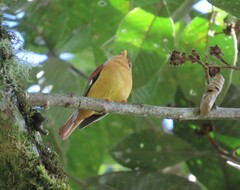
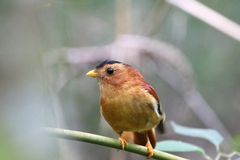
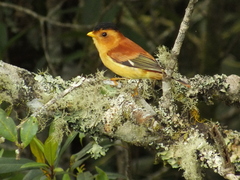
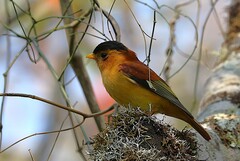
Black-capped Piprites

Black-capped Piprites

Piprites pileata

Silhouette: Emily Willoughby · PhyloPic

LCNTNear ThreatenedVUENCR
Daily sighting probability ~10% · With luck
at Itatiaia National Park

In 3 days ~30% in a week ~60%

209 Verified sightings at Itatiaia National Park From 2019 to 2026
209 In 1 park
August Best month
☀️ Diurnal When it's spotted

About the Black-capped Piprites

The black-capped piprites (Piprites pileata), also known as the black-capped manakin, bailarín castaño, or piprites capirotado, is a species of suboscine passerine. It has been placed in the genus Piprites, part of the Tyrannidae family. Previously, the species was included in the family Pipridae, but was reclassified following genetic studies.

It is found in the Atlantic Forest, especially in regions where Araucaria angustifolia are found, in the highlands of southeastern Brazil and northeastern Argentina. Until the recent rediscovery in Argentina, the only confirmed record there was a specimen taken in 1959. It is considered as rare and its population is in decline; it is considered vulnerable by BirdLife International. It is known from a number of protected areas, including the Itatiaia National Park in Rio de Janeiro, and Campos do Jordão State Park in São Paulo.

The black-capped piprites is distributed unevenly in the southeastern region of Brazil (south of Minas Gerais and the state of Rio de Janeiro) and in the extreme northeast of Argentina, in the province of Misiones. The species is found in the canopy and subcanopy around the edge of the Atlantic... Wikipedia →

Sounds

Song0:43

Brazil · 2025

© Ricardo José Mitidieri · XC978398 · CC BY-NC-SA 4.0

Canto0:19

Brazil · 2019

© Caio Brito · XC556513 · CC BY-NC-SA 4.0

Call0:48

Brazil · 2002

© Jeremy Minns · XC81686 · CC BY-NC-SA 3.0

Global Distribution

Parks Where Found

# Park Country Daily sighting probability
1 Itatiaia National Park 🇧🇷 Brazil
~10%

More parks will be added in future updates.

Before you go

What are the chances of seeing a Black-capped Piprites in Itatiaia National Park?

With luck

About 10% of wildlife watchers report a Black-capped Piprites sighting in Itatiaia National Park on a given day, based on 209 verified sightings from GBIF citizen-science data from 2019 to 2026. It is the 144th most-seen of the 352 birds we can rate there. Over three days the chance rises to about 30%, and over a week to about 60%, if each day is a fresh chance.

When is the best time to see a Black-capped Piprites in Itatiaia National Park?

June to August

In those months about 20% of wildlife watchers report a Black-capped Piprites in Itatiaia National Park on a given day, against under 5% in February and December, the lowest months. Those are among Itatiaia National Park's driest months, with about 50 mm of rain a month against 330 mm in December.

What time of day is best to see a Black-capped Piprites?

Between 8 and 11 am

Across all the parks we cover, that three-hour window holds the most Black-capped Piprites sightings with a recorded time, and about 9 in 10 of them come between 6 am and 6 pm: it is a daytime animal.

Where else can you see a Black-capped Piprites?

Only Itatiaia National Park, in our data

Itatiaia National Park is the only park on Wallace's Line with enough records to rate Black-capped Piprites sightings: about 10% of wildlife watchers there report one on a given day.

Which relatives of the Black-capped Piprites live in Itatiaia National Park?

Same family: Cotingidae

The closest relatives of the Black-capped Piprites that you can see in Itatiaia National Park (family Cotingidae, Cotingas) are Chestnut-crowned Becard (about 30%), Greenish Schiffornis (about 20%) and Black-and-gold Cotinga (about 20%), with each one's daily chance of a sighting.

Where does the Black-capped Piprites sighting chance come from?

GBIF citizen-science records

It is estimated from how often the Black-capped Piprites is recorded against all the birds logged in Itatiaia National Park (209 verified sightings from 2019 to 2026), calibrated against known sighting rates. Figures are rounded to the nearest 10% because citizen-science data supports honest approximations, not decimals, and months with records from fewer than five people show "—". How it works.

← Back to Itatiaia National Park