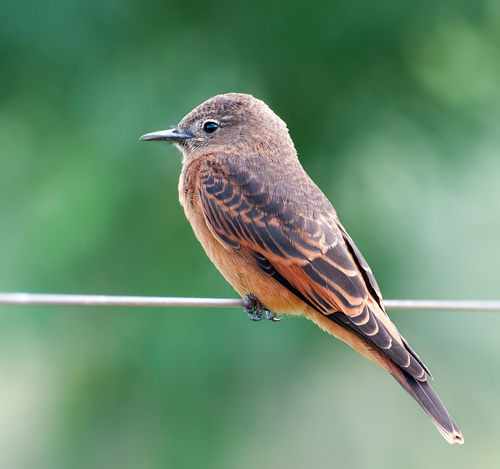
Serra do Mar Tyrant-Manakin

Serra do Mar Tyrant-Manakin

Neopelma chrysolophum

Silhouette: Edwin Price · PhyloPic

LCLeast ConcernNTVUENCR
Daily sighting probability ~20% · Possible
at Itatiaia National Park

In 3 days ~40% in a week ~70%

252 Verified sightings at Itatiaia National Park From 2019 to 2026
252 In 1 park
May Best month
☀️ Diurnal When it's spotted

About the Serra do Mar Tyrant-Manakin

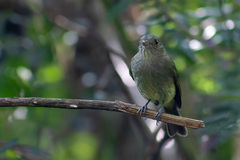
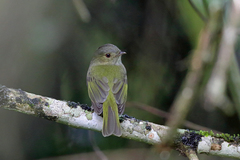
The Serra do Mar tyrant-manakin (Neopelma chrysolophum), also known as the Serra do Mar neopelma and Serra tyrant-manakin, is a species of bird in the family Pipridae, the manakins. It is endemic to Brazil. The Serra do Mar tyrant-manakin was originally described in 1944 as a subspecies of Wied's tyrant-manakin (Neopelma aurifrons). They were separated based on a study published in 1995.

The Serra do Mar tyrant-manakin's further taxonomy is unsettled. Worldwide taxonomic systems assign it to genus Neopelma. However, the independent South American Classification Committee follows the recommendation of a paper published in 2023 and assigns it to its own genus, Protopelma.

The Serra do Mar tyrant-manakin is monotypic. The Serra do Mar tyrant-manakin is 13 to 13.5 cm (5.1 to 5.3 in) long and weighs 13.5 to 14.9 g (0.48 to 0.53 oz). The sexes have the same plumage. Adults have a conspicuous yellow patch in the middle of the crown. The rest of their face, their upperparts, wings, and tail are olive-green. Their throat is dull grayish white, their upper breast grayish olive, and their lower breast and belly pale sulphur-yellow. They have a pale... Wikipedia →

Sounds

Song0:24

Brazil · 2021

© Ricardo José Mitidieri · XC688732 · CC BY-NC-SA 4.0

Call0:10

Brazil · 2019

© Marcelo J Feliti · XC494958 · CC BY-NC-SA 4.0

Song0:09

Brazil · 2019

© Ricardo Gagliardi · XC470835 · CC BY-NC-SA 4.0

Global Distribution

Parks Where Found

# Park Country Daily sighting probability
1 Itatiaia National Park 🇧🇷 Brazil
~20%

More parks will be added in future updates.

Before you go

What are the chances of seeing a Serra do Mar Tyrant-Manakin in Itatiaia National Park?

Possible

About 20% of wildlife watchers report a Serra do Mar Tyrant-Manakin sighting in Itatiaia National Park on a given day, based on 252 verified sightings from GBIF citizen-science data from 2019 to 2026. It is the 128th most-seen of the 352 birds we can rate there. Over three days the chance rises to about 40%, and over a week to about 70%, if each day is a fresh chance.

When is the best time to see a Serra do Mar Tyrant-Manakin in Itatiaia National Park?

May

In that month about 40% of wildlife watchers report a Serra do Mar Tyrant-Manakin in Itatiaia National Park on a given day, against under 5% in February, the lowest month. That is one of Itatiaia National Park's driest months, with about 70 mm of rain against 330 mm in December.

What time of day is best to see a Serra do Mar Tyrant-Manakin?

Between 9 am and noon

Across all the parks we cover, that three-hour window holds the most Serra do Mar Tyrant-Manakin sightings with a recorded time, and about 8 in 10 of them come between 6 am and 6 pm: it is a daytime animal.

Where else can you see a Serra do Mar Tyrant-Manakin?

Only Itatiaia National Park, in our data

Itatiaia National Park is the only park on Wallace's Line with enough records to rate Serra do Mar Tyrant-Manakin sightings: about 20% of wildlife watchers there report one on a given day.

Which relatives of the Serra do Mar Tyrant-Manakin live in Itatiaia National Park?

Same family: Pipridae

The closest relatives of the Serra do Mar Tyrant-Manakin that you can see in Itatiaia National Park (family Pipridae, Manakins) are Blue Manakin (about 60%) and Pin-tailed Manakin (about 10%), with each one's daily chance of a sighting.

Where does the Serra do Mar Tyrant-Manakin sighting chance come from?

GBIF citizen-science records

It is estimated from how often the Serra do Mar Tyrant-Manakin is recorded against all the birds logged in Itatiaia National Park (252 verified sightings from 2019 to 2026), calibrated against known sighting rates. Figures are rounded to the nearest 10% because citizen-science data supports honest approximations, not decimals, and months with records from fewer than five people show "—". How it works.

← Back to Itatiaia National Park