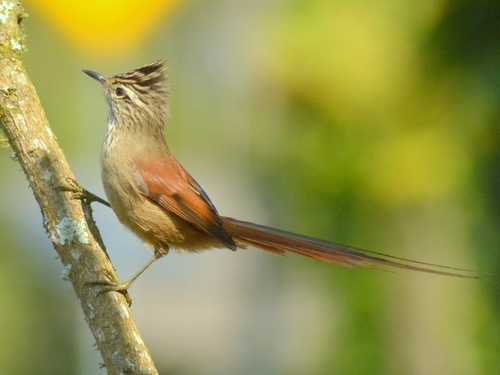
Sharp-billed Treehunter

Sharp-billed Treehunter

Heliobletus contaminatus

Silhouette: Sheatherius · PhyloPic

LCLeast ConcernNTVUENCR
Daily sighting probability ~20% · Possible
at Itatiaia National Park

In 3 days ~40% in a week ~70%

319 Verified sightings at Itatiaia National Park From 2019 to 2026
343 In all 2 parks
July Best month
☀️ Diurnal When it's spotted

About the Sharp-billed Treehunter

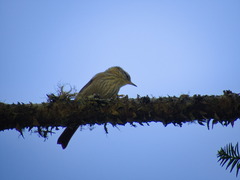
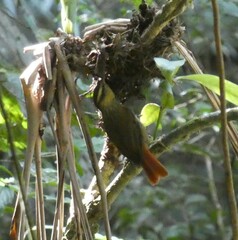
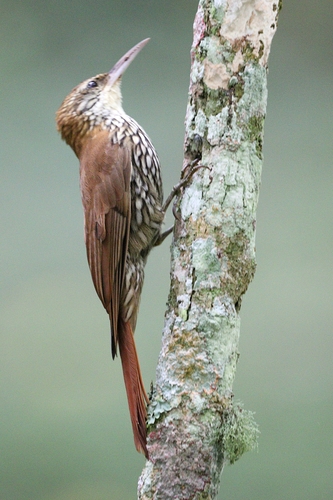
The sharp-billed treehunter (Heliobletus contaminatus), sometimes called the sharp-billed xenops, is a species of bird in the Furnariinae subfamily of the ovenbird family Furnariidae. It is found in Argentina, Brazil, Paraguay, and Uruguay.

However, there is some confusion about the subspecific epithets of the subspecies, and one or both might be changed. In recognition of that possibility, BirdLife International's Handbook of the Birds of the World gives H. c. camargoi the trinomial "Heliobletus contaminatus [new name]".

One author included genus Heliobletus within Xenops, as the sharp-billed treehunter's plumage is very similar to those of some Xenops species. Genetic data refute this treatment and find that it belongs in Heliobletus and is sister to genus Philydor.

The sharp-billed treehunter is the only member of genus Heliobletus. However, one author states that "[a]n undescribed ''Heliobletus sp. occurs in SE Bahia [Brazil]". Recordings of this undescribed taxon have been made... Wikipedia →

Sounds

Alarm call0:14

Uruguay · 2024

© Guillermo Menéndez (gmmv80) · XC894521 · CC BY-NC-SA 4.0

Song0:51

Brazil · 2017

© Rodrigo Dela Rosa · XC377520 · CC BY-NC-SA 4.0

Call0:21

Brazil · 2001

© Jeremy Minns · XC80816 · CC BY-NC-SA 3.0

Global Distribution

Parks Where Found

# Park Country Daily sighting probability
1 Itatiaia National Park 🇧🇷 Brazil
~20%
2 Serra dos Órgãos National Park 🇧🇷 Brazil
<5%

Before you go

What are the chances of seeing a Sharp-billed Treehunter in Itatiaia National Park?

Possible

About 20% of wildlife watchers report a Sharp-billed Treehunter sighting in Itatiaia National Park on a given day, based on 319 verified sightings from GBIF citizen-science data from 2019 to 2026. It is the 125th most-seen of the 352 birds we can rate there. Over three days the chance rises to about 40%, and over a week to about 70%, if each day is a fresh chance.

When is the best time to see a Sharp-billed Treehunter in Itatiaia National Park?

July

In that month about 30% of wildlife watchers report a Sharp-billed Treehunter in Itatiaia National Park on a given day, against under 5% in May and December, the lowest months. That is one of Itatiaia National Park's driest months, with about 25 mm of rain against 330 mm in December.

What time of day is best to see a Sharp-billed Treehunter?

Between 8 and 11 am

Across all the parks we cover, that three-hour window holds the most Sharp-billed Treehunter sightings with a recorded time, and about 9 in 10 of them come between 6 am and 6 pm: it is a daytime animal.

Is Itatiaia National Park the best place to see a Sharp-billed Treehunter?

Yes

Of the 2 parks where we can rate Sharp-billed Treehunter sightings, Itatiaia National Park has the highest daily chance: about 20%. Next come Serra dos Órgãos National Park (Brazil, under 5%).

Which relatives of the Sharp-billed Treehunter live in Itatiaia National Park?

Same family: Furnariidae

The closest relatives of the Sharp-billed Treehunter that you can see in Itatiaia National Park (family Furnariidae, Ovenbirds and Woodcreepers) are Olivaceous Woodcreeper (about 50%), Pallid Spinetail (about 40%) and Rufous-capped Spinetail (about 40%), with each one's daily chance of a sighting.

Where does the Sharp-billed Treehunter sighting chance come from?

GBIF citizen-science records

It is estimated from how often the Sharp-billed Treehunter is recorded against all the birds logged in Itatiaia National Park (319 verified sightings from 2019 to 2026), calibrated against known sighting rates. Figures are rounded to the nearest 10% because citizen-science data supports honest approximations, not decimals, and months with records from fewer than five people show "—". How it works.

← Back to Itatiaia National Park