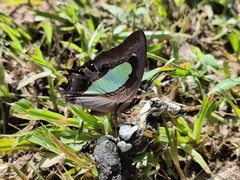
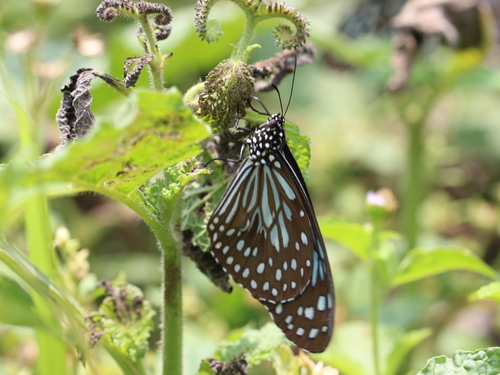
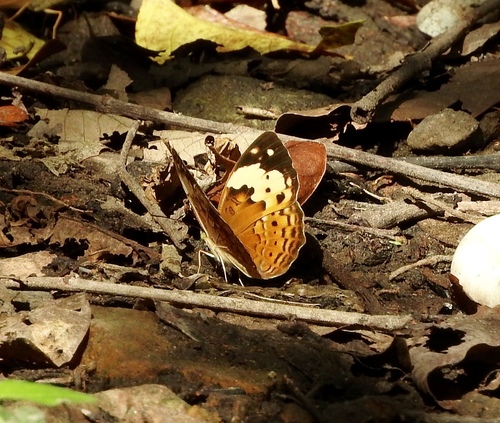
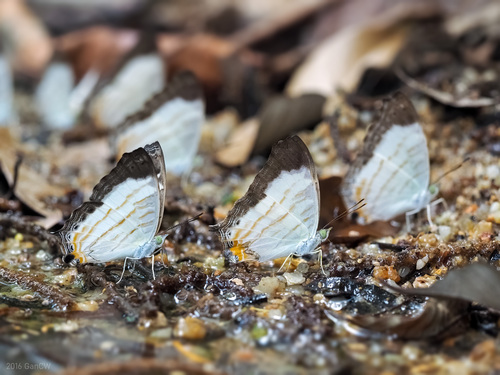
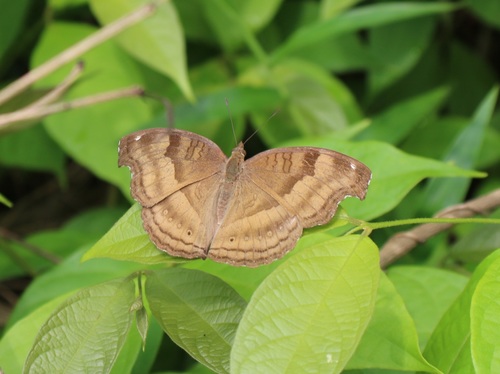
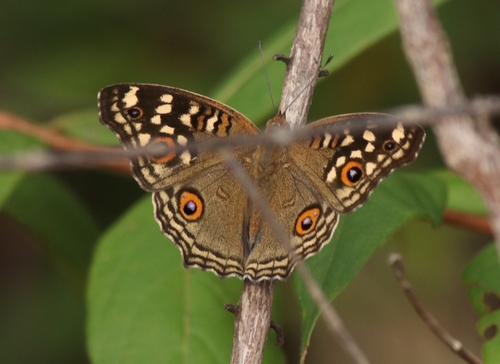
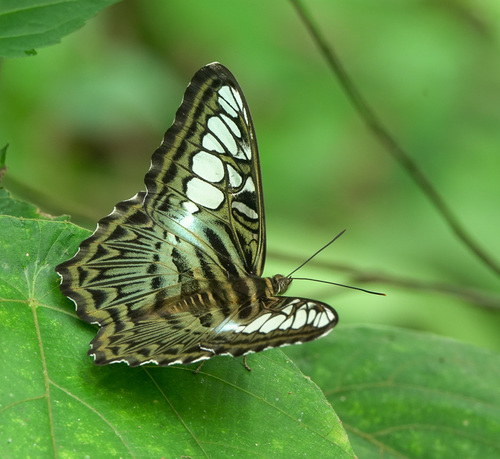
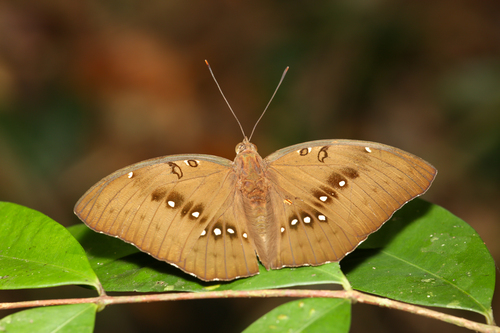
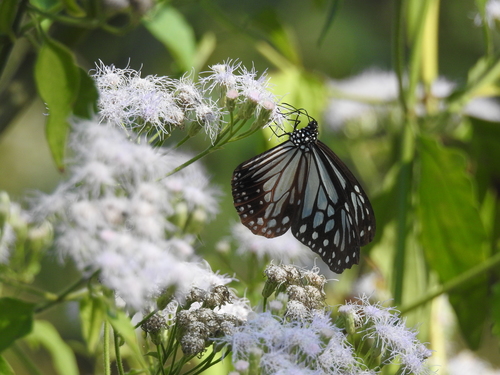
Common Nawab
Daily sighting probability ~20% · Possible
at Kaeng Krachan National Park

In 3 days ~40% in a week ~70%

40 Verified sightings at Kaeng Krachan National Park From 2019 to 2026
89 In all 5 parks
December Best month
☀️ Diurnal When it's spotted

About the Common Nawab

Polyura athamas, the common nawab, is a species of fast-flying canopy butterfly found in tropical Asia. It belongs to the Charaxinae (rajahs and nawabs) in the brush-footed butterfly family (Nymphalidae). It occurs in the Himalayas from Kashmir to Sikkim, the hills of central India and the Eastern Ghats, the Western Ghats and southern India, Sri Lanka, Assam, Cachar, and via Myanmar, Cambodia and the Tenasserim Hills far into Indonesia. In August 2016 a specimen was spotted and caught in Palawan, Philippines.

Male and female. Upperside black. Forewings and hindwings with a discal broad transverse area from below vein 4 in forewing to vein 2 on hindwing, a moderately large spot in interspace 5, a minute preapical dot beyond in interspace 6 on forewing, and a subterminal row of spots with two or three spots beyond them on the tornal angle of the hindwing, pale yellow, sometimes with an ochraceous, sometimes with a greenish tinge.

The discal area on the forewing is nearly as broad in interspace 3 as on the dorsum, on the hindwing narrowing to an acute point on vein 2 at two-thirds of its length from the base of the wing. Tails are touched with bluish grey. Underside... Wikipedia →

Global Distribution

Parks Where Found

# Park Country Daily sighting probability
1 Cuc Phuong National Park 🇻🇳 Vietnam
~30%
2 Gunung Leuser National Park 🇮🇩 Indonesia
~30%
3 Kaeng Krachan National Park 🇹🇭 Thailand
~20%
4 Taman Negara National Park 🇲🇾 Malaysia
~10%
5 Cat Tien National Park 🇻🇳 Vietnam
~10%

Cities Where Found

# City Country Daily sighting probability
1 Chattogram 🇧🇩 Bangladesh
~20%
2 Hong Kong 🇨🇳 China
~10%
3 Guangzhou 🇨🇳 China
<5%

Before you go

What are the chances of seeing a Common Nawab in Kaeng Krachan National Park?

Possible

About 20% of wildlife watchers report a Common Nawab sighting in Kaeng Krachan National Park on a given day, based on 40 verified sightings from GBIF citizen-science data from 2019 to 2026. It is the 35th most-seen of the 296 insects we can rate there. Over three days the chance rises to about 40%, and over a week to about 70%, if each day is a fresh chance.

When is the best time to see a Common Nawab in Kaeng Krachan National Park?

November and December

In those months about 30% of wildlife watchers report a Common Nawab in Kaeng Krachan National Park on a given day, against under 5% in April and September, the lowest months. Those are among Kaeng Krachan National Park's driest months, with about 65 mm of rain a month against 260 mm in September.

What time of day is best to see a Common Nawab?

Between 11 am and 2 pm

Across all the parks we cover, that three-hour window holds the most Common Nawab sightings with a recorded time, and about 9 in 10 of them come between 6 am and 6 pm: it is a daytime animal.

Is Kaeng Krachan National Park the best place to see a Common Nawab?

3rd of 5

Of the 5 parks where we can rate Common Nawab sightings, Kaeng Krachan National Park ranks 3rd at about 20%. The best odds are in Cuc Phuong National Park (Vietnam, about 30%) and Gunung Leuser National Park (Indonesia, about 30%).

Which relatives of the Common Nawab live in Kaeng Krachan National Park?

Same genus: Polyura

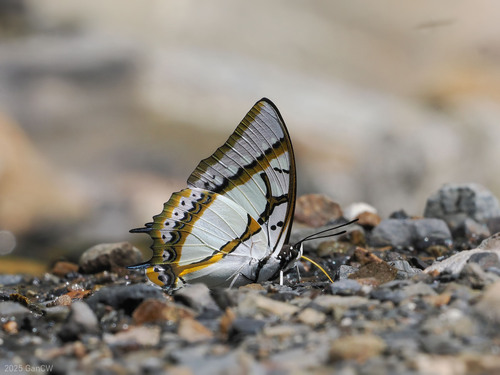
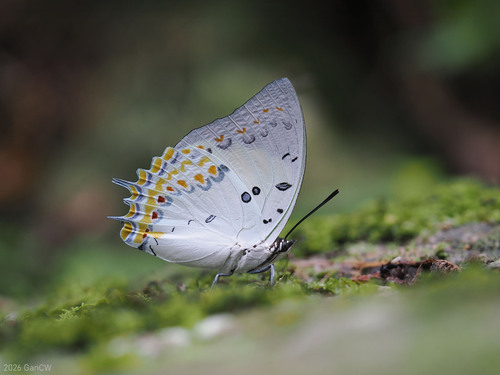
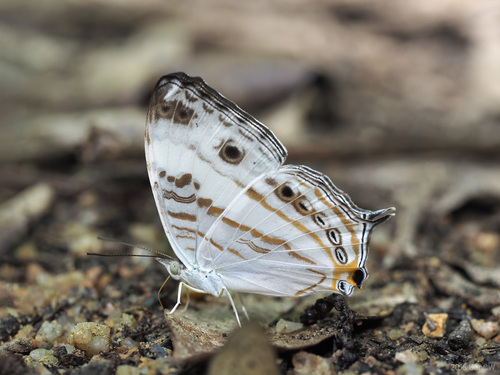
The closest relatives of the Common Nawab that you can see in Kaeng Krachan National Park (genus Polyura, Nawab Butterflies) are Great Nawab (about 10%) and Jewelled Nawab (about 10%), with each one's daily chance of a sighting.

Where does the Common Nawab sighting chance come from?

GBIF citizen-science records

It is estimated from how often the Common Nawab is recorded against all the insects logged in Kaeng Krachan National Park (40 verified sightings from 2019 to 2026), calibrated against known sighting rates. Figures are rounded to the nearest 10% because citizen-science data supports honest approximations, not decimals, and months with records from fewer than five people show "—". How it works.

← Back to Kaeng Krachan National Park