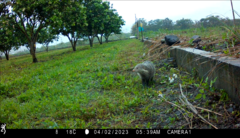
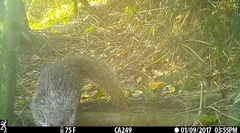
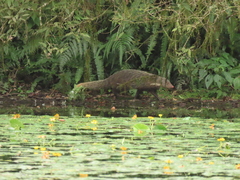
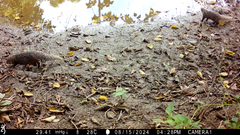
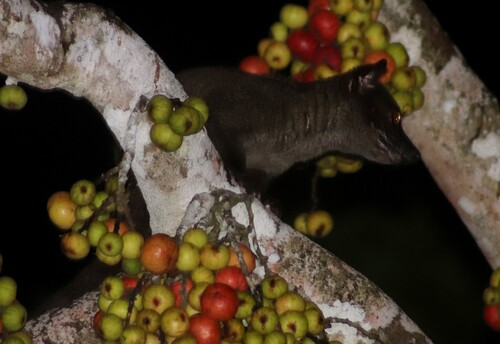
Crab-eating Mongoose

Crab-eating Mongoose

Herpestes urva

Silhouette: Margot Michaud · PhyloPic

Daily sighting probability ~10% · With luck
at Kaeng Krachan National Park

In 3 days ~20% in a week ~40%

6 Verified sightings at Kaeng Krachan National Park From 2019 to 2026
6 In 1 park
March Best month
🌅 Crepuscular When it's spotted

About the Crab-eating Mongoose

The crab-eating mongoose (Urva urva) is a species of mongoose found from the north-eastern Indian subcontinent and Southeast Asia to southern China and Taiwan. It is listed as least concern on the IUCN Red List. Gulo urva was the scientific name introduced by Brian Houghton Hodgson in 1836 who first described the type specimen that originated in central Nepal. It was later classified in the genus Herpestes, but all Asian mongooses are now thought to belong in the genus Urva, of which U. urva is the type species.

The crab-eating mongoose is grey on the sides and dusky brown on neck, chest, belly and limbs. It has a broad white stripe on the sides of the neck extending from the cheeks to the shoulder. It has white specks on the top of the head, its chin is white and its throat gray. Its iris is yellow. Its ears are short and rounded. It has webs between the digits. In head-to-body length it ranges from 47.7 to 55.8 cm (18.8 to 22.0 in) with a 28 to 34 cm (11 to 13 in) long bushy tail. Its weight ranges from 1.1 to 2.5 kg (2.4 to 5.5 lb).

The crab-eating mongoose occurs in northeastern India, northern Myanmar, Thailand... Wikipedia →

Sounds

Recording0:04

Taiwan · 2024

© Yunju Fang · iNaturalist · CC BY-NC 4.0

Global Distribution

Parks Where Found

# Park Country Daily sighting probability
1 Kaeng Krachan National Park 🇹🇭 Thailand
~10%

More parks will be added in future updates.

Cities Where Found

# City Country Daily sighting probability
1 Taipei 🇹🇼 Taiwan
~10%

Before you go

What are the chances of seeing a Crab-eating Mongoose in Kaeng Krachan National Park?

With luck

About 10% of wildlife watchers report a Crab-eating Mongoose sighting in Kaeng Krachan National Park on a given day, based on 6 verified sightings from GBIF citizen-science data from 2019 to 2026. It is the 26th most-seen of the 32 mammals we can rate there. Over three days the chance rises to about 20%, and over a week to about 40%, if each day is a fresh chance.

When is the best time to see a Crab-eating Mongoose in Kaeng Krachan National Park?

February–April and November–December

In those months about 10% of wildlife watchers report a Crab-eating Mongoose in Kaeng Krachan National Park on a given day, against under 5% in January and May–October, the lowest months. Those are among Kaeng Krachan National Park's driest months, with about 70 mm of rain a month against 260 mm in September.

What time of day is best to see a Crab-eating Mongoose?

Between 8 and 11 am

Across all the parks we cover, that three-hour window holds the most Crab-eating Mongoose sightings with a recorded time, and about 6 in 10 of them come between 6 am and 6 pm: it is most active around dawn and dusk.

Where else can you see a Crab-eating Mongoose?

Only Kaeng Krachan National Park, in our data

Kaeng Krachan National Park is the only park on Wallace's Line with enough records to rate Crab-eating Mongoose sightings: about 10% of wildlife watchers there report one on a given day.

Which relatives of the Crab-eating Mongoose live in Kaeng Krachan National Park?

Same order: Carnivora

The closest relatives of the Crab-eating Mongoose that you can see in Kaeng Krachan National Park (order Carnivora, Carnivorans) are Sun Bear (about 50%), Yellow-throated Marten (about 20%) and Leopard (about 20%), with each one's daily chance of a sighting.

Where does the Crab-eating Mongoose sighting chance come from?

GBIF citizen-science records

It is estimated from how often the Crab-eating Mongoose is recorded against all the mammals logged in Kaeng Krachan National Park (6 verified sightings from 2019 to 2026), calibrated against known sighting rates. Figures are rounded to the nearest 10% because citizen-science data supports honest approximations, not decimals, and months with records from fewer than five people show "—". How it works.

← Back to Kaeng Krachan National Park