Common Palm Civet

Common Palm Civet

Paradoxurus hermaphroditus

Silhouette: T. Michael Keesey · PhyloPic

LCLeast ConcernNTVUENCR
Daily sighting probability ~10% · With luck
at Kaeng Krachan National Park

In 3 days ~30% in a week ~60%

17 Verified sightings at Kaeng Krachan National Park From 2019 to 2026
230 In all 11 parks
October Best month
🌅 Crepuscular When it's spotted

About the Common Palm Civet

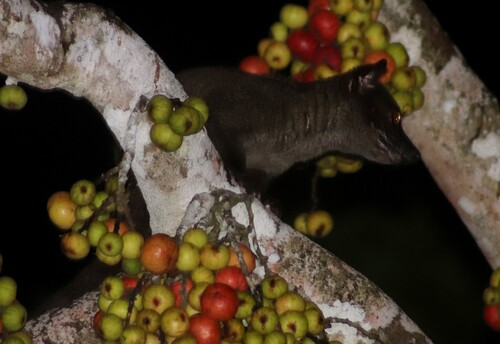
The Asian palm civet (Paradoxurus hermaphroditus), also called common palm civet, toddy cat and musang, is a viverrid native to South and Southeast Asia. Since 2008, it is IUCN Red Listed as least concern as it accommodates to a broad range of habitats. It is widely distributed with large populations that in 2008 were thought unlikely to be declining. It is threatened by poaching for the illegal wildlife trade.

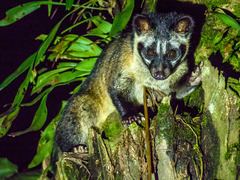
The Asian palm civet's long, stocky body is covered with coarse, shaggy hair that is usually greyish in colour. It has a white mask across the forehead, a small white patch under each eye, a white spot on each side of the nostrils, and a narrow dark line between the eyes. The muzzle, ears, lower legs, and distal half of the tail are black, with three rows of black markings on the body. Its head-to-body length is about 53 cm (21 in) with a 48 cm (19 in) long unringed tail. It weighs 2 to 5 kg (4.4 to 11.0 lb). Its anal scent glands emit a nauseating secretion as a chemical defense when threatened or upset.

The Asian palm civet is widely distributed in South and Southeast Asia, ranging from India, Nepal, Bangladesh, Bhutan,... Wikipedia →

Sounds

Call0:22

India · 2026

© Dr S S Suresh · XC1156251 · CC BY-NC-SA 4.0

Global Distribution

Parks Where Found

# Park Country Daily sighting probability
1 Kinabatangan Wildlife Sanctuary 🇲🇾 Malaysia
~40%
2 Danum Valley Conservation Area 🇲🇾 Malaysia
~40%
3 Cat Tien National Park 🇻🇳 Vietnam
~40%
4 Khao Yai National Park 🇹🇭 Thailand
~30%
5 Satpura National Park 🇮🇳 India
~20%
6 Bali Barat National Park 🇮🇩 Indonesia
~20%
7 Taman Negara National Park 🇲🇾 Malaysia
~20%
8 Sepilok 🇲🇾 Malaysia
~20%
9 Khao Sok National Park 🇹🇭 Thailand
~20%
10 Kaeng Krachan National Park 🇹🇭 Thailand
~10%
11 Minneriya National Park 🇱🇰 Sri Lanka
~10%

Cities Where Found

# City Country Daily sighting probability
1 Dehradun 🇮🇳 India
~20%
2 Jakarta 🇮🇩 Indonesia
~20%
3 Kozhikode 🇮🇳 India
~20%
4 Kuala Lumpur 🇲🇾 Malaysia
~20%
5 Kolkata 🇮🇳 India
~10%
6 Colombo [Sri Jayawardenepura Kotte] 🇱🇰 Sri Lanka
~10%
7 Singapore 🇸🇬 Singapore
~10%
8 Bandung 🇮🇩 Indonesia
~10%
9 Kochi 🇮🇳 India
~10%
10 Pune 🇮🇳 India
~10%

Zoos & Centres Where Found

# Zoo / Centre Country
1 Tierpark Berlin 🇩🇪 Germany In captivity
2 Melaka Zoo and Bird Park 🇲🇾 Malaysia In captivity
3 Bali Zoo 🇮🇩 Indonesia In captivity
4 Nehru Zoological Park 🇮🇳 India In captivity
5 Saigon Zoo and Botanical Gardens 🇻🇳 Vietnam In captivity
6 VigoNature 🇪🇸 Spain In captivity
7 Padmaja Naidu Himalayan Zoological Park 🇮🇳 India In captivity
8 Thrissur Zoo 🇮🇳 India In captivity

Before you go

What are the chances of seeing a Common Palm Civet in Kaeng Krachan National Park?

With luck

About 10% of wildlife watchers report a Common Palm Civet sighting in Kaeng Krachan National Park on a given day, based on 17 verified sightings from GBIF citizen-science data from 2019 to 2026. It is the 18th most-seen of the 32 mammals we can rate there. Over three days the chance rises to about 30%, and over a week to about 60%, if each day is a fresh chance.

When is the best time to see a Common Palm Civet in Kaeng Krachan National Park?

October

In that month about 30% of wildlife watchers report a Common Palm Civet in Kaeng Krachan National Park on a given day, against under 5% in January, June–July and September, the lowest months. That is one of Kaeng Krachan National Park's wettest months, with about 240 mm of rain against 30 mm in December.

What time of day is best to see a Common Palm Civet?

Between 3 and 6 pm

Across all the parks we cover, that three-hour window holds the most Common Palm Civet sightings with a recorded time, and about 6 in 10 of them come between 6 am and 6 pm: it is most active around dawn and dusk.

Which relatives of the Common Palm Civet live in Kaeng Krachan National Park?

Same family: Viverridae

The closest relatives of the Common Palm Civet that you can see in Kaeng Krachan National Park (family Viverridae, Civets, Genets, and Oyans) are Masked Palm Civet (about 10%), Large Indian Civet (about 10%) and Small-toothed Palm Civet (about 10%), with each one's daily chance of a sighting.

Where does the Common Palm Civet sighting chance come from?

GBIF citizen-science records

It is estimated from how often the Common Palm Civet is recorded against all the mammals logged in Kaeng Krachan National Park (17 verified sightings from 2019 to 2026), calibrated against known sighting rates. Figures are rounded to the nearest 10% because citizen-science data supports honest approximations, not decimals, and months with records from fewer than five people show "—". How it works.

← Back to Kaeng Krachan National Park