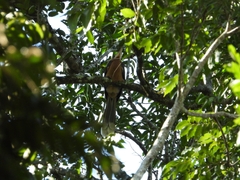
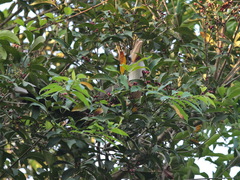

Rusty-cheeked Hornbill

Rusty-cheeked Hornbill

Anorrhinus tickelli

Silhouette: Charles J. Sharp and T. Michael Keesey · PhyloPic

LCNTNear ThreatenedVUENCR
Daily sighting probability ~10% · With luck
at Kaeng Krachan National Park

In 3 days ~30% in a week ~60%

514 Verified sightings at Kaeng Krachan National Park From 2019 to 2026
514 In 1 park
February Best month

About the Rusty-cheeked Hornbill

Tickell's brown hornbill (Anorrhinus tickelli), also known as the rusty-cheeked hornbill, is a species of hornbill found in forests in Burma and adjacent western Thailand. Austen's brown hornbill is sometimes considered as a subspecies of Tickell's brown hornbill.

At about 60–65 cm (24–26 in) in length, it is a medium-sized hornbill, dark brown above and red-brown below. The male has brighter rufous cheeks and throat. Juveniles of both sexes resemble adult males. It inhabits evergreen and deciduous hill forest from foothills to 1500 m.

It breeds co-cooperatively, in groups. Habitat loss to logging and agriculture is known to be prevalent within its range. The binomial commemorates the ornithologist Samuel Tickell. Wikipedia →

Sounds

Call0:21

Thailand · 2018

© Somkiat Pakapinyo (Chai) · XC403648 · CC BY-NC-SA 4.0

Song0:47

Thailand · 2017

© Roland Zeidler · XC399546 · CC BY-NC-SA 4.0

Call0:38

Thailand · 2016

© Greg Irving · XC349487 · CC BY-NC-SA 4.0

Global Distribution

Parks Where Found

# Park Country Daily sighting probability
1 Kaeng Krachan National Park 🇹🇭 Thailand
~10%

More parks will be added in future updates.

Before you go

What are the chances of seeing a Rusty-cheeked Hornbill in Kaeng Krachan National Park?

With luck

About 10% of wildlife watchers report a Rusty-cheeked Hornbill sighting in Kaeng Krachan National Park on a given day, based on 514 verified sightings from GBIF citizen-science data from 2019 to 2026. It is the 125th most-seen of the 360 birds we can rate there. Over three days the chance rises to about 30%, and over a week to about 60%, if each day is a fresh chance.

When is the best time to see a Rusty-cheeked Hornbill in Kaeng Krachan National Park?

January and February

In those months about 20% of wildlife watchers report a Rusty-cheeked Hornbill in Kaeng Krachan National Park on a given day, against under 5% in September and November, the lowest months. Those are among Kaeng Krachan National Park's driest months, with about 40 mm of rain a month against 260 mm in September.

Where else can you see a Rusty-cheeked Hornbill?

Only Kaeng Krachan National Park, in our data

Kaeng Krachan National Park is the only park on Wallace's Line with enough records to rate Rusty-cheeked Hornbill sightings: about 10% of wildlife watchers there report one on a given day.

Which relatives of the Rusty-cheeked Hornbill live in Kaeng Krachan National Park?

Same family: Bucerotidae

The closest relatives of the Rusty-cheeked Hornbill that you can see in Kaeng Krachan National Park (family Bucerotidae, Hornbills) are Oriental Pied Hornbill (about 70%), Great Hornbill (about 40%) and Wreathed Hornbill (about 10%), with each one's daily chance of a sighting.

Where does the Rusty-cheeked Hornbill sighting chance come from?

GBIF citizen-science records

It is estimated from how often the Rusty-cheeked Hornbill is recorded against all the birds logged in Kaeng Krachan National Park (514 verified sightings from 2019 to 2026), calibrated against known sighting rates. Figures are rounded to the nearest 10% because citizen-science data supports honest approximations, not decimals, and months with records from fewer than five people show "—". How it works.

← Back to Kaeng Krachan National Park