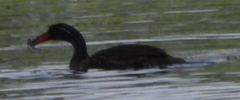
African Finfoot

African Finfoot

Podica senegalensis

Silhouette: Sheatherius · PhyloPic

LCLeast ConcernNTVUENCR
Daily sighting probability ~20% · Possible
at Kafue National Park

In 3 days ~50% in a week ~80%

165 Verified sightings at Kafue National Park From 2019 to 2026
876 In all 7 parks
July Best month
☀️ Diurnal When it's spotted

About the African Finfoot

The African finfoot or Peter's finfoot (Podica senegalensis) is an aquatic bird from the family Heliornithidae (the finfoots and sungrebe). The species lives in the rivers and lakes of western, central, and southern Africa.

The African finfoot is an underwater specialist with a long neck, a striking sharp beak, and bright red, lobed feet. The plumage varies by race, generally pale underneath and darker on top. The males are usually darker than the females.

The African finfoot can be found in a range of habitats across Africa, in areas where there are rivers, streams, and lakes with good cover on the banks. This range includes forest, wooded savannah, flooded forest, and even mangrove swamps.

The finfoot feeds on aquatic invertebrates, including both adults and larval mayflies, dragonflies, crustaceans, also snails, fish and amphibians. They are thought to be highly opportunistic and take some of their prey directly off the waters surface. They are adept out of water and will forage on the banks as well, unlike the grebes, which they resemble but are not related to.

Finfoots are usually seen singly or in pairs. They are very secretive. Even... Wikipedia →

Sounds

Call0:13

Zambia · 2025

© Dries Van de Loock · XC1036489 · CC BY-NC-ND 4.0

Uncertain0:29

Tanzania · 2023

© Riaan Marais · XC827905 · CC BY-NC-SA 4.0

Call0:29

Sierra Leone · 2022

© Brendan Sloan · XC905929 · CC BY-NC-ND 4.0

Global Distribution

Parks Where Found

# Park Country Daily sighting probability
1 Niokolo-Koba National Park 🇸🇳 Senegal
~50%
2 Lake Mburo National Park 🇺🇬 Uganda
~20%
3 Kafue National Park 🇿🇲 Zambia
~20%
4 Murchison Falls National Park 🇺🇬 Uganda
<5%
5 iSimangaliso Wetland Park 🇿🇦 South Africa
<5%
6 Kruger National Park 🇿🇦 South Africa
<5%
7 Bwindi Impenetrable National Park 🇺🇬 Uganda
<5%

Before you go

What are the chances of seeing an African Finfoot in Kafue National Park?

Possible

About 20% of wildlife watchers report an African Finfoot sighting in Kafue National Park on a given day, based on 165 verified sightings from GBIF citizen-science data from 2019 to 2026. It is the 69th most-seen of the 338 birds we can rate there. Over three days the chance rises to about 50%, and over a week to about 80%, if each day is a fresh chance.

When is the best time to see an African Finfoot in Kafue National Park?

May and July

In those months about 40% of wildlife watchers report an African Finfoot in Kafue National Park on a given day, against about 10% in November, the lowest month. Those are among Kafue National Park's driest months, with almost no rain against 290 mm in January.

What time of day is best to see an African Finfoot?

Between 8 and 11 am

Across all the parks we cover, that three-hour window holds the most African Finfoot sightings with a recorded time, and about 9 in 10 of them come between 6 am and 6 pm: it is a daytime animal.

Is Kafue National Park the best place to see an African Finfoot?

3rd of 7

Of the 7 parks where we can rate African Finfoot sightings, Kafue National Park ranks 3rd at about 20%. The best odds are in Niokolo-Koba National Park (Senegal, about 50%) and Lake Mburo National Park (Uganda, about 20%).

Which relatives of the African Finfoot live in Kafue National Park?

Same order: Gruiformes

The closest relatives of the African Finfoot that you can see in Kafue National Park (order Gruiformes, Cranes, Rails, and Allies) are Wattled Crane (about 30%), Grey Crowned Crane (about 20%) and Black Crake (about 10%), with each one's daily chance of a sighting.

Where does the African Finfoot sighting chance come from?

GBIF citizen-science records

It is estimated from how often the African Finfoot is recorded against all the birds logged in Kafue National Park (165 verified sightings from 2019 to 2026), calibrated against known sighting rates. Figures are rounded to the nearest 10% because citizen-science data supports honest approximations, not decimals, and months with records from fewer than five people show "—". How it works.

← Back to Kafue National Park