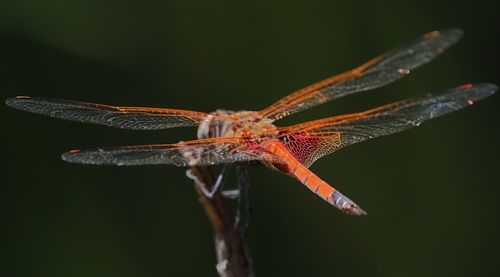
Leichhardt's Grasshopper

Leichhardt's Grasshopper

Petasida ephippigera

Daily sighting probability ~20% · Possible
at Kakadu National Park

In 3 days ~50% in a week ~80%

36 Verified sightings at Kakadu National Park From 2019 to 2026
36 In 1 park
December Best month
☀️ Diurnal When it's spotted

About the Leichhardt's Grasshopper

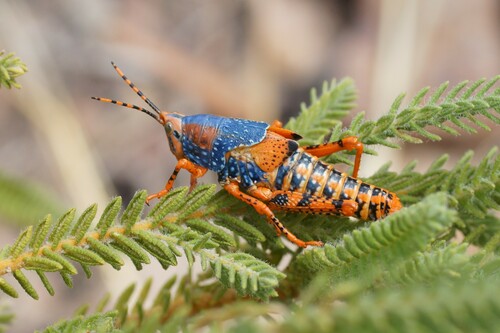
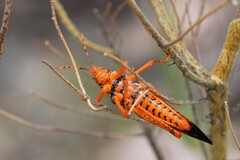
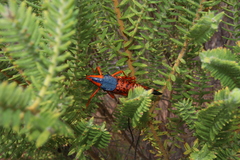
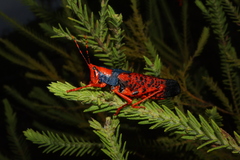
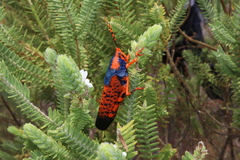
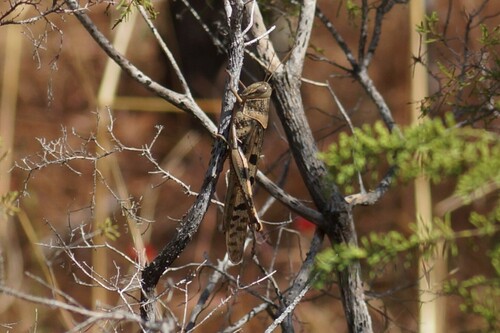
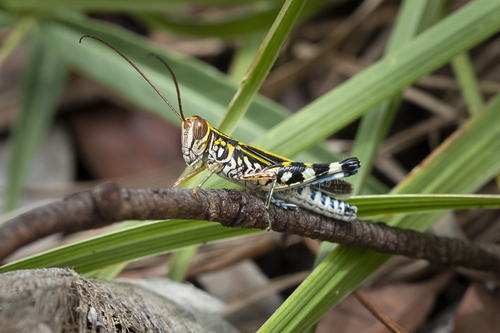
Petasida ephippigera, the Leichhardt's grasshopper, Alyurr, is a relatively large, brightly coloured pyrgomorph species of grasshopper in the monotypic genus Petasida, native to the Top End region of tropical northern Australia.

The Leichhardt's grasshopper is largely restricted to remote sandstone areas with Pityrodia shrubs, which are the main food source for both the adults and the nymphs. Although this shrub is quite widespread in the region, the Leichhardt's grasshopper appears to be local, scarce and declining for reasons that are not fully understood, but the controlled burning practices within its range are possibly part of the explanation. The Leichhardt's grasshopper is one of the most emblematic animals of the Kakadu National Park (seeing it there requires some effort), and it also occurs in the Nitmiluk and Keep River National Parks.

This grasshopper is known as alyurr in the local Kundjeyhmi language and it plays a role in their mythology. The species is named after Ludwig Leichhardt. He was the second European to record this grasshopper in 1845 in an area that later would become part of the Kakadu National Park. The species was first recorded by John Dring... Wikipedia →

Global Distribution

Parks Where Found

# Park Country Daily sighting probability
1 Kakadu National Park 🇦🇺 Australia
~20%

More parks will be added in future updates.

Before you go

What are the chances of seeing a Leichhardt's Grasshopper in Kakadu National Park?

Possible

About 20% of wildlife watchers report a Leichhardt's Grasshopper sighting in Kakadu National Park on a given day, based on 36 verified sightings from GBIF citizen-science data from 2019 to 2026. It is the 17th most-seen of the 76 insects we can rate there. Over three days the chance rises to about 50%, and over a week to about 80%, if each day is a fresh chance.

When is the best time to see a Leichhardt's Grasshopper in Kakadu National Park?

December

In that month about 60% of wildlife watchers report a Leichhardt's Grasshopper in Kakadu National Park on a given day, against under 5% in March, May–June and September, the lowest months. That is one of Kakadu National Park's wettest months, with about 250 mm of rain against almost none in August.

What time of day is best to see a Leichhardt's Grasshopper?

Between 11 am and 2 pm

Across all the parks we cover, that three-hour window holds the most Leichhardt's Grasshopper sightings with a recorded time, and about 8 in 10 of them come between 6 am and 6 pm: it is a daytime animal.

Where else can you see a Leichhardt's Grasshopper?

Only Kakadu National Park, in our data

Kakadu National Park is the only park on Wallace's Line with enough records to rate Leichhardt's Grasshopper sightings: about 20% of wildlife watchers there report one on a given day.

Which relatives of the Leichhardt's Grasshopper live in Kakadu National Park?

Same order: Orthoptera

The closest relatives of the Leichhardt's Grasshopper that you can see in Kakadu National Park (order Orthoptera, Grasshoppers, Crickets, and Katydids) are Tropical Sharptail (about 20%), Giant Grasshopper (about 20%) and Nicsara trigonalis (about 20%), with each one's daily chance of a sighting.

Where does the Leichhardt's Grasshopper sighting chance come from?

GBIF citizen-science records

It is estimated from how often the Leichhardt's Grasshopper is recorded against all the insects logged in Kakadu National Park (36 verified sightings from 2019 to 2026), calibrated against known sighting rates. Figures are rounded to the nearest 10% because citizen-science data supports honest approximations, not decimals, and months with records from fewer than five people show "—". How it works.

← Back to Kakadu National Park