Black-throated Coucal

Black-throated Coucal

Centropus leucogaster

Silhouette: Nicolas Huet le Jeune and Jean-Gabriel Prêtre (vectorized by T. Michael Keesey) · PhyloPic

LCLeast ConcernNTVUENCR
Daily sighting probability ~30% · Possible
at Kakum National Park

In 3 days ~60% in a week ~90%

141 Verified sightings at Kakum National Park From 2019 to 2026
197 In all 3 parks
July Best month
☀️🌙 Day & Night When it's spotted

About the Black-throated Coucal

The black-throated coucal (Centropus leucogaster) is a species of cuckoo in the family Cuculidae. It is found in West Africa in dense second growth along forest edge and grassy swamps. The subspecies found in northern and central Zaire is sometimes split as Neumann's coucal (Centropus neumanni).

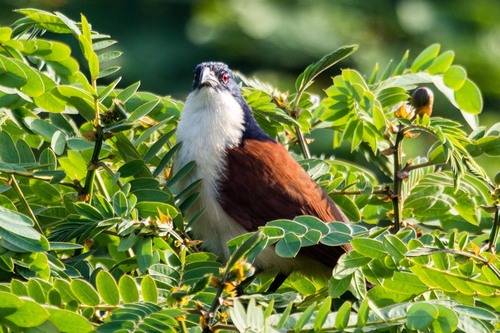
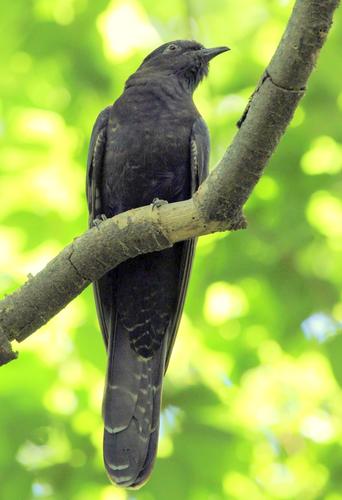
The black-throated coucal is the largest species in the genus Centropus, growing to 46 to 58 cm (18 to 23 in) in length. The sexes are similar, the adult having the head, neck, upper breast and mantle black, glossed with violet-blue, the wings rufous-chestnut, the back black barred with white and the tail black, the tail feathers having paler bases. The lower breast and belly are white, the thighs, flanks and undertail-coverts having a rufous tinge. The juvenile has somewhat similar plumage to the adult, but is barred and streaked with buff, and lacks the gloss on the head.

The black-throated coucal is native to western Africa. Its range includes Cameroon, The Democratic Republic of Congo, Côte d'Ivoire, Gabon, Ghana, Guinea, Guinea-Bissau, Liberia, Niger, Nigeria, Senegal, Sierra Leone, and Togo. Its typical habitat is the edges of secondary...


Wikipedia →

Sounds

Song0:13

Uganda · 2023

© Brendan Sloan · XC829063 · CC BY-NC-ND 4.0

Call0:55

Ghana · 2018

© Phil Gregory · XC609904 · CC BY-NC-SA 4.0

Song1:14

Ghana · 2022

© Peter Boesman · XC718953 · CC BY-NC-ND 4.0

Global Distribution

Parks Where Found

# Park Country Daily sighting probability
1 Kakum National Park 🇬🇭 Ghana
~30%
2 Semuliki National Park 🇺🇬 Uganda
~10%
3 Taï National Park 🇨🇮 Ivory Coast
~10%

Before you go

What are the chances of seeing a Black-throated Coucal in Kakum National Park?

Possible

About 30% of wildlife watchers report a Black-throated Coucal sighting in Kakum National Park on a given day, based on 141 verified sightings from GBIF citizen-science data from 2019 to 2026. It is the 71st most-seen of the 250 birds we can rate there. Over three days the chance rises to about 60%, and over a week to about 90%, if each day is a fresh chance.

When is the best time to see a Black-throated Coucal in Kakum National Park?

July and September–October

In those months about 40% of wildlife watchers report a Black-throated Coucal in Kakum National Park on a given day, against about 20% in January–February, April–June and November, the lowest months.

What time of day is best to see a Black-throated Coucal?

Between 9 am and noon

Across all the parks we cover, that three-hour window holds the most Black-throated Coucal sightings with a recorded time, and about half of them come between 6 am and 6 pm: it is seen both by day and at night.

Is Kakum National Park the best place to see a Black-throated Coucal?

Yes

Of the 3 parks where we can rate Black-throated Coucal sightings, Kakum National Park has the highest daily chance: about 30%. Next come Semuliki National Park (Uganda, about 10%) and Taï National Park (Ivory Coast, about 10%).

Which relatives of the Black-throated Coucal live in Kakum National Park?

Same genus: Centropus

The closest relatives of the Black-throated Coucal that you can see in Kakum National Park (genus Centropus, Coucals) are Blue-headed Coucal (about 20%) and Senegal Coucal (about 20%), with each one's daily chance of a sighting.

Where does the Black-throated Coucal sighting chance come from?

GBIF citizen-science records

It is estimated from how often the Black-throated Coucal is recorded against all the birds logged in Kakum National Park (141 verified sightings from 2019 to 2026), calibrated against known sighting rates. Figures are rounded to the nearest 10% because citizen-science data supports honest approximations, not decimals, and months with records from fewer than five people show "—". How it works.

← Back to Kakum National Park