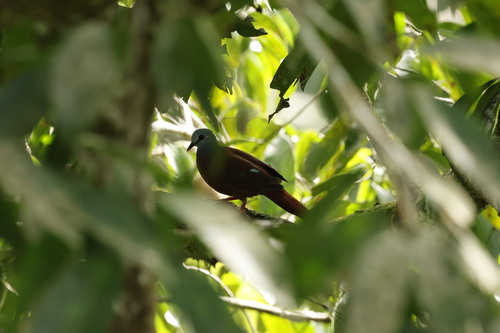


Blue-headed Wood-Dove

Blue-headed Wood-Dove

Turtur brehmeri

Silhouette: Sheatherius · PhyloPic

LCLeast ConcernNTVUENCR
Daily sighting probability ~30% · Possible
at Kakum National Park

In 3 days ~60% in a week ~90%

150 Verified sightings at Kakum National Park From 2019 to 2026
160 In all 2 parks
July Best month
☀️ Diurnal When it's spotted

About the Blue-headed Wood-Dove

The blue-headed wood dove (Turtur brehmeri), also known as the blue-headed dove, is a medium-sized (up to 25 cm (9.8 in) long), rufous brown wood-dove with bluish-grey head, iridescent green patches on wings, reddish bill, dark brown iris, and dark red feet. Both sexes are similar. The young is duller in colour than adult.

The blue-headed wood dove is widespread across the African tropical rainforest. The blue-headed wood dove nests in trees. The nest is made from twigs, leaves, and other vegetation. Its diet consists mainly of seeds, fallen fruits, insects, and small animals taken from feeding grounds. The female usually lays one to two eggs.

Widespread and locally common throughout its large range, the blue-headed wood dove is evaluated as of least concern on the IUCN Red List of Threatened Species. BirdLife Species Factsheet

Wikipedia →

Sounds

Song1:20

Congo (Democratic Republic) · 2023

© Deville Tanguy · XC822888 · CC BY-NC-SA 4.0

Call0:19

Central African Republic · 2020

© Rod Cassidy · XC614649 · CC BY-NC-SA 4.0

Song0:48

Ghana · 2022

© Peter Boesman · XC719552 · CC BY-NC-ND 4.0

Global Distribution

Parks Where Found

# Park Country Daily sighting probability
1 Kakum National Park 🇬🇭 Ghana
~30%
2 Taï National Park 🇨🇮 Ivory Coast
~20%

Zoos & Centres Where Found

# Zoo / Centre Country
1 Disney's Animal Kingdom 🇺🇸 United States In captivity
2 San Diego Zoo 🇺🇸 United States In captivity
3 Cape May County Park & Zoo 🇺🇸 United States In captivity
4 San Antonio Zoo 🇺🇸 United States In captivity

Before you go

What are the chances of seeing a Blue-headed Wood-Dove in Kakum National Park?

Possible

About 30% of wildlife watchers report a Blue-headed Wood-Dove sighting in Kakum National Park on a given day, based on 150 verified sightings from GBIF citizen-science data from 2019 to 2026. It is the 66th most-seen of the 250 birds we can rate there. Over three days the chance rises to about 60%, and over a week to about 90%, if each day is a fresh chance.

When is the best time to see a Blue-headed Wood-Dove in Kakum National Park?

July

In that month about 50% of wildlife watchers report a Blue-headed Wood-Dove in Kakum National Park on a given day, against about 10% in March and April, the lowest months.

What time of day is best to see a Blue-headed Wood-Dove?

Between 8 and 11 am

Across all the parks we cover, that three-hour window holds the most Blue-headed Wood-Dove sightings with a recorded time, and about 8 in 10 of them come between 6 am and 6 pm: it is a daytime animal.

Is Kakum National Park the best place to see a Blue-headed Wood-Dove?

Yes

Of the 2 parks where we can rate Blue-headed Wood-Dove sightings, Kakum National Park has the highest daily chance: about 30%. Next come Taï National Park (Ivory Coast, about 20%).

Which relatives of the Blue-headed Wood-Dove live in Kakum National Park?

Same genus: Turtur

The closest relatives of the Blue-headed Wood-Dove that you can see in Kakum National Park (genus Turtur, Wood-Doves) are Tambourine Dove (about 40%) and Blue-spotted Wood-Dove (about 20%), with each one's daily chance of a sighting.

Where does the Blue-headed Wood-Dove sighting chance come from?

GBIF citizen-science records

It is estimated from how often the Blue-headed Wood-Dove is recorded against all the birds logged in Kakum National Park (150 verified sightings from 2019 to 2026), calibrated against known sighting rates. Figures are rounded to the nearest 10% because citizen-science data supports honest approximations, not decimals, and months with records from fewer than five people show "—". How it works.

← Back to Kakum National Park