Brown-cheeked Hornbill

Brown-cheeked Hornbill

Bycanistes cylindricus

Silhouette: Charles J. Sharp and T. Michael Keesey · PhyloPic

LCNTVUVulnerableENCR
Daily sighting probability ~40% · Likely
at Kakum National Park

In 3 days ~80% in a week >90%

252 Verified sightings at Kakum National Park From 2019 to 2026
252 In 1 park
July Best month
☀️ Diurnal When it's spotted

About the Brown-cheeked Hornbill

The brown-cheeked hornbill (Bycanistes cylindricus) is a species of hornbill in the family Bucerotidae. It is found in Ivory Coast, Ghana, Guinea, Liberia, Sierra Leone, and Togo. Its natural habitats are tropical and subtropical moist broadleaf forests, plantations, and secondary growth forests. It is threatened by habitat destruction, as timber is harvested and the forests become increasingly fragmented.

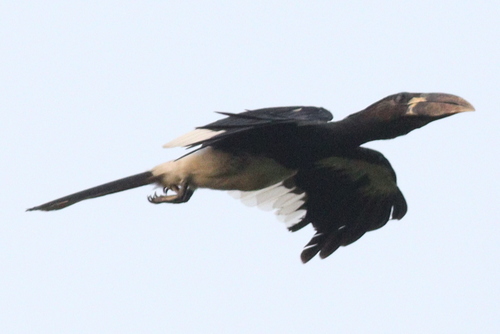
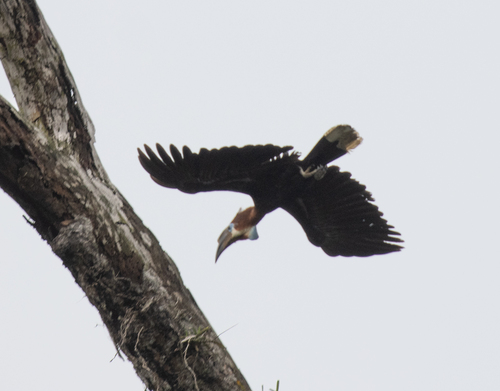
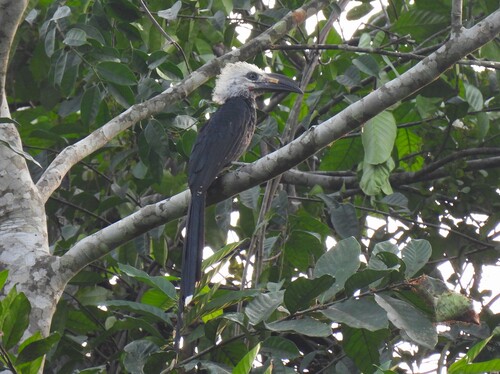
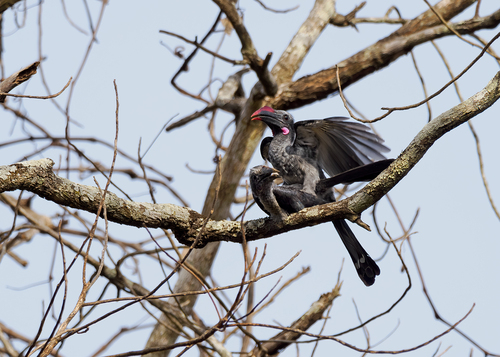
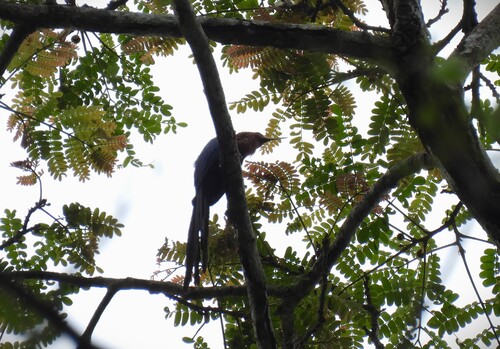
The brown-cheeked hornbill is a large bird, measuring 60 to 70 cm (24 to 28 in) in length. The male has a large yellow, down-curving beak topped by a casque, a hollow structure attached to the upper mandible. The head, upper parts and underparts are black apart from the reddish-brown cheeks, and the white rump, belly and tail. The female is smaller but otherwise similar to the male apart from having a black beak and casque. Its call is a descending series of coarse croaks "rrah...rrah...rrah...rrah" or "rack kack kak-kak".

The brown-cheeked hornbill is native to the Upper Guinean forests region of tropical West Africa, its range including southern Guinea, Sierra Leone, Liberia, Ivory Coast, southwestern Ghana and Togo. These forests...

Wikipedia →

Sounds

Call0:41

Ivory Coast · 2018

© Étienne Leroy · XC411799 · CC BY-NC-SA 4.0

Call0:38

Sierra Leone · 2006

© Frank Lambert · XC23300 · CC BY-NC-ND 4.0

Call0:28

Ghana · 2022

© Peter Boesman · XC718913 · CC BY-NC-ND 4.0

Global Distribution

Parks Where Found

# Park Country Daily sighting probability
1 Kakum National Park 🇬🇭 Ghana
~40%

More parks will be added in future updates.

Before you go

What are the chances of seeing a Brown-cheeked Hornbill in Kakum National Park?

Likely

About 40% of wildlife watchers report a Brown-cheeked Hornbill sighting in Kakum National Park on a given day, based on 252 verified sightings from GBIF citizen-science data from 2019 to 2026. It is the 21st most-seen of the 250 birds we can rate there. Over three days the chance rises to about 80%, and over a week to over 90%, if each day is a fresh chance.

When is the best time to see a Brown-cheeked Hornbill in Kakum National Park?

July

In that month about 60% of wildlife watchers report a Brown-cheeked Hornbill in Kakum National Park on a given day, against about 30% in December, the lowest month.

What time of day is best to see a Brown-cheeked Hornbill?

Between 7 and 10 am

Across all the parks we cover, that three-hour window holds the most Brown-cheeked Hornbill sightings with a recorded time, and about 9 in 10 of them come between 6 am and 6 pm: it is a daytime animal.

Where else can you see a Brown-cheeked Hornbill?

Only Kakum National Park, in our data

Kakum National Park is the only park on Wallace's Line with enough records to rate Brown-cheeked Hornbill sightings: about 40% of wildlife watchers there report one on a given day.

Where does the Brown-cheeked Hornbill sighting chance come from?

GBIF citizen-science records

It is estimated from how often the Brown-cheeked Hornbill is recorded against all the birds logged in Kakum National Park (252 verified sightings from 2019 to 2026), calibrated against known sighting rates. Figures are rounded to the nearest 10% because citizen-science data supports honest approximations, not decimals, and months with records from fewer than five people show "—". How it works.

← Back to Kakum National Park