White-crested Hornbill

White-crested Hornbill

Horizocerus albocristatus

Silhouette: Charles J. Sharp and T. Michael Keesey · PhyloPic

LCLeast ConcernNTVUENCR
Daily sighting probability ~30% · Possible
at Kakum National Park

In 3 days ~70% in a week ~90%

180 Verified sightings at Kakum National Park From 2019 to 2026
329 In all 3 parks
July Best month
☀️ Diurnal When it's spotted

About the White-crested Hornbill

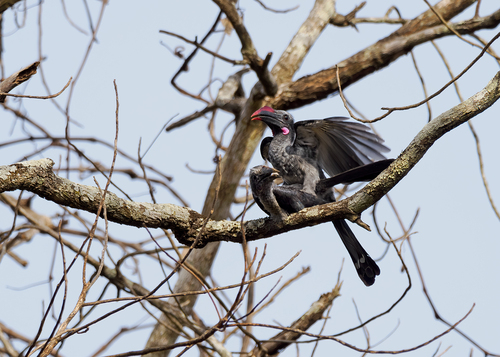
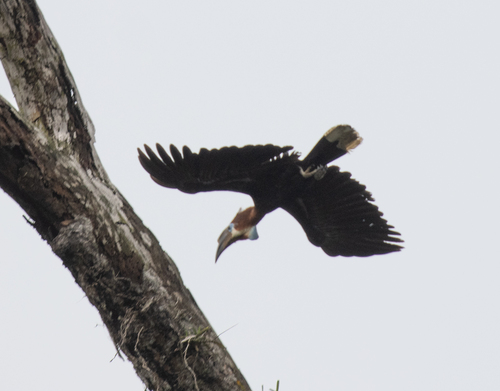
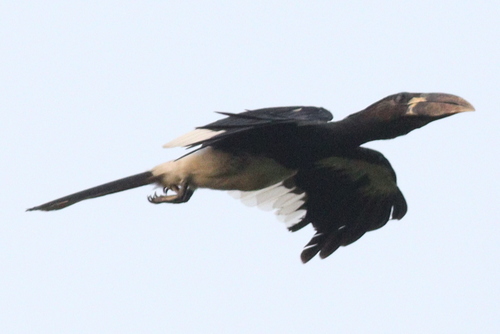
The western long-tailed hornbill (Horizocerus albocristatus) is a species of hornbill (family Bucerotidae) found in humid forests of West Africa. It was formerly considered to be conspecific with the eastern long-tailed hornbill (Horizocerus cassini) with the English name "white-crested hornbill".

The western long-tailed hornbill was formally described in 1848 by the American ornithologist John Cassin based on a specimen that had been collected near the Saint Paul River in Liberia. He coined the binomial name Buceros albocristatus. The specific epithet combines the Latin albus meaning "white" with cristatus meaning "crested" or "plumed". The species is now placed in the genus Horizocerus that was introduced in 1899 by the American ornithologist Harry C. Oberholser. The western long-tailed hornbill was formerly considered to be conspecific with the eastern long-tailed hornbill (Horizocerus cassini) with the English name "white-crested hornbill".

There are two subspecies, which differ primarily in the amount of white to their head and neck and the presence or absence of white tips to the wing-coverts: H. a...
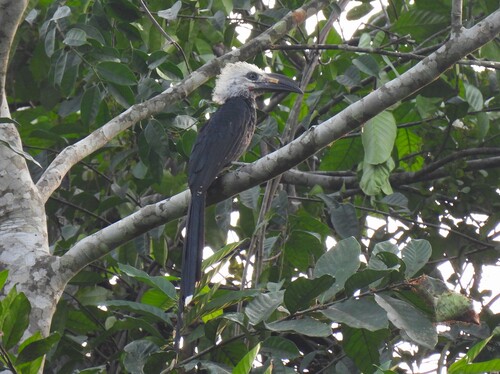
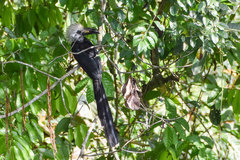
Wikipedia →

Sounds

Call0:26

Ivory Coast · 2026

© Étienne Leroy · XC1186481 · CC BY-NC-SA 4.0

Song0:54

Congo (Brazzaville) · 2019

© Mathias D'haen · XC531739 · CC BY-NC-SA 4.0

Call1:27

Ghana · 2023

© Alain Verneau · XC792630 · CC BY-NC-SA 4.0

Global Distribution

Parks Where Found

# Park Country Daily sighting probability
1 Semuliki National Park 🇺🇬 Uganda
~30%
2 Kakum National Park 🇬🇭 Ghana
~30%
3 Taï National Park 🇨🇮 Ivory Coast
~20%

Zoos & Centres Where Found

# Zoo / Centre Country
1 San Diego Zoo 🇺🇸 United States In captivity
2 Bronx Zoo 🇺🇸 United States In captivity
3 Ueno Zoo 🇯🇵 Japan In captivity
4 Bird Paradise 🇸🇬 Singapore In captivity
5 Rainforest Wild Asia 🇸🇬 Singapore In captivity
6 Central Park Zoo 🇺🇸 United States In captivity

Before you go

What are the chances of seeing a White-crested Hornbill in Kakum National Park?

Possible

About 30% of wildlife watchers report a White-crested Hornbill sighting in Kakum National Park on a given day, based on 180 verified sightings from GBIF citizen-science data from 2019 to 2026. It is the 51st most-seen of the 250 birds we can rate there. Over three days the chance rises to about 70%, and over a week to about 90%, if each day is a fresh chance.

When is the best time to see a White-crested Hornbill in Kakum National Park?

July and November

In those months about 40% of wildlife watchers report a White-crested Hornbill in Kakum National Park on a given day, against about 20% in June and December, the lowest months.

What time of day is best to see a White-crested Hornbill?

Between 7 and 10 am

Across all the parks we cover, that three-hour window holds the most White-crested Hornbill sightings with a recorded time, and about 7 in 10 of them come between 6 am and 6 pm: it is a daytime animal.

Is Kakum National Park the best place to see a White-crested Hornbill?

Among the best

Of the 3 parks where we can rate White-crested Hornbill sightings, Kakum National Park ranks 2nd at about 30%, level with the leaders once rounded. The best odds are in Semuliki National Park (Uganda, about 30%).

Where does the White-crested Hornbill sighting chance come from?

GBIF citizen-science records

It is estimated from how often the White-crested Hornbill is recorded against all the birds logged in Kakum National Park (180 verified sightings from 2019 to 2026), calibrated against known sighting rates. Figures are rounded to the nearest 10% because citizen-science data supports honest approximations, not decimals, and months with records from fewer than five people show "—". How it works.

← Back to Kakum National Park