Long-tailed Hawk

Long-tailed Hawk

Urotriorchis macrourus

Silhouette: Sheatherius · PhyloPic

LCLeast ConcernNTVUENCR
Daily sighting probability ~10% · With luck
at Kakum National Park

In 3 days ~20% in a week ~40%

41 Verified sightings at Kakum National Park From 2019 to 2026
51 In all 2 parks
June Best month
☀️ Diurnal When it's spotted

About the Long-tailed Hawk

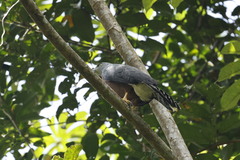
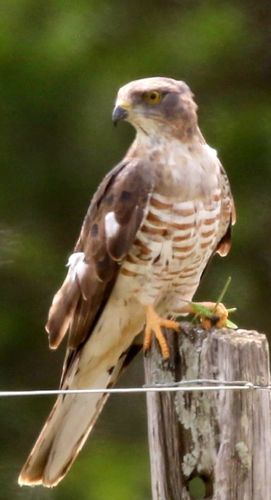
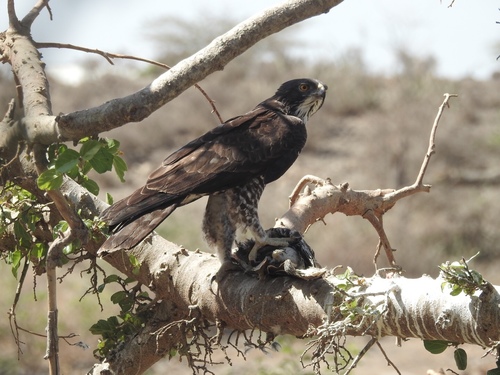
The long-tailed hawk (Urotriorchis macrourus) is an African bird of prey in the family Accipitridae. It is the only member of the genus Urotriorchis. The long-tailed hawk is a distinctively shaped raptor with a very noticeable long, barred tail and is dark grey on its upperparts and chestnut on its underparts with a contrasting white throat and undertail coverts. In flight the white flight feathers on the underwing are heavily barred with dark grey. There is a rare morph which has a grey breast, with a paler grey throat but still has the white undertail coverts. The bill is black, the eyes, cere, legs and feet are yellow. Juveniles are browner, with a white-breasted "plain" morph and a "marked" morph which has the breast streaked with brown. It has a wingspan of 81–90 centimetres (32–35 in) and a total length of 56–65 centimetres (22–26 in), including the tail of 30–37 centimetres (12–15 in). Females are about 15% larger than males. Since the tail comprises about 56% of this raptor's total length, this species ties with the cinereous harrier as the raptor with the longest tail relative to its body size.

It is a rather vocal bird which is often first detected...

Wikipedia →

Sounds

Call1:00

Uganda · 2022

© Peter Boesman · XC740058 · CC BY-NC-ND 4.0

Uncertain0:26

Gabon · 2021

© BurBenj · XC681708 · CC BY-NC-SA 4.0

Song0:47

Ivory Coast · 2019

© Étienne Leroy · XC513767 · CC BY-NC-SA 4.0

Global Distribution

Parks Where Found

# Park Country Daily sighting probability
1 Kakum National Park 🇬🇭 Ghana
~10%
2 Semuliki National Park 🇺🇬 Uganda
<5%

Before you go

What are the chances of seeing a Long-tailed Hawk in Kakum National Park?

With luck

About 10% of wildlife watchers report a Long-tailed Hawk sighting in Kakum National Park on a given day, based on 41 verified sightings from GBIF citizen-science data from 2019 to 2026. It is the 175th most-seen of the 250 birds we can rate there. Over three days the chance rises to about 20%, and over a week to about 40%, if each day is a fresh chance.

When is the best time to see a Long-tailed Hawk in Kakum National Park?

June

In that month about 20% of wildlife watchers report a Long-tailed Hawk in Kakum National Park on a given day, against under 5% in February–March, May and August, the lowest months. That is one of Kakum National Park's wettest months, with about 250 mm of rain against 35 mm in January.

What time of day is best to see a Long-tailed Hawk?

Between 6 and 9 am

Across all the parks we cover, that three-hour window holds the most Long-tailed Hawk sightings with a recorded time, and about 7 in 10 of them come between 6 am and 6 pm: it is a daytime animal.

Is Kakum National Park the best place to see a Long-tailed Hawk?

Yes

Of the 2 parks where we can rate Long-tailed Hawk sightings, Kakum National Park has the highest daily chance: about 10%. Next come Semuliki National Park (Uganda, under 5%).

Which relatives of the Long-tailed Hawk live in Kakum National Park?

Same family: Accipitridae

The closest relatives of the Long-tailed Hawk that you can see in Kakum National Park (family Accipitridae, Hawks, Eagles, and Kites) are African Harrier-Hawk (about 60%), Palmnut Vulture (about 40%) and Black Kite (about 30%), with each one's daily chance of a sighting.

Where does the Long-tailed Hawk sighting chance come from?

GBIF citizen-science records

It is estimated from how often the Long-tailed Hawk is recorded against all the birds logged in Kakum National Park (41 verified sightings from 2019 to 2026), calibrated against known sighting rates. Figures are rounded to the nearest 10% because citizen-science data supports honest approximations, not decimals, and months with records from fewer than five people show "—". How it works.

← Back to Kakum National Park