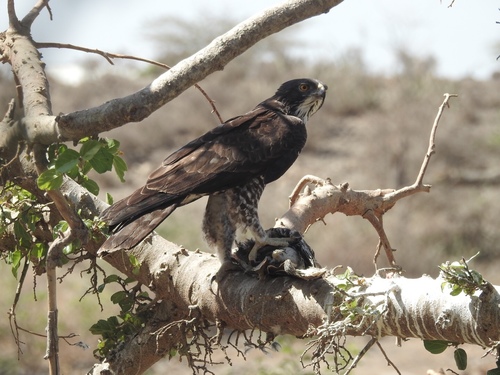
Cassin's Hawk-Eagle

Cassin's Hawk-Eagle

Aquila africana

Silhouette: Shyamal · PhyloPic

LCLeast ConcernNTVUENCR
Daily sighting probability ~10% · With luck
at Kakum National Park

In 3 days ~20% in a week ~40%

45 Verified sightings at Kakum National Park From 2019 to 2026
276 In all 5 parks
July Best month
☀️ Diurnal When it's spotted

About the Cassin's Hawk-Eagle

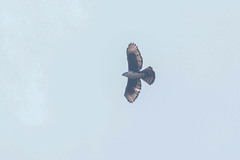
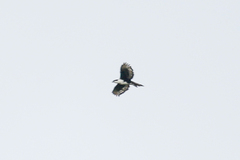
Cassin's hawk-eagle (Aquila africana) or Cassin's eagle, is a relatively small eagle in the family Accipitridae. Its feathered legs mark it as member of the Aquilinae or booted eagle subfamily. A forest-dependent species, it occurs in primary rainforests across western, central and (marginally) eastern Africa where it preys on birds and tree squirrels. It was named after John Cassin who first described it in 1865. Due to widespread habitat destruction, its populations are steadily declining but have not yet warranted upgrading its status from Least Concern.

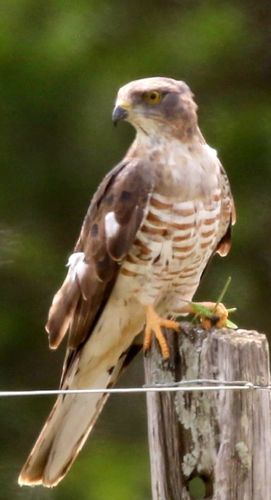
The adult Cassin's hawk-eagle appears as a small eagle, with short rounded wings and a long rounded tail. It has dark brown upperparts, with white spots and a brown tail with three black bars and a broad black subterminal band. The tarsi are white with black streaks, and the underparts are all white or white with black blotches along the sides of the lower breast. It has yellowish-brown eyes, pale yellow ceres and feet and a black bill. Immature and juvenile plumage is strikingly different from that of adults. A brown or rufous head with dusky lores and streaked black on the throat and centre of the crown is typical...

Wikipedia →

Sounds

Uncertain0:19

Congo (Democratic Republic) · 2025

© Deville Tanguy · XC1182080 · CC BY-NC-SA 4.0

Global Distribution

Parks Where Found

# Park Country Daily sighting probability
1 Nyungwe National Park 🇷🇼 Rwanda
~10%
2 Kakum National Park 🇬🇭 Ghana
~10%
3 Bwindi Impenetrable National Park 🇺🇬 Uganda
<5%
4 Semuliki National Park 🇺🇬 Uganda
<5%
5 Kibale National Park 🇺🇬 Uganda
<5%

Before you go

What are the chances of seeing a Cassin's Hawk-Eagle in Kakum National Park?

With luck

About 10% of wildlife watchers report a Cassin's Hawk-Eagle sighting in Kakum National Park on a given day, based on 45 verified sightings from GBIF citizen-science data from 2019 to 2026. It is the 174th most-seen of the 250 birds we can rate there. Over three days the chance rises to about 20%, and over a week to about 40%, if each day is a fresh chance.

When is the best time to see a Cassin's Hawk-Eagle in Kakum National Park?

March–May, July and September–January

In those months about 10% of wildlife watchers report a Cassin's Hawk-Eagle in Kakum National Park on a given day, against under 5% in February, June and August, the lowest months.

What time of day is best to see a Cassin's Hawk-Eagle?

Between 8 and 11 am

Across all the parks we cover, that three-hour window holds the most Cassin's Hawk-Eagle sightings with a recorded time, and about 9 in 10 of them come between 6 am and 6 pm: it is a daytime animal.

Is Kakum National Park the best place to see a Cassin's Hawk-Eagle?

Among the best

Of the 5 parks where we can rate Cassin's Hawk-Eagle sightings, Kakum National Park ranks 2nd at about 10%, level with the leaders once rounded. The best odds are in Nyungwe National Park (Rwanda, about 10%).

Which relatives of the Cassin's Hawk-Eagle live in Kakum National Park?

Same family: Accipitridae

The closest relatives of the Cassin's Hawk-Eagle that you can see in Kakum National Park (family Accipitridae, Hawks, Eagles, and Kites) are African Harrier-Hawk (about 60%), Palmnut Vulture (about 40%) and Black Kite (about 30%), with each one's daily chance of a sighting.

Where does the Cassin's Hawk-Eagle sighting chance come from?

GBIF citizen-science records

It is estimated from how often the Cassin's Hawk-Eagle is recorded against all the birds logged in Kakum National Park (45 verified sightings from 2019 to 2026), calibrated against known sighting rates. Figures are rounded to the nearest 10% because citizen-science data supports honest approximations, not decimals, and months with records from fewer than five people show "—". How it works.

← Back to Kakum National Park