Melancholy Woodpecker

Melancholy Woodpecker

Dendropicos lugubris

LCLeast ConcernNTVUENCR
Daily sighting probability ~20% · Possible
at Kakum National Park

In 3 days ~50% in a week ~80%

116 Verified sightings at Kakum National Park From 2019 to 2026
116 In 1 park
July Best month
☀️ Diurnal When it's spotted

About the Melancholy Woodpecker

The melancholy woodpecker (Dendropicos lugubris) is a species of woodpecker. It is found in West Africa from Sierra Leone east to Nigeria, living in forests, forest edges, clearings and woodlands. It is sometimes considered to be a subspecies of the Gabon woodpecker. The International Union for Conservation of Nature has assessed it as a least-concern species.

This species was formally described by the German ornithologist Gustav Hartlaub in 1857. The species is monotypic. It was sometimes considered conspecific with the Gabon woodpecker, Dendropicos gabonensis, because D. gabonensis reichenowi is intermediate between the two species.

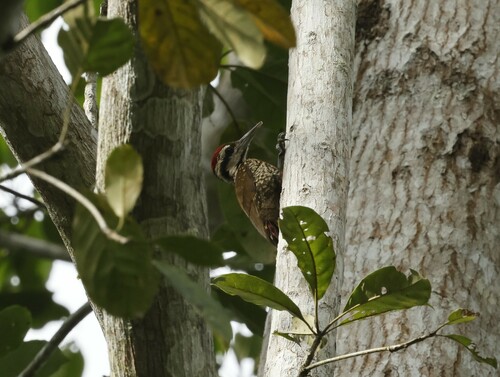
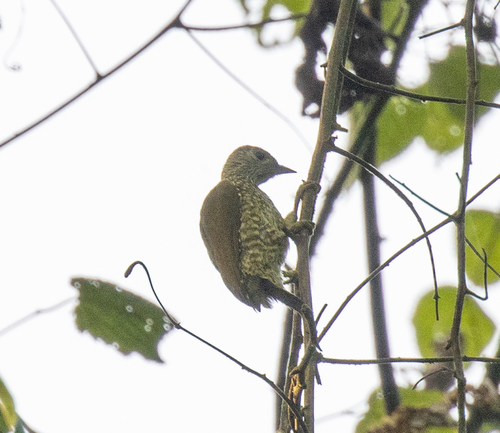
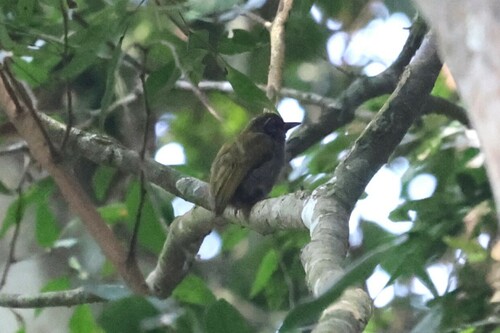
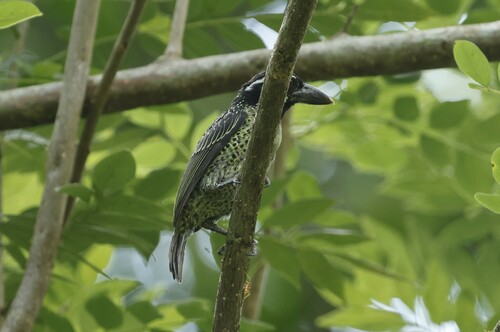
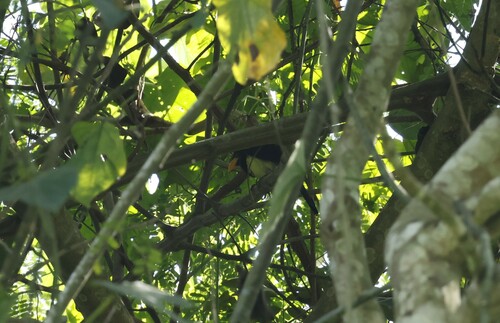
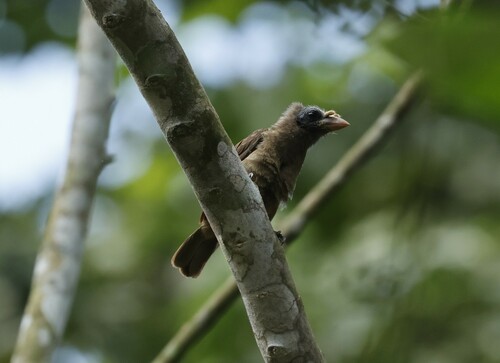
The melancholy woodpecker is 17–18 cm (6.7–7.1 in) long. The crown is olive-brown, and the nape is red in the male and blackish in the female. The face is white and has an olive-brown malar, dusky ear coverts and a white supercilium. The chin and throat are white and often have dark streaks or spots. The upperparts are bronzy-green. The flight feathers are brown, with greenish-bronze edges. The tail is black above and grey-black below. The underparts are greenish-yellow, with broad brown streaks. The beak is greyish, the...

Wikipedia →

Sounds

Call0:35

Ivory Coast · 2020

© Étienne Leroy · XC519835 · CC BY-NC-SA 4.0

Call0:58

Ghana · 2017

© Patrik Åberg · XC400014 · CC BY-NC-SA 4.0

Call0:20

Ghana · 2022

© Peter Boesman · XC719090 · CC BY-NC-ND 4.0

Global Distribution

Parks Where Found

# Park Country Daily sighting probability
1 Kakum National Park 🇬🇭 Ghana
~20%

More parks will be added in future updates.

Before you go

What are the chances of seeing a Melancholy Woodpecker in Kakum National Park?

Possible

About 20% of wildlife watchers report a Melancholy Woodpecker sighting in Kakum National Park on a given day, based on 116 verified sightings from GBIF citizen-science data from 2019 to 2026. It is the 87th most-seen of the 250 birds we can rate there. Over three days the chance rises to about 50%, and over a week to about 80%, if each day is a fresh chance.

When is the best time to see a Melancholy Woodpecker in Kakum National Park?

July and September

In those months about 30% of wildlife watchers report a Melancholy Woodpecker in Kakum National Park on a given day, against about 20% in August and October–June, the lowest months.

What time of day is best to see a Melancholy Woodpecker?

Between 7 and 10 am

Across all the parks we cover, that three-hour window holds the most Melancholy Woodpecker sightings with a recorded time, and about 9 in 10 of them come between 6 am and 6 pm: it is a daytime animal.

Where else can you see a Melancholy Woodpecker?

Only Kakum National Park, in our data

Kakum National Park is the only park on Wallace's Line with enough records to rate Melancholy Woodpecker sightings: about 20% of wildlife watchers there report one on a given day.

Which relatives of the Melancholy Woodpecker live in Kakum National Park?

Same family: Picidae

The closest relatives of the Melancholy Woodpecker that you can see in Kakum National Park (family Picidae, Woodpeckers) are Fire-bellied Woodpecker (about 40%), Buff-Spotted Woodpecker (about 10%) and African Piculet (about 10%), with each one's daily chance of a sighting.

Where does the Melancholy Woodpecker sighting chance come from?

GBIF citizen-science records

It is estimated from how often the Melancholy Woodpecker is recorded against all the birds logged in Kakum National Park (116 verified sightings from 2019 to 2026), calibrated against known sighting rates. Figures are rounded to the nearest 10% because citizen-science data supports honest approximations, not decimals, and months with records from fewer than five people show "—". How it works.

← Back to Kakum National Park