Common Four-Ring

Common Four-Ring

Ypthima huebneri

Daily sighting probability ~20% · Possible
at Kanha National Park

In 3 days ~50% in a week ~80%

11 Verified sightings at Kanha National Park From 2019 to 2026
30 In all 3 parks
October Best month
☀️ Diurnal When it's spotted

About the Common Four-Ring

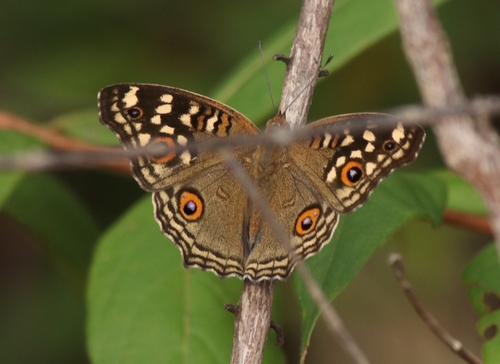
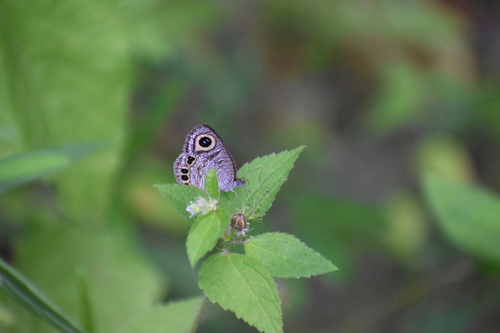
Ypthima huebneri, the common fourring, is a species of Satyrinae butterfly found in Asia. Upperside greyish brown. Forewing with the usual comparatively large, bi-pupilled, yellow-ringed, black preapical ocellus. Hindwing usually with two, sometimes with three, very rarely without any, smaller similar uni-pupilled postdiscal ocelli. Underside greyish white, not very densely covered with transverse short brown striae. Forewing with the preapical ocellus as on the upperside, obscure discal and subterminal dull brown transverse fasciae and a narrow brown ring round the ocellus diffusely produced posteriorly. Hindwing with one apical and typically three postdiscal posterior ocelli placed in a curve; traces of transverse brown discal and subterminal fasciae in most specimens. Antenna, head, thorax and abdomen greyish brown, the abdomen paler beneath. Male without secondary sex-mark.

Similar, somewhat paler on both upper and under sides; the discal and subterminal transverse fasciae more pronounced; the ocelli on the underside of the hindwing minute or absent. Adults have a wingspan of 40–43 mm. Var. jocularia... Wikipedia →
Global Distribution

Parks Where Found

# Park Country Daily sighting probability
1 Nagarhole National Park 🇮🇳 India
~40%
2 Periyar National Park 🇮🇳 India
~20%
3 Kanha National Park 🇮🇳 India
~20%

Cities Where Found

# City Country Daily sighting probability
1 Jamshedpur 🇮🇳 India
~40%
2 Thiruvananthapuram 🇮🇳 India
~30%
3 Thrissur 🇮🇳 India
~30%
4 Kozhikode 🇮🇳 India
~30%
5 Berhampore 🇮🇳 India
~20%
6 Kuala Lumpur 🇲🇾 Malaysia
~20%
7 Bengaluru 🇮🇳 India
~20%
8 Mysuru 🇮🇳 India
~20%
9 Kolkata 🇮🇳 India
~20%
10 Ponnani 🇮🇳 India
~20%

Before you go

What are the chances of seeing a Common Four-Ring in Kanha National Park?

Possible

About 20% of wildlife watchers report a Common Four-Ring sighting in Kanha National Park on a given day, based on 11 verified sightings from GBIF citizen-science data from 2019 to 2026. It is the 50th most-seen of the 106 insects we can rate there. Over three days the chance rises to about 50%, and over a week to about 80%, if each day is a fresh chance.

When is the best time to see a Common Four-Ring in Kanha National Park?

October

In that month about 50% of wildlife watchers report a Common Four-Ring in Kanha National Park on a given day, against under 5% in December to August, the lowest months. That is one of Kanha National Park's driest months, with about 50 mm of rain against 430 mm in July.

What time of day is best to see a Common Four-Ring?

Between 9 am and noon

Across all the parks we cover, that three-hour window holds the most Common Four-Ring sightings with a recorded time, and about 7 in 10 of them come between 6 am and 6 pm: it is a daytime animal.

Is Kanha National Park the best place to see a Common Four-Ring?

3rd of 3

Of the 3 parks where we can rate Common Four-Ring sightings, Kanha National Park ranks 3rd at about 20%. The best odds are in Nagarhole National Park (India, about 40%) and Periyar National Park (India, about 20%).

Which relatives of the Common Four-Ring live in Kanha National Park?

Same family: Nymphalidae

The closest relatives of the Common Four-Ring that you can see in Kanha National Park (family Nymphalidae, Brush-footed Butterflies) are Common Evening Brown (about 40%), Baronet (about 40%) and Common Crow (about 30%), with each one's daily chance of a sighting.

Where does the Common Four-Ring sighting chance come from?

GBIF citizen-science records

It is estimated from how often the Common Four-Ring is recorded against all the insects logged in Kanha National Park (11 verified sightings from 2019 to 2026), calibrated against known sighting rates. Figures are rounded to the nearest 10% because citizen-science data supports honest approximations, not decimals, and months with records from fewer than five people show "—". How it works.

← Back to Kanha National Park