Baer's Pochard

Baer's Pochard

Aythya baeri

Silhouette: Andy Wilson · PhyloPic

LCNTVUENCRCritically Endangered
Daily sighting probability <5% · Rare
at Kaziranga National Park

In 3 days <5%

11 Verified sightings at Kaziranga National Park From 2019 to 2026
11 In 1 park
January Best month
☀️ Diurnal When it's spotted

About the Baer's Pochard

Baer's pochard (Aythya baeri) is a diving duck found in eastern Asia. It is a resident bird in North and Central China, and formerly bred in southeast Russia and Northeast China, migrating in winter to southern China, Vietnam, Japan, and India. Baer's pochard is a monotypic species. The holotype was collected in middle Amur.

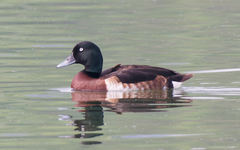
It has a distinctive black head and neck with green gloss. While in poor light, it is likely to look completely black. It is similar and closely related to the ferruginous duck, and they were previously considered to be a single species; Baer's pochard is differentiated by its white flanks when floating on the water, as well as its longer, more rounded head and larger size.

Its breeding season varies by latitude and environment. The nest, built from sedges, reeds and other plants, is placed among emergent vegetation, usually in shallow water or on small islands or ridges. Its clutch size ranges from 5 to 14. Males usually take on sentry duty, and females take on the responsibility of incubating.

Baer's pochard was once a common species in its range, but is now very rare. The number of mature individuals may be fewer than 1,000, and its population is still declining. Hunting and habitat loss are considered to be the main reasons. This species has been classified as critically endangered by the IUCN, and listed as a first-class protected animal in China. Wikipedia →

Global Distribution

Parks Where Found

# Park Country Daily sighting probability
1 Kaziranga National Park 🇮🇳 India
<5%

More parks will be added in future updates.

Cities Where Found

# City Country Daily sighting probability
1 Jinan 🇨🇳 China
~10%
2 Suzhou 🇨🇳 China
<5%
3 Chengdu 🇨🇳 China
<5%
4 Beijing 🇨🇳 China
<5%
5 Osaka 🇯🇵 Japan
<5%
6 Nagoya 🇯🇵 Japan
<5%

Zoos & Centres Where Found

# Zoo / Centre Country
1 Shedd Aquarium 🇺🇸 United States In captivity
2 Denver Zoo 🇺🇸 United States In captivity
3 Natura Artis Magistra 🇳🇱 Netherlands In captivity
4 Ostrava Zoo 🇨🇿 Czechia In captivity
5 Tulsa Zoo 🇺🇸 United States In captivity
6 Zoo Pilsen 🇨🇿 Czechia In captivity
7 Whitcliff Park (Deer Park) 🇬🇧 United Kingdom In captivity
8 Bronx Zoo 🇺🇸 United States In captivity
9 Slimbridge Wetland Centre 🇬🇧 United Kingdom In captivity
10 Louisville Zoo 🇺🇸 United States In captivity
11 Edinburgh Zoo 🇬🇧 United Kingdom In captivity
12 Moody Gardens 🇺🇸 United States In captivity
13 Fort Worth Zoo 🇺🇸 United States In captivity
14 Zoo Knoxville 🇺🇸 United States In captivity
15 Wilhelma 🇩🇪 Germany In captivity
16 Houston Zoo 🇺🇸 United States In captivity
17 Parc Zoologique et Botanique de Mulhouse 🇫🇷 France In captivity
18 Akron Zoo 🇺🇸 United States In captivity
19 Lincoln Park Zoo 🇺🇸 United States In captivity
20 Aquazoo Friesland 🇳🇱 Netherlands In captivity
21 Bioparc Fuengirola 🇪🇸 Spain In captivity

Before you go

What are the chances of seeing a Baer's Pochard in Kaziranga National Park?

Rare

Under 5% of wildlife watchers report a Baer's Pochard sighting in Kaziranga National Park on a given day, based on 11 verified sightings from GBIF citizen-science data from 2019 to 2026. It is the 279th most-seen of the 323 birds we can rate there. Over three days the chance rises to under 5%, if each day is a fresh chance.

When is the best time to see a Baer's Pochard in Kaziranga National Park?

January

In that month about 10% of wildlife watchers report a Baer's Pochard in Kaziranga National Park on a given day, against under 5% in February–May and August–December, the lowest months. That is one of Kaziranga National Park's driest months, with about 15 mm of rain against 520 mm in June. June and July have too few records to rate.

What time of day is best to see a Baer's Pochard?

Between 9 am and noon

Across all the parks we cover, that three-hour window holds the most Baer's Pochard sightings with a recorded time, and nearly all of them come between 6 am and 6 pm: it is a daytime animal.

Where else can you see a Baer's Pochard?

Only Kaziranga National Park, in our data

Kaziranga National Park is the only park on Wallace's Line with enough records to rate Baer's Pochard sightings: under 5% of wildlife watchers there report one on a given day.

Which relatives of the Baer's Pochard live in Kaziranga National Park?

Same genus: Aythya

The closest relatives of the Baer's Pochard that you can see in Kaziranga National Park (genus Aythya, Scaups, Pochards, and Allies) are Ferruginous Duck (about 20%), Tufted Duck (about 10%) and Common Pochard (about 10%), with each one's daily chance of a sighting.

Where does the Baer's Pochard sighting chance come from?

GBIF citizen-science records

It is estimated from how often the Baer's Pochard is recorded against all the birds logged in Kaziranga National Park (11 verified sightings from 2019 to 2026), calibrated against known sighting rates. Figures are rounded to the nearest 10% because citizen-science data supports honest approximations, not decimals, and months with records from fewer than five people show "—". How it works.

← Back to Kaziranga National Park