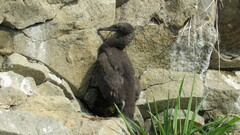
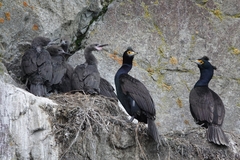
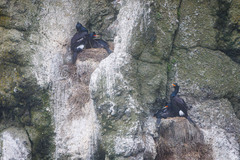
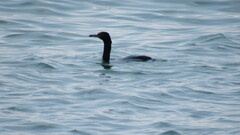
Red-faced Cormorant

Red-faced Cormorant

Phalacrocorax urile

Silhouette: L. Shyamal · PhyloPic

Daily sighting probability ~30% · Possible
at Kenai Fjords National Park

In 3 days ~60% in a week ~90%

225 Verified sightings at Kenai Fjords National Park From 2019 to 2026
225 In 1 park
June Best month
☀️ Diurnal When it's spotted

About the Red-faced Cormorant

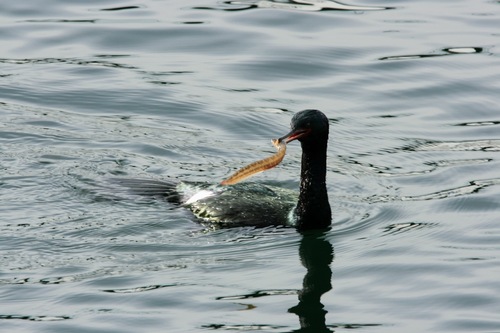
The red-faced cormorant (Urile urile), red-faced shag or violet shag, is a bird species of the family Phalacrocoracidae. Its range spans from the eastern tip of Hokkaidō in Japan, northern korean peninsula, via the Kuril Islands, the southern tip of the Kamchatka Peninsula and the Aleutian Arc to the Alaska Peninsula and Gulf of Alaska.

The red-faced cormorant was formally described in 1789 by the German naturalist Johann Friedrich Gmelin in his revised and expanded edition of Carl Linnaeus's Systema Naturae. He placed it in the genus Pelecanus and coined the binomial name Pelecanus urile. Gmelin based his description on the "red faced shag" of John Latham and the "red faced corvarant" of Thomas Pennant. The authors cited different translations of an account of Georg Wilhelm Steller's exploration of the Kamchatka Peninsula. The red-faced cormorant was formerly classified in the genus Phalacrocorax; it was moved to the resurrected genus Urile based on a molecular phylogenetic study published in 2014. The genus had been introduced in 1856 by the French naturalist Charles Lucien Bonaparte. The epithet urile is possibly derived from the Russian vernacular name of this species... Wikipedia →

Global Distribution

Parks Where Found

# Park Country Daily sighting probability
1 Kenai Fjords National Park 🇺🇸 United States
~30%

More parks will be added in future updates.

Before you go

What are the chances of seeing a Red-faced Cormorant in Kenai Fjords National Park?

Possible

About 30% of wildlife watchers report a Red-faced Cormorant sighting in Kenai Fjords National Park on a given day, based on 225 verified sightings from GBIF citizen-science data from 2019 to 2026. It is the 16th most-seen of the 99 birds we can rate there. Over three days the chance rises to about 60%, and over a week to about 90%, if each day is a fresh chance.

What time of day is best to see a Red-faced Cormorant?

Between 11 am and 2 pm

Across all the parks we cover, that three-hour window holds the most Red-faced Cormorant sightings with a recorded time, and about 8 in 10 of them come between 6 am and 6 pm: it is a daytime animal.

Where else can you see a Red-faced Cormorant?

Only Kenai Fjords National Park, in our data

Kenai Fjords National Park is the only park on Wallace's Line with enough records to rate Red-faced Cormorant sightings: about 30% of wildlife watchers there report one on a given day.

Which relatives of the Red-faced Cormorant live in Kenai Fjords National Park?

Same genus: Phalacrocorax

The closest relatives of the Red-faced Cormorant that you can see in Kenai Fjords National Park (genus Phalacrocorax, Typical Old World Cormorants) are Pelagic Cormorant (about 60%) and Double-crested Cormorant (about 40%), with each one's daily chance of a sighting.

Where does the Red-faced Cormorant sighting chance come from?

GBIF citizen-science records

It is estimated from how often the Red-faced Cormorant is recorded against all the birds logged in Kenai Fjords National Park (225 verified sightings from 2019 to 2026), calibrated against known sighting rates. Figures are rounded to the nearest 10% because citizen-science data supports honest approximations, not decimals, and months with records from fewer than five people show "—". How it works.

← Back to Kenai Fjords National Park