Pelagic Cormorant

Pelagic Cormorant

Phalacrocorax pelagicus

Silhouette: L. Shyamal · PhyloPic

Daily sighting probability ~60% · Likely
at Kenai Fjords National Park

In 3 days ~90% in a week >90%

696 Verified sightings at Kenai Fjords National Park From 2019 to 2026
7,984 In all 8 parks
August Best month
☀️ Diurnal When it's spotted

About the Pelagic Cormorant

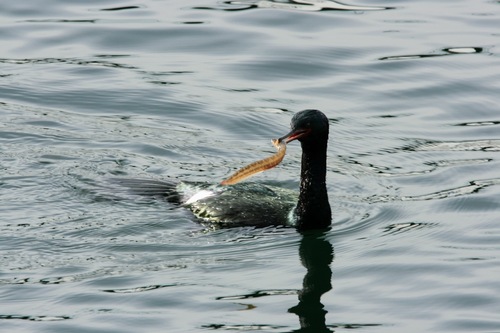
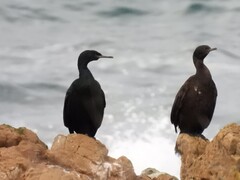
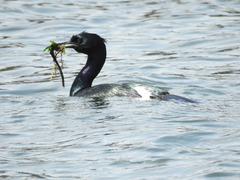
The pelagic cormorant (Urile pelagicus), also known as Baird's cormorant or violet-green cormorant, is a small member of the cormorant family Phalacrocoracidae. Analogous to other smallish cormorants, it is also called the pelagic shag occasionally. This seabird lives along the coasts of the northern Pacific; during winter it can also be found in the open ocean. Pelagic cormorants have relatively short wings due to their need for economical movement underwater, and consequently have the highest flight costs of any bird.

It was formerly classified in the genus Phalacrocorax, but a 2014 study supported reclassifying it and several other Pacific cormorant species into the genus Urile. The IOC followed this classification in 2021. This is a smallish cormorant which measures 25 to 35 in (64 to 89 cm) in length, with a wingspan of about 3.3 ft (1.0 m) and a weight of 52–86 oz (1,500–2,400 g) when fully grown. Adults in nonbreeding plumage are all-black with a metallic iridescence. In breeding plumage they grow two short crests (one on top of the head and one at the nape), white thighs, and scattered white filoplumes on the head and neck. The long thin bill and the large... Wikipedia →

Global Distribution

Parks Where Found

# Park Country Daily sighting probability
1 Kenai Fjords National Park 🇺🇸 United States
~60%
2 Great Bear Rainforest 🇨🇦 Canada
~30%
3 Olympic National Park 🇺🇸 United States
~30%
4 Pacific Rim National Park Reserve 🇨🇦 Canada
~30%
5 Channel Islands National Park 🇺🇸 United States
~20%
6 Redwood National Park 🇺🇸 United States
~20%
7 Katmai National Park 🇺🇸 United States
<5%
8 Wrangell-St. Elias National Park 🇺🇸 United States
<5%

Cities Where Found

# City Country Daily sighting probability
1 Vancouver 🇨🇦 Canada
~20%
2 Seattle 🇺🇸 United States
~10%
3 San Francisco 🇺🇸 United States
<5%
4 San Diego 🇺🇸 United States
<5%
5 Busan 🇰🇷 South Korea
<5%
6 Los Angeles 🇺🇸 United States
<5%
7 Tokyo 🇯🇵 Japan
<5%

Before you go

What are the chances of seeing a Pelagic Cormorant in Kenai Fjords National Park?

Likely

About 60% of wildlife watchers report a Pelagic Cormorant sighting in Kenai Fjords National Park on a given day, based on 696 verified sightings from GBIF citizen-science data from 2019 to 2026. It is the 6th most-seen of the 99 birds we can rate there. Over three days the chance rises to about 90%, and over a week to over 90%, if each day is a fresh chance.

What time of day is best to see a Pelagic Cormorant?

Between 1 and 4 pm

Across all the parks we cover, that three-hour window holds the most Pelagic Cormorant sightings with a recorded time, and about 9 in 10 of them come between 6 am and 6 pm: it is a daytime animal.

Is Kenai Fjords National Park the best place to see a Pelagic Cormorant?

Yes

Of the 8 parks where we can rate Pelagic Cormorant sightings, Kenai Fjords National Park has the highest daily chance: about 60%. Next come Great Bear Rainforest (Canada, about 30%) and Olympic National Park (United States, about 30%). All parks ranked.

Which relatives of the Pelagic Cormorant live in Kenai Fjords National Park?

Same genus: Phalacrocorax

The closest relatives of the Pelagic Cormorant that you can see in Kenai Fjords National Park (genus Phalacrocorax, Typical Old World Cormorants) are Double-crested Cormorant (about 40%) and Red-faced Cormorant (about 30%), with each one's daily chance of a sighting.

Where does the Pelagic Cormorant sighting chance come from?

GBIF citizen-science records

It is estimated from how often the Pelagic Cormorant is recorded against all the birds logged in Kenai Fjords National Park (696 verified sightings from 2019 to 2026), calibrated against known sighting rates. Figures are rounded to the nearest 10% because citizen-science data supports honest approximations, not decimals, and months with records from fewer than five people show "—". How it works.

← Back to Kenai Fjords National Park