Bibron's Thick-toed Gecko

Bibron's Thick-toed Gecko

Chondrodactylus bibronii

Silhouette: Jose Carlos Arenas-Monroy · PhyloPic

LCLeast ConcernNTVUENCR
Daily sighting probability ~30% · Possible
at Kgalagadi Transfrontier Park

In 3 days ~60% in a week ~90%

44 Verified sightings at Kgalagadi Transfrontier Park From 2019 to 2026
60 In all 3 parks
March Best month
🌅 Crepuscular When it's spotted

About the Bibron's Thick-toed Gecko

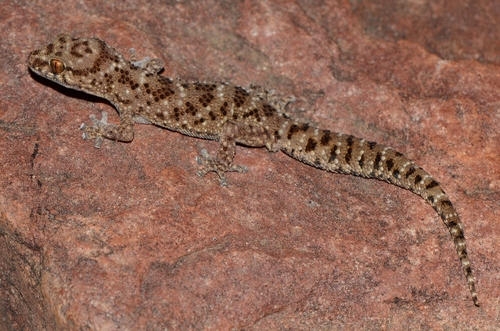
Chondrodactylus bibronii, commonly known as Bibron's thick-toed gecko, Bibron's sand gecko, or simply Bibron's gecko, is a species of lizard in the family Gekkonidae. The species is native to southern Africa. C. bibronii has been used as an animal model in bioastronautic research examining the effects of spaceflight on the morphology and physiology of vertebrates.

The specific name, bibronii, is in honor of French herpetologist Gabriel Bibron, as are several common names. Bibron's gecko is distributed across the southern part of the African continent in Namibia, South Africa, and Eswatini. It is common in South Africa, where it is one of the largest gecko species.

C. bibronii has been introduced in the southeastern United States. Populations have been found in Manatee County, Florida. A moderate-sized gecko, C. bibronii reaches a total length (including tail) of 6 to 8 in (15 to 20 cm). It has a stockier build than most other geckos. The female is generally smaller than the male. Its base color is brown, and it has a beaded pattern dorsally, with black crossbars. The male has white dots; the female may, as well. The belly is white... Wikipedia →

Sounds

Recording0:23

South Africa · 2020

© Marion Maclean · iNaturalist · CC BY-NC 4.0

Global Distribution

Parks Where Found

# Park Country Daily sighting probability
1 Kgalagadi Transfrontier Park 🇿🇦 South Africa
~30%
2 Namib-Naukluft National Park 🇳🇦 Namibia
~10%
3 Table Mountain National Park 🇿🇦 South Africa
<5%

Zoos & Centres Where Found

# Zoo / Centre Country
1 VigoNature 🇪🇸 Spain In captivity

Before you go

What are the chances of seeing a Bibron's Thick-toed Gecko in Kgalagadi Transfrontier Park?

Possible

About 30% of wildlife watchers report a Bibron's Thick-toed Gecko sighting in Kgalagadi Transfrontier Park on a given day, based on 44 verified sightings from GBIF citizen-science data from 2019 to 2026. It is the 5th most-seen of the 14 reptiles we can rate there. Over three days the chance rises to about 60%, and over a week to about 90%, if each day is a fresh chance.

When is the best time to see a Bibron's Thick-toed Gecko in Kgalagadi Transfrontier Park?

March and October

In those months about 40% of wildlife watchers report a Bibron's Thick-toed Gecko in Kgalagadi Transfrontier Park on a given day, against under 5% in June, the lowest month.

What time of day is best to see a Bibron's Thick-toed Gecko?

Between 7 and 10 pm

Across all the parks we cover, that three-hour window holds the most Bibron's Thick-toed Gecko sightings with a recorded time, and about 7 in 10 of them come between 6 pm and 6 am: it is most active around dawn and dusk.

Is Kgalagadi Transfrontier Park the best place to see a Bibron's Thick-toed Gecko?

Yes

Of the 3 parks where we can rate Bibron's Thick-toed Gecko sightings, Kgalagadi Transfrontier Park has the highest daily chance: about 30%. Next come Namib-Naukluft National Park (Namibia, about 10%) and Table Mountain National Park (South Africa, under 5%).

Which relatives of the Bibron's Thick-toed Gecko live in Kgalagadi Transfrontier Park?

Same family: Gekkonidae

The closest relatives of the Bibron's Thick-toed Gecko that you can see in Kgalagadi Transfrontier Park (family Gekkonidae, Typical Geckos) are Common Barking Gecko (about 20%) and Cape Thick-toed Gecko (about 10%), with each one's daily chance of a sighting.

Where does the Bibron's Thick-toed Gecko sighting chance come from?

GBIF citizen-science records

It is estimated from how often the Bibron's Thick-toed Gecko is recorded against all the reptiles logged in Kgalagadi Transfrontier Park (44 verified sightings from 2019 to 2026), calibrated against known sighting rates. Figures are rounded to the nearest 10% because citizen-science data supports honest approximations, not decimals, and months with records from fewer than five people show "—". How it works.

← Back to Kgalagadi Transfrontier Park