Emma Gray's Forest Lizard

Emma Gray's Forest Lizard

Calotes emma

Silhouette: Vijay Karthick · PhyloPic

LCLeast ConcernNTVUENCR
Daily sighting probability ~70% · Very likely
at Khao Luang National Park

In 3 days >90%

56 Verified sightings at Khao Luang National Park From 2019 to 2026
611 In all 6 parks
March Best month
☀️ Diurnal When it's spotted

About the Emma Gray's Forest Lizard

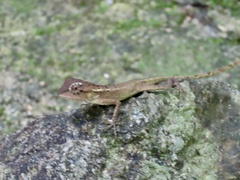
Calotes emma, commonly known as the forest garden lizard or Emma Gray's forest lizard, is a species of lizard in the family Agamidae. The species is native to China, South Asia, and Southeast Asia. There are two recognized subspecies.

The specific name, emma, is in honor of English conchologist Maria Emma Gray, the wife of John Edward Gray, the describer of this species. C. emma has the following morphology. Physical Structure: There are three small groups of spines, completely separate from each other, on each side of the head, one behind the superciliary margin and two above each tympanum. The dorsal crest is well developed on the neck and on the anterior part of the trunk, gradually disappearing behind. There is a transverse fold in front of each shoulder, and the gular sac is but little developed. The tail is laterally compressed. There are about 51 series of scales round the middle of the trunk.

Color pattern: The dorsum is brownish olive, with brown bands across the back, which are lighter in the middle and interrupted by a white band running along each side of the back. The eyelids have short, radiating brown streaks. There is a brown band from... Wikipedia →

Global Distribution

Parks Where Found

# Park Country Daily sighting probability
1 Khao Sok National Park 🇹🇭 Thailand
~80%
2 Khao Luang National Park 🇹🇭 Thailand
~70%
3 Cuc Phuong National Park 🇻🇳 Vietnam
~50%
4 Khao Yai National Park 🇹🇭 Thailand
~50%
5 Kaeng Krachan National Park 🇹🇭 Thailand
~40%
6 Doi Inthanon National Park 🇹🇭 Thailand
~40%

Before you go

What are the chances of seeing an Emma Gray's Forest Lizard in Khao Luang National Park?

Very likely

About 70% of wildlife watchers report an Emma Gray's Forest Lizard sighting in Khao Luang National Park on a given day, based on 56 verified sightings from GBIF citizen-science data from 2019 to 2026. It is the most-seen of the 16 reptiles we can rate there. Over three days the chance rises to over 90%, if each day is a fresh chance.

When is the best time to see an Emma Gray's Forest Lizard in Khao Luang National Park?

February–March and July

In those months about 80% of wildlife watchers report an Emma Gray's Forest Lizard in Khao Luang National Park on a given day, against about 20% in October, the lowest month. Those are among Khao Luang National Park's driest months, with about 100 mm of rain a month against 350 mm in November.

What time of day is best to see an Emma Gray's Forest Lizard?

Between 11 am and 2 pm

Across all the parks we cover, that three-hour window holds the most Emma Gray's Forest Lizard sightings with a recorded time, and about 7 in 10 of them come between 6 am and 6 pm: it is a daytime animal.

Is Khao Luang National Park the best place to see an Emma Gray's Forest Lizard?

2nd of 6

Of the 6 parks where we can rate Emma Gray's Forest Lizard sightings, Khao Luang National Park ranks 2nd at about 70%. The best odds are in Khao Sok National Park (Thailand, about 80%). All parks ranked.

Which relatives of the Emma Gray's Forest Lizard live in Khao Luang National Park?

Same family: Agamidae

The closest relatives of the Emma Gray's Forest Lizard that you can see in Khao Luang National Park (family Agamidae, Dragons) are Black-barbed Flying Dragon (about 40%) and Barred Flying Dragon (about 30%), with each one's daily chance of a sighting.

Where does the Emma Gray's Forest Lizard sighting chance come from?

GBIF citizen-science records

It is estimated from how often the Emma Gray's Forest Lizard is recorded against all the reptiles logged in Khao Luang National Park (56 verified sightings from 2019 to 2026), calibrated against known sighting rates. Figures are rounded to the nearest 10% because citizen-science data supports honest approximations, not decimals, and months with records from fewer than five people show "—". How it works.

← Back to Khao Luang National Park