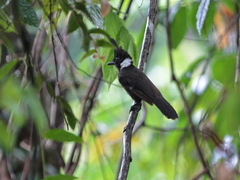
Crested Jay

Crested Jay

Platylophus galericulatus

Silhouette: Sheatherius · PhyloPic

LCNTNear ThreatenedVUENCR
Daily sighting probability <5% · Rare
at Khao Sok National Park

In 3 days ~10% in a week ~30%

31 Verified sightings at Khao Sok National Park From 2019 to 2026
411 In all 7 parks
March Best month
☀️ Diurnal When it's spotted

About the Crested Jay

The crested jayshrike or crested shrikejay (Platylophus galericulatus), formerly known as the crested jay (despite not being a true jay), is a species of bird found in Brunei, Indonesia, Malaysia, Myanmar, and Thailand. It is the only member of the genus Platylophus and the family Platylophidae.

Although traditionally placed in the family Corvidae, its taxonomy has been under contention since the 2000s, as phylogenetic analyses indicate that it is not a true corvid, but rather a basal member of the Corvoidea radiation. Some authorities have suggested that it may belong to the helmetshrikes. In 2019, eBird and the Clements Checklist renamed the species the crested shrikejay and placed it in its own family, the Platylophidae, which was undescribed at the time. In 2021, the family Platylophidae was officially described, and in 2022 the International Ornithological Congress reclassified the species into Platylophidae. However, the family name Lophocittidae, originally described as Lophocitteae in 1855 by Johann Jakob Kaup, may have referred to the crested shrikejay, and if so would take precedence over Platylophidae.

Its natural habitats are subtropical or tropical moist lowland forest and subtropical or tropical moist montane forest of the Thai-Malay Peninsula, Sumatra, Java, and Borneo. It is threatened by habitat loss from illegal logging and land conversion for farming, as well as wildfires and capture for the wildlife trade. Research conducted by a team led by EcoVerde Global Consulting found that the crested jayshrike is used as a “master bird” to train other songbird species. Despite it receiving legal protection in Indonesia in 2018, the trade in the bird markets remained open and the number of individuals for the species remained unchanged over a 15 year period Wikipedia →

Sounds

Recording0:39

Thailand · 2022

© paul_faz · iNaturalist · CC BY-NC 4.0

Recording0:29

Malaysia · 2025

© David Torres · iNaturalist · CC BY-NC 4.0

Recording0:28

Malaysia · 2018

© Tom Visbeek · Observation.org, Nature data from around the World · CC BY-NC-ND 4.0

Global Distribution

Parks Where Found

# Park Country Daily sighting probability
1 Taman Negara National Park 🇲🇾 Malaysia
~10%
2 Danum Valley Conservation Area 🇲🇾 Malaysia
~10%
3 Khao Luang National Park 🇹🇭 Thailand
~10%
4 Khao Sok National Park 🇹🇭 Thailand
<5%
5 Kinabalu Park 🇲🇾 Malaysia
<5%
6 Kaeng Krachan National Park 🇹🇭 Thailand
<5%
7 Kinabatangan Wildlife Sanctuary 🇲🇾 Malaysia
<5%

Before you go

What are the chances of seeing a Crested Jay in Khao Sok National Park?

Rare

Under 5% of wildlife watchers report a Crested Jay sighting in Khao Sok National Park on a given day, based on 31 verified sightings from GBIF citizen-science data from 2019 to 2026. It is the 134th most-seen of the 213 birds we can rate there. Over three days the chance rises to about 10%, and over a week to about 30%, if each day is a fresh chance.

When is the best time to see a Crested Jay in Khao Sok National Park?

March to May

In those months about 10% of wildlife watchers report a Crested Jay in Khao Sok National Park on a given day, against under 5% in June to February, the lowest months.

What time of day is best to see a Crested Jay?

Between 7 and 10 am

Across all the parks we cover, that three-hour window holds the most Crested Jay sightings with a recorded time, and about 9 in 10 of them come between 6 am and 6 pm: it is a daytime animal.

Where does the Crested Jay sighting chance come from?

GBIF citizen-science records

It is estimated from how often the Crested Jay is recorded against all the birds logged in Khao Sok National Park (31 verified sightings from 2019 to 2026), calibrated against known sighting rates. Figures are rounded to the nearest 10% because citizen-science data supports honest approximations, not decimals, and months with records from fewer than five people show "—". How it works.

← Back to Khao Sok National Park