Austen's Brown Hornbill

Austen's Brown Hornbill

Anorrhinus austeni

Silhouette: Charles J. Sharp and T. Michael Keesey · PhyloPic

LCNTNear ThreatenedVUENCR
Daily sighting probability ~10% · With luck
at Khao Yai National Park

In 3 days ~30% in a week ~50%

264 Verified sightings at Khao Yai National Park From 2019 to 2026
516 In all 2 parks
April Best month
🌅 Crepuscular When it's spotted

About the Austen's Brown Hornbill

Austen's brown hornbill (Anorrhinus austeni), also known as the white-throated brown hornbill or brown hornbill, is a medium-sized species of hornbill found in forests from northeastern India to Vietnam and northern Thailand. It is rare throughout its range and is threatened by habitat loss and fragmentation.

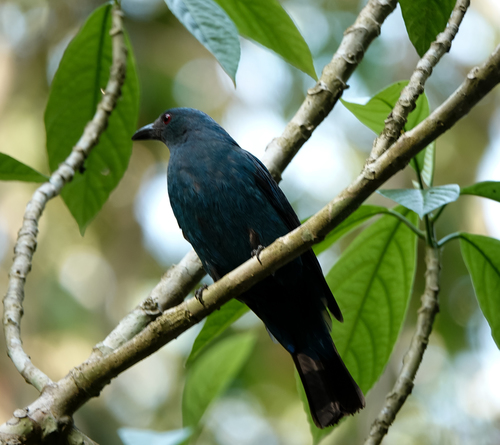
Austen's brown hornbill has dark brown upperparts (back, wings, and tail) with a lighter-coloured belly, cheeks, and throat. It has a white-tipped tail and wings and has blue-coloured bare skin around the eyes. The species is sexually dimorphic. The bill and casque are ivory white in females and cream-coloured in males. Females have a grey-brown throat, belly, and cheeks, whereas males have a whitish throat and cheeks with a reddish belly. The female also has a yellow wash below the eye. Juveniles look similar to adult males but have a short yellow bill, orange skin around the eye, and pale-brown feather tips. The male weighs 710–900 g (25–32 oz) and is 73–80 cm (29–31 in) long. The female is smaller.

Thomas C. Jerdon formally described Austen's brown hornbill as Anorrhinus austeni in 1872 in Asalu, Cachar Hills, Assam, India in The Ibis. The genus... Wikipedia →

Sounds

Call1:08

Vietnam · 2010

© Hans Matheve · XC156462 · CC BY-NC-ND 3.0

Call0:31

Thailand · 2015

© Ross Gallardy · XC295163 · CC BY-NC-SA 4.0

Call0:45

Vietnam

© Frank Lambert · XC67598 · CC BY-NC-ND 4.0

Global Distribution

Parks Where Found

# Park Country Daily sighting probability
1 Namdapha National Park 🇮🇳 India
~20%
2 Khao Yai National Park 🇹🇭 Thailand
~10%

Before you go

What are the chances of seeing an Austen's Brown Hornbill in Khao Yai National Park?

With luck

About 10% of wildlife watchers report an Austen's Brown Hornbill sighting in Khao Yai National Park on a given day, based on 264 verified sightings from GBIF citizen-science data from 2019 to 2026. It is the 117th most-seen of the 278 birds we can rate there. Over three days the chance rises to about 30%, and over a week to about 50%, if each day is a fresh chance.

When is the best time to see an Austen's Brown Hornbill in Khao Yai National Park?

April

In that month about 30% of wildlife watchers report an Austen's Brown Hornbill in Khao Yai National Park on a given day, against under 5% in June and August–January, the lowest months.

What time of day is best to see an Austen's Brown Hornbill?

Between 3 and 6 am

Across all the parks we cover, that three-hour window holds the most Austen's Brown Hornbill sightings with a recorded time, and about half of them come between 6 am and 6 pm: it is most active around dawn and dusk.

Is Khao Yai National Park the best place to see an Austen's Brown Hornbill?

2nd of 2

Of the 2 parks where we can rate Austen's Brown Hornbill sightings, Khao Yai National Park ranks 2nd at about 10%. The best odds are in Namdapha National Park (India, about 20%).

Which relatives of the Austen's Brown Hornbill live in Khao Yai National Park?

Same family: Bucerotidae

The closest relatives of the Austen's Brown Hornbill that you can see in Khao Yai National Park (family Bucerotidae, Hornbills) are Oriental Pied Hornbill (about 70%), Great Hornbill (about 50%) and Wreathed Hornbill (about 40%), with each one's daily chance of a sighting.

Where does the Austen's Brown Hornbill sighting chance come from?

GBIF citizen-science records

It is estimated from how often the Austen's Brown Hornbill is recorded against all the birds logged in Khao Yai National Park (264 verified sightings from 2019 to 2026), calibrated against known sighting rates. Figures are rounded to the nearest 10% because citizen-science data supports honest approximations, not decimals, and months with records from fewer than five people show "—". How it works.

← Back to Khao Yai National Park