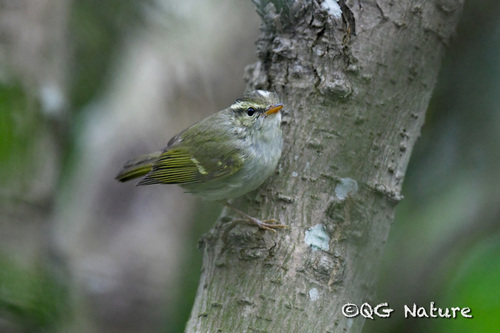
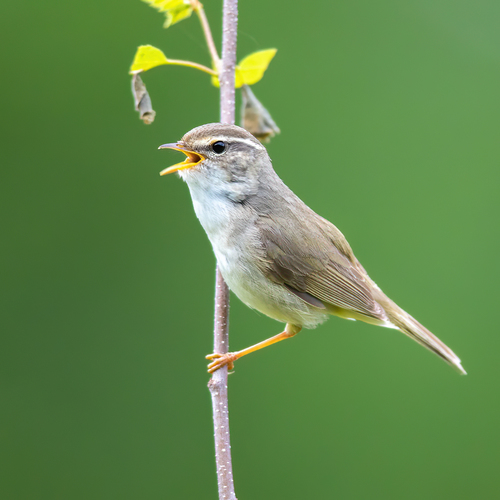
Davison's Leaf-Warbler

Davison's Leaf-Warbler

Phylloscopus intensior

Silhouette: Margot Michaud · PhyloPic

LCLeast ConcernNTVUENCR
Daily sighting probability <5% · Rare
at Khao Yai National Park

In 3 days ~10%

36 Verified sightings at Khao Yai National Park From 2019 to 2026
2,054 In all 2 parks
December Best month
🌅 Crepuscular When it's spotted

About the Davison's Leaf-Warbler

Davison's leaf warbler (Phylloscopus intensior) or the white-tailed leaf warbler, is a species of leaf warbler (family Phylloscopidae). It was formerly included in the "Old World warbler" assemblage. It is found in the China, Laos, Myanmar, Thailand, and Vietnam. Its natural habitats are subtropical or tropical moist lowland forest and subtropical or tropical moist montane forest.

A species from Mount Mulayit called the Tenasserim white-tailed willow warbler (Acanthopneuste davisoni) named after the collector William Ruxton Davison was described by Eugene Oates in 1889. To this species was added a few more subspecies, including disturbans, ogilviegranti, and klossi. Another subspecies was described by the American ornithologist Herbert Girton Deignan in 1956 and given the trinomial name Phylloscopus davisoni intensior. The taxa disturbans, ogilviegranti and klossi were found to form a clade that is sister to P. hainanus. Since ogilviegranti was the first described of the three members of the clade it was elevated to a species and the two others made into subspecies since the sequence differences were small. A study of the mitochondrial DNA sequences and calls suggested that davisoni in the strict sense was a sister of Seicercus xanthoschistos. Wikipedia →

Sounds

Song0:26

China · 2026

© Yang Li · XC1133297 · CC BY-NC-SA 4.0

Call0:14

Thailand · 2025

© Lim Ying Hien 林勇贤 · XC1078158 · CC BY-NC-ND 4.0

Song1:06

Thailand · 1986

© Jelle Scharringa · XC1075534 · CC BY-NC-SA 4.0

Global Distribution

Parks Where Found

# Park Country Daily sighting probability
1 Doi Inthanon National Park 🇹🇭 Thailand
~50%
2 Khao Yai National Park 🇹🇭 Thailand
<5%

Before you go

What are the chances of seeing a Davison's Leaf-Warbler in Khao Yai National Park?

Rare

Under 5% of wildlife watchers report a Davison's Leaf-Warbler sighting in Khao Yai National Park on a given day, based on 36 verified sightings from GBIF citizen-science data from 2019 to 2026. It is the 204th most-seen of the 278 birds we can rate there. Over three days the chance rises to about 10%, if each day is a fresh chance.

When is the best time to see a Davison's Leaf-Warbler in Khao Yai National Park?

December

In that month about 10% of wildlife watchers report a Davison's Leaf-Warbler in Khao Yai National Park on a given day, against under 5% in January to November, the lowest months. That is one of Khao Yai National Park's driest months, with about 15 mm of rain against 330 mm in September.

What time of day is best to see a Davison's Leaf-Warbler?

Between 3 and 6 am

Across all the parks we cover, that three-hour window holds the most Davison's Leaf-Warbler sightings with a recorded time, and about half of them come between 6 am and 6 pm: it is most active around dawn and dusk.

Is Khao Yai National Park the best place to see a Davison's Leaf-Warbler?

2nd of 2

Of the 2 parks where we can rate Davison's Leaf-Warbler sightings, Khao Yai National Park ranks 2nd at under 5%. The best odds are in Doi Inthanon National Park (Thailand, about 50%).

Which relatives of the Davison's Leaf-Warbler live in Khao Yai National Park?

Same genus: Phylloscopus

The closest relatives of the Davison's Leaf-Warbler that you can see in Khao Yai National Park (genus Phylloscopus, Leaf Warblers) are Yellow-browed Warbler (about 50%), Two-barred Warbler (about 20%) and Claudia's Leaf-Warbler (about 20%), with each one's daily chance of a sighting.

Where does the Davison's Leaf-Warbler sighting chance come from?

GBIF citizen-science records

It is estimated from how often the Davison's Leaf-Warbler is recorded against all the birds logged in Khao Yai National Park (36 verified sightings from 2019 to 2026), calibrated against known sighting rates. Figures are rounded to the nearest 10% because citizen-science data supports honest approximations, not decimals, and months with records from fewer than five people show "—". How it works.

← Back to Khao Yai National Park